
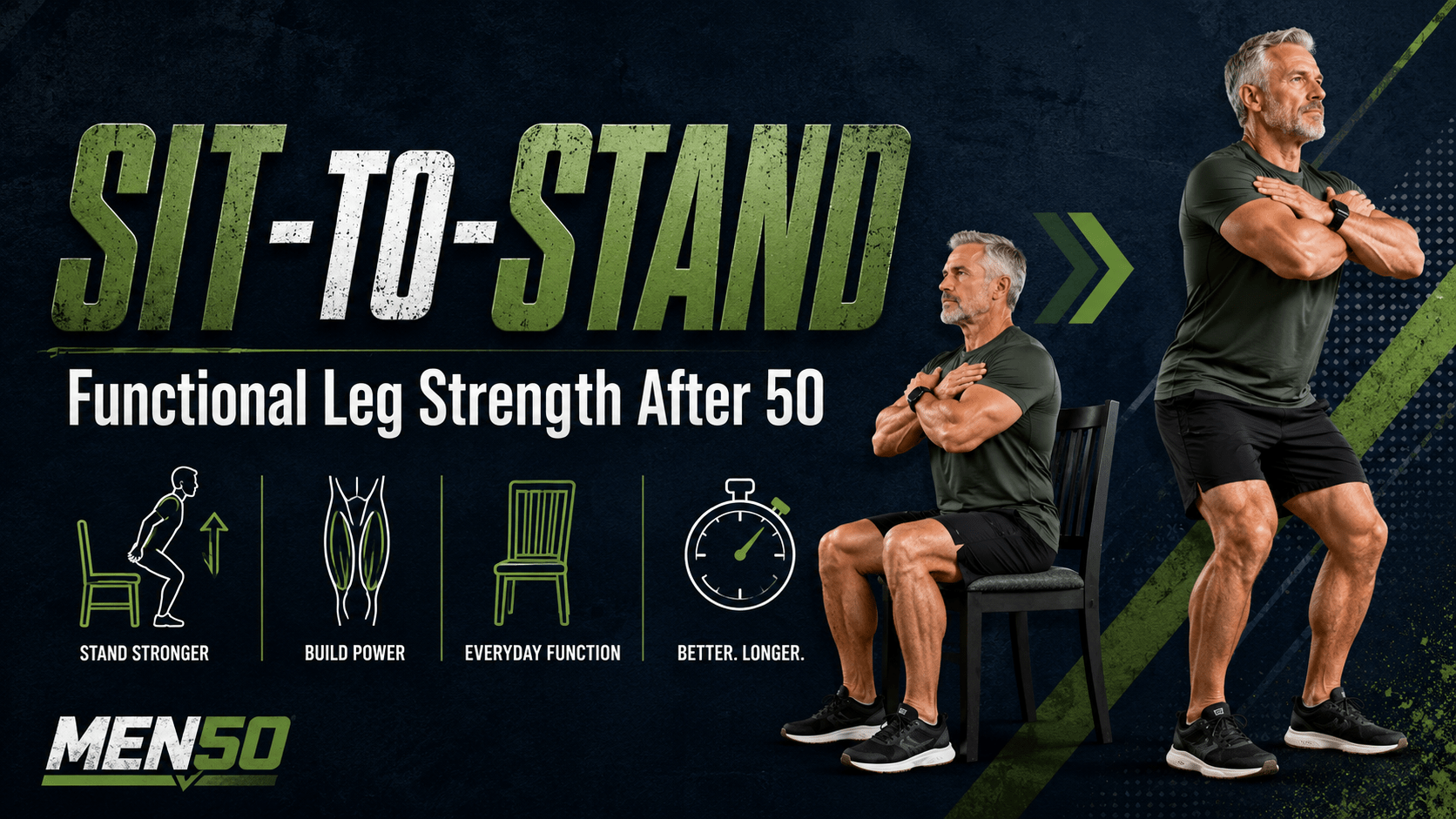
The sit-to-stand is one of the most useful movements a man over 50 can train, and one of the only exercises that doubles as a validated clinical test. It directly mirrors something you do dozens of times every day — getting out of a chair — and the 30-Second Chair Stand Test, developed by researchers Rikli and Jones as part of the Senior Fitness Test, is a well-established predictor of fall risk and lower-body strength in adults over 60. Train it consistently and you build the strength to rise from any chair, sofa, or low surface with control. You also build the leg power that protects against falls.
Part of the Build Muscle After 50 pillar — strength training for men over 50.
Key Takeaways
- The sit-to-stand trains the quads, glutes, hamstrings, and core in the exact pattern you use dozens of times daily.
- The 30-Second Chair Stand Test is a validated clinical measure of leg strength and fall risk. Most men over 50 should aim for 17+ reps in 30 seconds.
- Programming: 2–4 sets of 8–15 reps, 2–4 times per week. Stop 1–2 reps before form breaks.
- Clean reps and control matter more than speed. This is true even when testing — controlled reps are stronger reps.
- This is a different exercise from the chair squat. The sit-to-stand starts from a seated rest position; the chair squat taps the chair without sitting. Both belong in a complete programme.
How to Perform the Sit-to-Stand
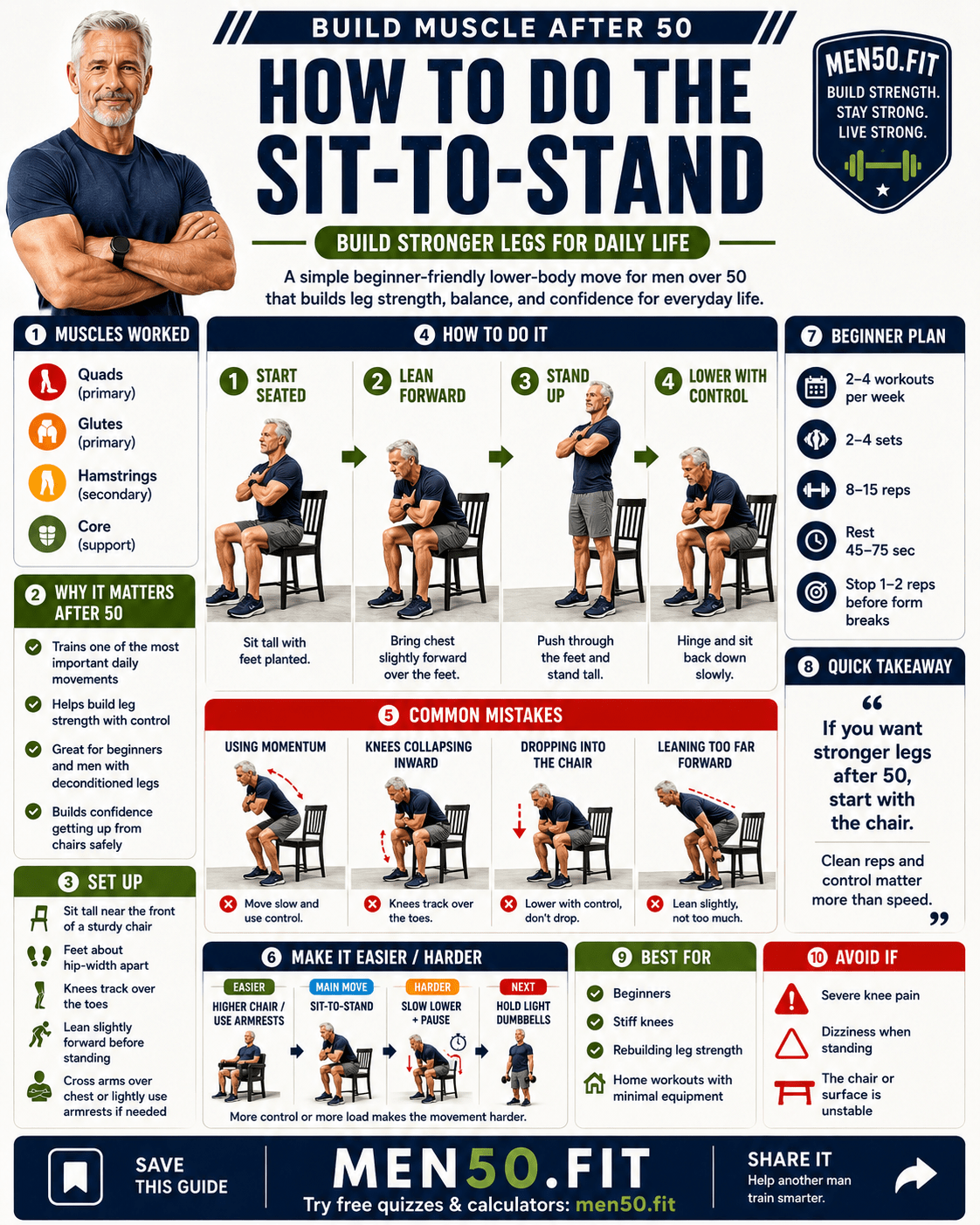
Set up first:
- Sit tall near the front of a sturdy chair — not all the way back into it.
- Feet about hip-width apart, flat on the floor, knees tracking over the toes.
- Lean slightly forward before standing — chest comes forward over the feet.
- Cross arms over the chest, or lightly touch armrests if you need support.
Then the movement:
- Start seated. Sit tall with feet planted. Core engaged. Chest up. Arms crossed over the chest (or extended forward for balance if needed).
- Lean forward. Bring your chest slightly forward over your feet. Your weight should shift onto the middle of your feet, not your heels. Don’t lean too far — chest over knees is the limit.
- Stand up. Push through your feet and stand fully upright. Drive through the heels with a small forward weight shift. Squeeze the glutes at the top. Stand tall, fully extended — not still slightly bent forward.
- Lower with control. Hinge at the hips and sit back down slowly — 2–3 seconds on the way down. Touch the seat lightly. Don’t drop onto the chair. Pause briefly, then begin the next rep.
The cue that matters most: clean reps and control matter more than speed. Even during the 30-second test, men who do controlled reps usually outperform men who rush through them — sloppy reps fatigue the legs faster and accumulate balance corrections that slow each subsequent rep.
Why the Sit-to-Stand Matters After 50
Lower body strength declines at roughly 1–2% per year after 50 without training intervention — that’s the sarcopenia rate documented in dozens of studies on older adults. The strength loss isn’t distributed evenly across the body. The quads, glutes, and hip extensors — the prime movers of standing up — decline faster than smaller muscles, partly because most men stop loading them with any real effort once they leave their physical-job years behind.
The visible result is needing to push off the arms of a chair, hesitating before low sofas, or struggling to rise from the floor. The hidden result is the deterioration of the same muscle groups most responsible for preventing falls. Hip extension strength in particular correlates closely with fall risk in older adults — strong glutes mean a powerful push-off during walking and faster recovery if you stumble.
The 30-Second Chair Stand Test was developed by Roberta Rikli and C. Jessie Jones in 1999 as part of the Senior Fitness Test, the most widely used functional assessment battery for adults over 60. It’s used in physiotherapy clinics, geriatric medicine, and research worldwide. The test is simple — count how many full sit-to-stand reps you can complete in 30 seconds, arms crossed over the chest — and the score gives a snapshot of your lower-body strength and your fall risk relative to your age peers.
Here are the established age-norm averages for men (Rikli & Jones data, refined by subsequent research):
| Age | Average Range |
|---|---|
| 60–64 | 14–19 reps |
| 65–69 | 12–18 reps |
| 70–74 | 12–17 reps |
| 75–79 | 11–17 reps |
| 80–84 | 10–15 reps |
| 85–89 | 8–14 reps |
Men in their 50s should typically exceed the 60–64 range — aim for 17+ reps. Scores below the lower bound of your age range correlate with increased fall risk and reduced functional capacity. The good news: like most leg strength markers, the score improves quickly with training. Most men who start below average can reach the average range within 4–8 weeks of consistent practice.
Sets and Reps
The sit-to-stand works as both a training exercise and a benchmark you can re-test every 4–8 weeks to track progress.
| Stage | Variation | Sets × Reps | Frequency |
|---|---|---|---|
| Beginner | Higher chair OR use armrests for support | 2 × 8–10 | 2–3× per week |
| Novice | Standard chair, no hand support | 3 × 10–12 | 2–3× per week |
| Intermediate | Slow 3-second lowering + 1-second pause at bottom | 3 × 10–15 | 2–4× per week |
| Advanced | Hold light dumbbells (5–15 lbs / 2–7 kg) at chest | 3 × 10–12 | 2–3× per week |
Rest 45–75 seconds between sets. Stop 1–2 reps before form breaks — pushing past form (knees caving, dropping into the chair, using momentum) trains compensation patterns, not strength.
The 30-Second Chair Stand Test protocol:
- Standard sturdy chair, around 17 inches (43 cm) seat height.
- Arms crossed over the chest (no hand assistance).
- Count full stand-to-sit-to-stand reps in exactly 30 seconds.
- A partial rep at the buzzer counts if you’re more than halfway up.
- Re-test every 4–8 weeks to track progress.
Common Mistakes
The four errors that turn a great functional exercise into a wasted one:
- Using momentum. Rocking forward to launch yourself up turns the exercise into a swing instead of a strength move. Move slowly and use control — the slow version is the version that builds strength.
- Knees collapsing inward. As fatigue sets in, the knees want to drift toward each other on the way up. Keep them tracking over the toes throughout — drive the knees out, especially on the last 2–3 reps of each set.
- Dropping into the chair. Letting yourself fall the last few inches removes the most useful part of the rep — the eccentric (lowering) phase, where most strength is built. Lower with control, touch the seat lightly, pause briefly.
- Leaning too far forward. Some men compensate by folding the torso almost parallel to the floor to launch upward. Chest forward to roughly over the knees is enough. Leaning further loads the lower back and reduces the work on the quads and glutes.
Make It Easier or Harder
If standard sit-to-stands are too challenging:
- Use a higher chair — adding a firm cushion to the seat reduces range of motion.
- Use armrests — light hand support takes some load off the legs while you build strength. Aim to need less and less support over time.
- Reduce reps — start with 2 sets of 5 reps with full rest between if 8 reps is too many.
To make it harder once standard form is solid:
- Slow the lowering phase to 3–4 seconds per rep.
- Add a 1–2 second pause at the bottom (seated, but core still engaged) before the next rep.
- Hold light dumbbells at chest height — 5–15 lbs (2–7 kg) per hand is plenty. Don’t go heavier than that without progressing to a chair squat or proper goblet squat first.
- Use a lower chair to increase range of motion.
The progression order from your infographic is: Higher chair / armrests → Standard sit-to-stand → Slow lower + pause → Hold dumbbells. Master each stage before progressing.
Safety Note
Use a chair that will not slide — place it against a wall if there’s any chance it will move. The chair must be stable; a wobbly or sliding chair is how injuries happen during this exercise.
Never drop onto the seat — always lower under control. Dropping loads the lower back, knees, and hips with impact they don’t need.
Avoid the sit-to-stand if you have severe knee pain that doesn’t improve with reduced range, dizziness when standing (which may indicate orthostatic hypotension and should be discussed with a doctor), or unstable seating surfaces. Men with diagnosed knee or hip conditions should get clearance from a physiotherapist before progressing to weighted versions.
Build Your Personal Training Plan
The sit-to-stand is one piece of a complete lower-body programme. Get a personalised exercise plan based on your current strength, mobility, and any limitations.
Take the Free Fitness Profiler →
FAQs
What does my sit-to-stand test score mean?
Compare your 30-second rep count to the age-norm table in the Why It Matters section. Scoring within the average range for your age group indicates normal lower-body strength. Scoring below the average range indicates increased fall risk and is a signal to train the exercise regularly. Scoring above the average range indicates good functional leg strength. Men in their 50s should typically score 17+ reps; men who score under 12 should make this a daily training priority and consider speaking with a physiotherapist about a broader functional assessment.
Sit-to-stand vs chair squat — which is right for me?
Both belong in a complete programme; they target the same muscles in slightly different ways. The sit-to-stand starts from a seated rest position and trains the “rising from rest” pattern — exactly what you do dozens of times daily. The chair squat keeps you standing throughout and only taps the chair as a depth marker, which maintains continuous load through every rep. If you can only do one, start with the sit-to-stand — it’s more directly functional. Add the chair squat once the sit-to-stand feels easy.
Why can I do this exercise but still struggle to get up from the floor?
Getting up from the floor requires significantly more strength, mobility, and balance than getting out of a chair. Floor-to-stand involves hip and knee flexion well beyond 90 degrees, ankle mobility, and core control through positions a chair never demands. If you can do sit-to-stands easily but struggle to get up from the floor, you need to specifically train the floor-to-stand pattern. The Sitting-Rising Test (covered in the chair squat article) is a useful benchmark, and slowly working through that motion regularly is the fix.
Can the sit-to-stand replace squats entirely?
For many men over 50, especially those rebuilding leg strength or managing knee issues, yes — at least at the start. The sit-to-stand trains the same primary muscles (quads, glutes, hamstrings) at a manageable load, with built-in safety. Eventually most men benefit from progressing to weighted versions, the chair squat, then unsupported bodyweight squats, then goblet squats. But for the first 6–12 weeks of leg training after a long break, sit-to-stands alone do most of the work.
How often should I do this exercise?
2–4 times per week is the standard recommendation. Daily is fine if you’re using it as a low-intensity habit (one set of 10–15 reps every morning, no added load), but heavier or higher-intensity sit-to-stand sessions need 48 hours between sessions for recovery. The legs are large muscle groups and respond to recovery the same as upper-body work.
References
- Rikli RE, Jones CJ. Development and validation of a functional fitness test for community-residing older adults. Journal of Aging and Physical Activity. 1999;7(2):129-161.
- de Brito LBB, Ricardo DR, de Araújo DSMS, et al. Ability to sit and rise from the floor as a predictor of all-cause mortality. European Journal of Preventive Cardiology. 2014;21(7):892-898.
- Centers for Disease Control and Prevention. STEADI: Stopping Elderly Accidents, Deaths & Injuries. cdc.gov
Disclaimer: This article is for educational purposes only and is not medical advice. Consult a qualified healthcare professional before starting any new exercise programme, especially if you have existing knee, hip, or balance conditions.