
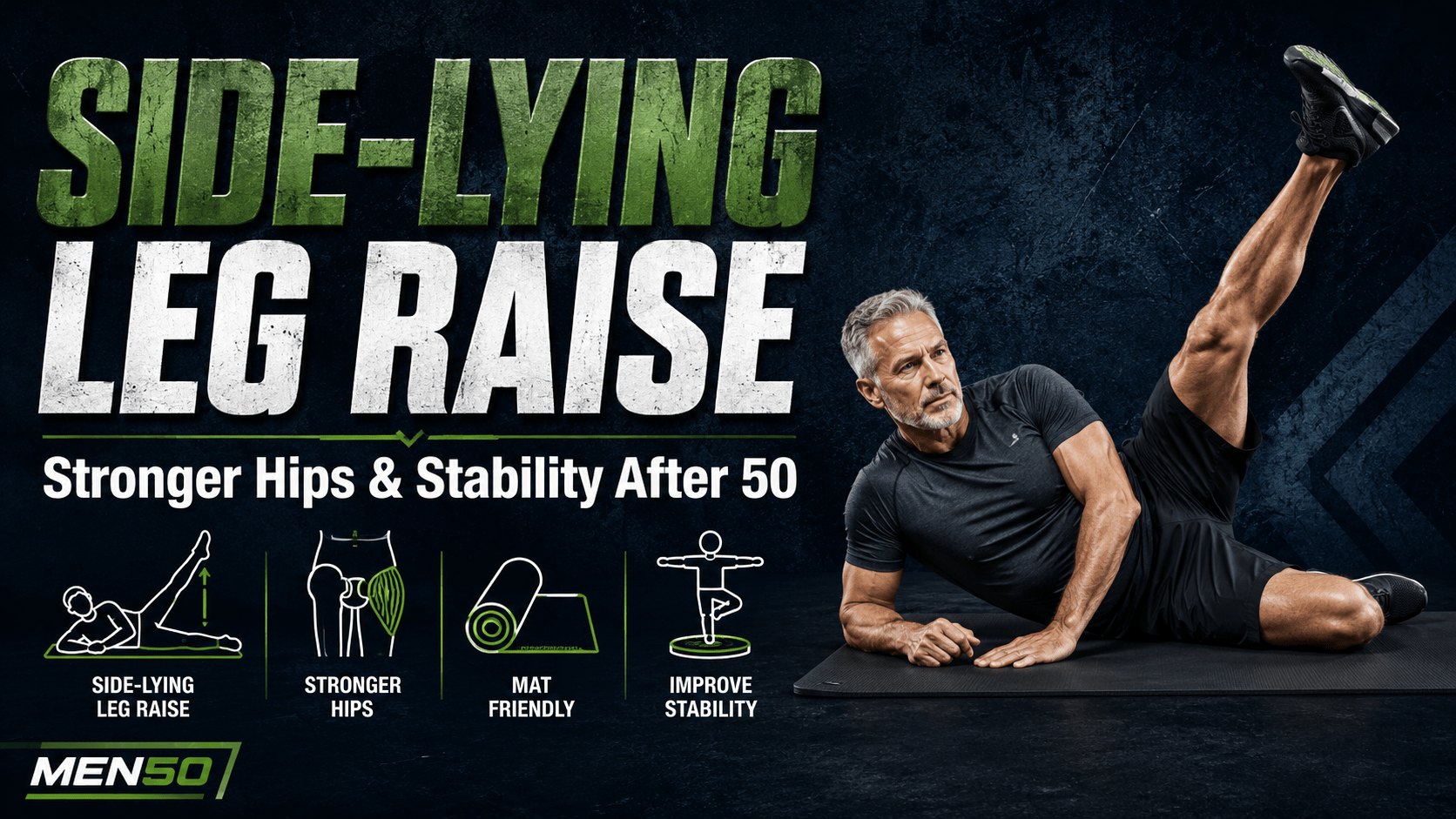
The side-lying leg raise is the no-balance-required version of side-glute training. Where the standing hip abduction trains the gluteus medius in a functional, weight-bearing position, the side-lying version isolates the same muscle without any of the balance demands of standing on one leg. For men over 50 who can’t yet safely balance on one foot — or anyone in early rehabilitation after a hip or knee issue — this is often the right place to start. It’s also the version most physiotherapists prescribe first because it targets the gluteus medius cleanly, with minimal compensation from other muscles.
Part of the Build Muscle After 50 pillar — strength training for men over 50.
Key Takeaways
- The side-lying leg raise trains the same primary muscle as the standing hip abduction — the gluteus medius — but with zero balance demand.
- This is the most isolated, accessible glute medius exercise in the matrix. Ideal for men who can’t yet do standing balance work safely.
- Programming: 2–4 sets of 10–15 reps per side, 2–3 times per week. Rest 30–60 seconds between sets.
- Lift with control, squeeze your outer hip, and lower slowly. Strong hips help you move better, stay balanced, and protect your joints.
- Pair with the standing hip abduction for complete coverage — side-lying for pure isolation, standing for functional transfer to walking and balance.
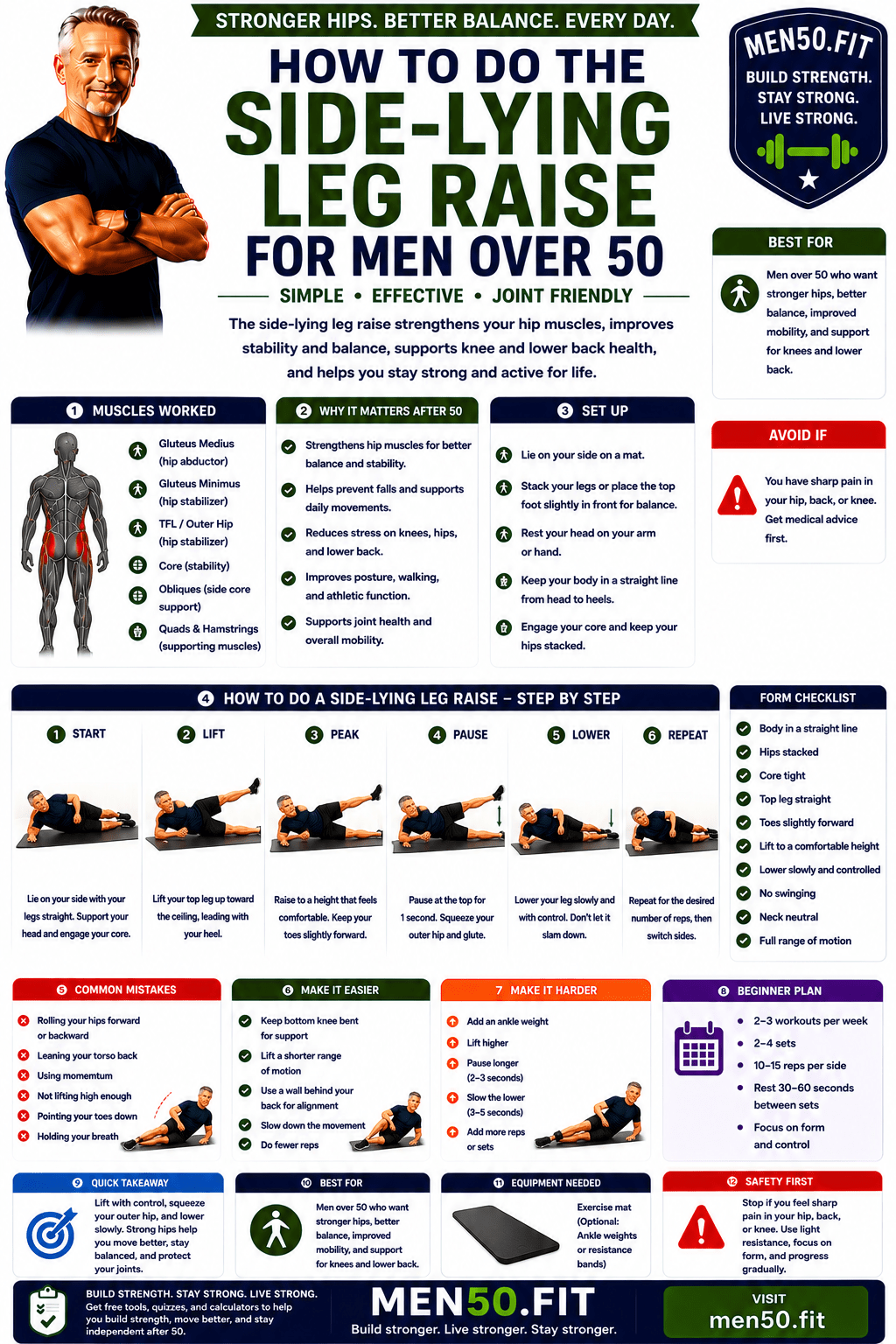
How to Perform the Side-Lying Leg Raise
Set up first:
- Lie on your side on a mat. Bottom arm under your head for support, top hand resting in front of you for balance.
- Stack your legs on top of each other — or place the top foot slightly in front for additional balance.
- Body in a straight line from head to heels — no arching the lower back, no curling forward.
- Hips stacked — one directly above the other. The pelvis stays vertical throughout the rep.
- Engage your core to keep the spine neutral.
Then the movement:
- Start. Lie on your side with your legs straight and stacked. Support your head with your bottom arm. Engage your core. Take a moment to set the position before the first rep.
- Lift. Lift your top leg up toward the ceiling, leading with your heel. Take 1–2 seconds to lift. Keep your toes pointing slightly forward (toward your face, not toward the floor).
- Peak. Raise to a height that feels comfortable — usually about 30–45 degrees from the start. Don’t try to kick higher than your hip mobility allows.
- Pause. Pause at the top for 1 second. Squeeze your outer hip and glute consciously — feel the muscle work.
- Lower. Lower your leg slowly and with control. Take 2–3 seconds on the way down. Don’t let it slam down — control the descent on every rep.
- Repeat. Complete the reps on one side, then switch. Maintain clean form every rep — quality over quantity.
The cue that matters most: lead with your heel, not your toe. Pointing the toes down rotates the hip inward and reduces gluteus medius activation. Leading with the heel keeps the hip externally rotated and puts the work where it should be — on the glute, not on the hip flexor.
Why the Side-Lying Leg Raise Matters After 50
The gluteus medius is the side-hip muscle that stabilises your pelvis during every single-leg moment in daily life — and walking is essentially a series of single-leg moments. When the glute medius is weak (which it commonly is in men over 50), the pelvis drops on each step (physiotherapists call this Trendelenburg gait), the knees drift inward during squatting and walking, and the lower back works overtime to compensate. The downstream effects show up as fall risk, knee pain, hip pain, and chronic low-grade lower-back ache.
The side-lying leg raise trains this exact muscle directly. The hinged-over position of the standing version requires balance, core bracing, and postural control — all of which are useful but can also dilute the focus on the gluteus medius itself. The side-lying position removes those demands entirely and isolates the glute medius more cleanly than almost any other exercise. For men who genuinely have weak glute medius (which is most men over 50, even those who don’t know it), the side-lying version often produces faster strength gains because there’s nothing else competing for fatigue.
Why “side-lying” rather than just “lying”: the position has to be sideways for the gluteus medius to work against gravity properly. The muscle’s job is to abduct the leg (move it away from the midline) — which means lifting the leg sideways. Lying on your back with your leg extended doesn’t load the glute medius; the leg just rolls outward without resistance.
There’s also a rehabilitation context that matters for older men. Most physiotherapists prescribe side-lying leg raises early in the treatment of:
- Greater trochanteric pain syndrome (pain on the side of the hip — common in men over 50)
- IT band issues (often related to weak glute medius)
- Post-hip-replacement recovery (where balance training comes later)
- Knee pain related to hip weakness (the knee-valgus pattern)
- Lower back pain related to hip instability
In each case, the side-lying version is the starting point because it builds strength without challenging balance or putting weight through potentially compromised joints. Once strength returns, the standing hip abduction becomes appropriate.
For healthy men over 50, both versions belong in a complete glute routine. Side-lying for pure isolation and rehabilitation; standing for functional transfer to walking and fall prevention. Many men over 50 do both — side-lying once or twice a week as part of their floor work, standing more often as a daily habit.
Sets and Reps
This exercise rewards consistency more than load. The glute medius is a stability muscle — it responds well to frequent, light-to-moderate work.
| Stage | Variation | Sets × Reps per Side | Frequency |
|---|---|---|---|
| Beginner | Bodyweight, smaller range | 2 × 10–12 | 2–3× per week |
| Novice | Bodyweight, full range | 2–3 × 10–15 | 2–3× per week |
| Intermediate | Ankle weight (2–5 lbs) | 3 × 12–15 | 2–3× per week |
| Advanced | Heavier ankle weight or resistance band + pause at top | 3–4 × 12–15 | 2–3× per week |
Rest 30–60 seconds between sets. Quality of glute engagement matters more than reps. Most men over 50 see better results from clean, controlled bodyweight reps than from heavier loaded reps with body roll or compensation.
Daily mini-doses also work. One set of 10–12 per side every morning as part of a floor routine adds up to real glute medius strength over weeks. This exercise tolerates daily frequency at bodyweight load.
Common Mistakes
The six errors that turn an isolation exercise into a hip flexor or oblique exercise:
- Rolling your hips forward or backward. The single most common mistake. As you lift the leg, the body wants to roll the hip backward to make the lift easier — but rolling shifts the work to the hip flexor and quadriceps instead of the glute medius. Keep the hips perfectly stacked, one directly above the other. If you can’t keep them stacked, you’re either lifting too high or you’ve rolled.
- Leaning your torso back. Similar problem to rolling the hips — when the torso leans back, the body compensates for weak glute medius by using the hip flexor and lower back. Stay in a straight line from head to heels throughout the rep.
- Using momentum. Quick, swinging reps use elastic recoil to bounce the leg up. The glute medius barely fires. Lift slowly (1–2 seconds), pause briefly, lower slowly (2–3 seconds). The slow tempo is the exercise.
- Not lifting high enough. Going only a few inches off the ground doesn’t reach the working range where the gluteus medius fires hardest. Aim for 30–45 degrees from the start — high enough that you genuinely feel the muscle working.
- Pointing your toes down. Internally rotating the foot (toes pointed at the floor) shifts work to the tensor fasciae latae (TFL) and hip flexor instead of the gluteus medius. Keep the toes pointing slightly forward (toward your face). Lead with the heel, not the toe.
- Holding your breath. Breath-holding under exertion raises blood pressure unnecessarily and limits the number of clean reps you can do. Breathe out as you lift; breathe in as you lower. Smooth breathing throughout.
Make It Easier or Harder
If standard side-lying leg raises are too challenging:
- Keep the bottom knee bent for support — gives you a more stable base and reduces the demand on the obliques.
- Lift a shorter range of motion — even 20–30 degrees still trains the glute medius. Build range over weeks.
- Use a wall behind your back for alignment — your back stays against the wall throughout, which prevents the rolling-backward mistake automatically.
- Slow down the movement — counterintuitively, slower can feel harder because momentum disappears.
- Do fewer reps — start with 2 sets of 6–8 per side if 10 is too many.
To make it harder once form is solid:
- Add an ankle weight — 2–3 lbs (1 kg) is plenty to start. Many men over 50 stay at 2–5 lbs long-term and continue making progress.
- Lift higher — only if you can maintain perfectly stacked hips.
- Pause longer at the top for 2–3 seconds with the leg lifted and glute squeezed.
- Slow the lowering phase to 3–5 seconds per rep — significantly more demanding.
- Add more reps or sets — 3 sets of 15 reps per side with bodyweight is more useful than 2 sets of 8 with ankle weights and poor form.
For variety, try the clamshell (lie on your side with knees bent at 90 degrees, feet together, open the top knee like a clamshell). Similar muscle, different angle. Useful for adding variety to a glute routine.
Safety Note
Avoid the side-lying leg raise if you have sharp pain in your hip, back, or knee during the movement, or a recent injury affecting those areas. Get medical advice first if pain persists.
If you feel pain on the side of the hip (where the glute medius tendon attaches at the greater trochanter), reduce the range of motion and remove any added load. Greater trochanteric pain syndrome can become chronic if pushed through; light work usually helps it, heavy work usually doesn’t.
The position is generally very safe — you’re lying down — but pay attention to breathing. Many men hold their breath during isometric or quasi-isometric exercises, which raises blood pressure. Breathe smoothly throughout.
Build Your Personal Training Plan
The side-lying leg raise is one piece of a complete lower-body and balance programme. Get a personalised exercise plan based on your current strength, mobility, and any limitations.
Take the Free Fitness Profiler →
FAQs
Side-lying leg raise vs standing hip abduction — which is better?
They train the same primary muscle (gluteus medius) but serve different purposes. The side-lying version is more isolated — fewer muscles compete for the work, so the glute medius gets a cleaner training stimulus. It’s also more accessible: no balance demand, useful for rehabilitation or men with weak balance. The standing hip abduction has more functional carryover to walking and fall prevention because it loads the glute medius in a weight-bearing position similar to standing on one leg. For most men over 50, including both gives the best results — side-lying for pure strength, standing for functional transfer. If you can only pick one, the standing version has more carryover to daily life.
How do I know if my hips stay stacked?
Two practical checks. Use a wall — lie on your side with your back against the wall. If your hips roll backward during the lift, you’ll feel the top hip lose contact with the wall. Touch test — place your top hand on your top hip during the lift. If you feel the hip rolling, you’ve lost the stacked position. Once you can do bodyweight reps with stacked hips reliably, you’ve earned the option to add load. Until then, focus on the position.
Why does my hip flexor hurt during this exercise?
Almost always because you’re rolling your hip backward as you lift, which shifts the work to the hip flexor and quadriceps instead of the gluteus medius. The fix: drop the lift height, keep the hips stacked, and lead with the heel (not the toe). Lift only as high as you can manage with stacked hips — even if that’s only 20 degrees. Build range as the glute medius gets stronger over weeks. If hip flexor discomfort persists despite good form, take 2–3 days off this exercise and ease back with lighter, slower reps.
Should I use ankle weights?
Eventually — but not at the start. Master bodyweight reps with clean form for 3–4 weeks first. Most men over 50 can progress to bodyweight 3 sets of 15 per side before adding load. Once you can, start with 2–3 lbs (1 kg) ankle weights and build up to 5 lbs (2 kg) over months. Going heavier than 5 lbs almost always causes the body to compensate (rolling, leaning, using momentum) — at which point you’ve stopped training the gluteus medius properly.
Can I do this exercise every day?
Yes — at bodyweight load and moderate volume. The glute medius is a postural/stability muscle that responds well to frequent practice. One set of 10–12 per side every morning is a sustainable habit that adds up over months. Heavier work (with ankle weights) needs 48 hours of recovery; limit that to 2–3 days per week. Most men over 50 benefit from doing the side-lying version 2–3 times per week and the standing version daily or near-daily.
References
- American College of Sports Medicine. Resistance Training for Older Adults Position Stand. acsm.org
- Centers for Disease Control and Prevention. STEADI: Stopping Elderly Accidents, Deaths & Injuries. cdc.gov
- National Institute on Aging. Exercise & Physical Activity: Your Everyday Guide. nia.nih.gov
Disclaimer: This article is for educational purposes only and is not medical advice. Consult a qualified healthcare professional before starting any new exercise programme, especially if you have existing hip, knee, or back conditions.