
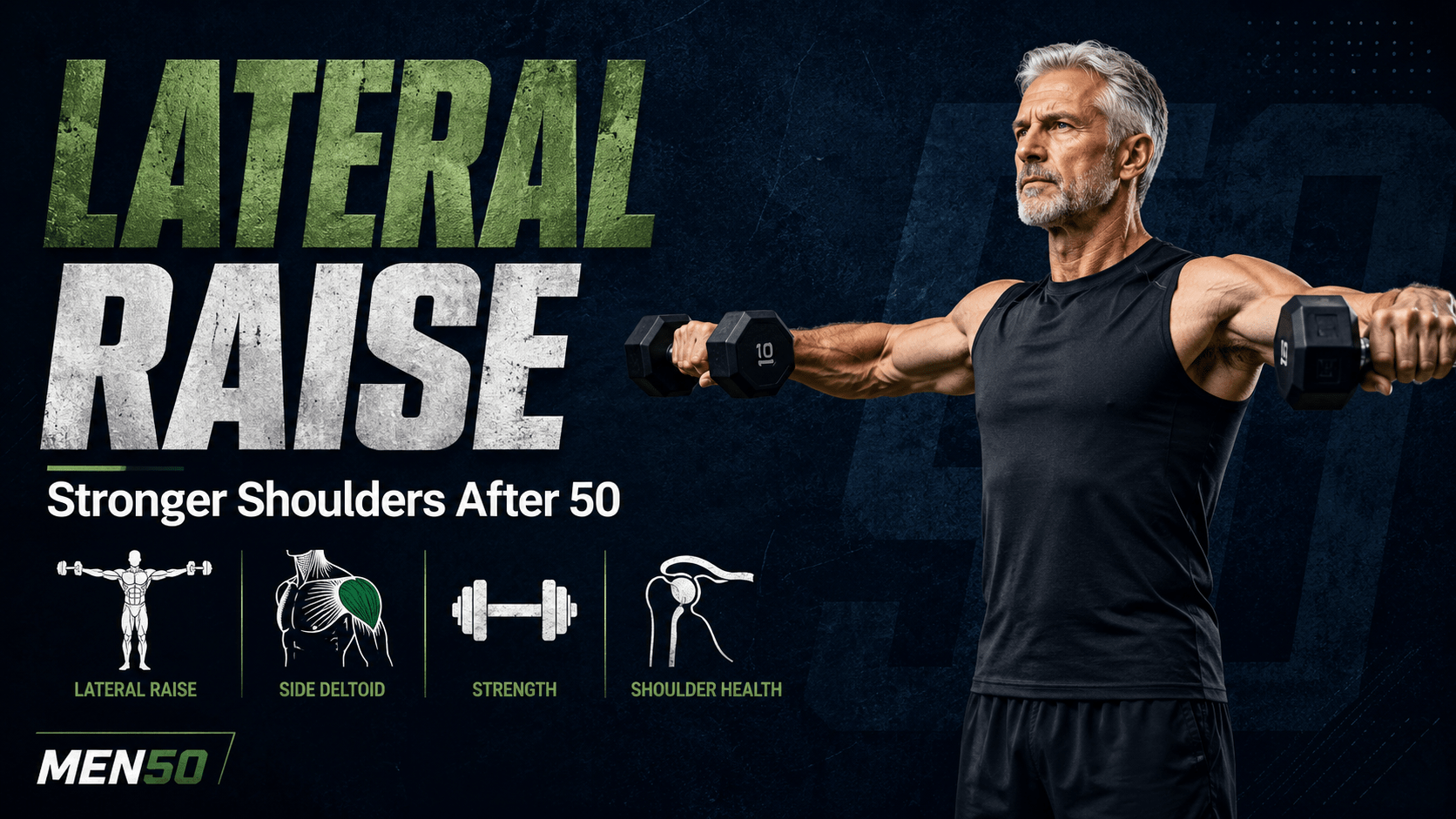
The dumbbell lateral raise is the one shoulder exercise that compound pressing won’t replace. Push-ups, floor presses, and bench presses all train the front of the shoulder hard — but they barely touch the side deltoid, the muscle that creates the shoulder “cap” you see from the front. For men over 50, the lateral raise matters less for how it makes shoulders look and more for what it does: it builds the side-shoulder strength that’s involved in reaching, lifting overhead, and keeping the shoulder joint stable during everyday movement.
Part of the Build Muscle After 50 pillar — strength training for men over 50.
Key Takeaways
- The lateral raise directly trains the side deltoids — the part of the shoulder that compound presses barely touch.
- Programming: 2–4 sets of 10–15 reps, 2–3 times per week. Rest 45–75 seconds between sets.
- Lift to shoulder height, not above. Raising higher recruits the upper traps and shrugs the shoulders. Stop at the top of “T” position.
- Lead with your elbows, not your hands. The cue that makes this exercise work properly.
- Most men go too heavy on lateral raises. Use lighter dumbbells than your ego suggests — 5–15 lbs is the working range for most men over 50.
How to Perform the Dumbbell Lateral Raise
Set up first:
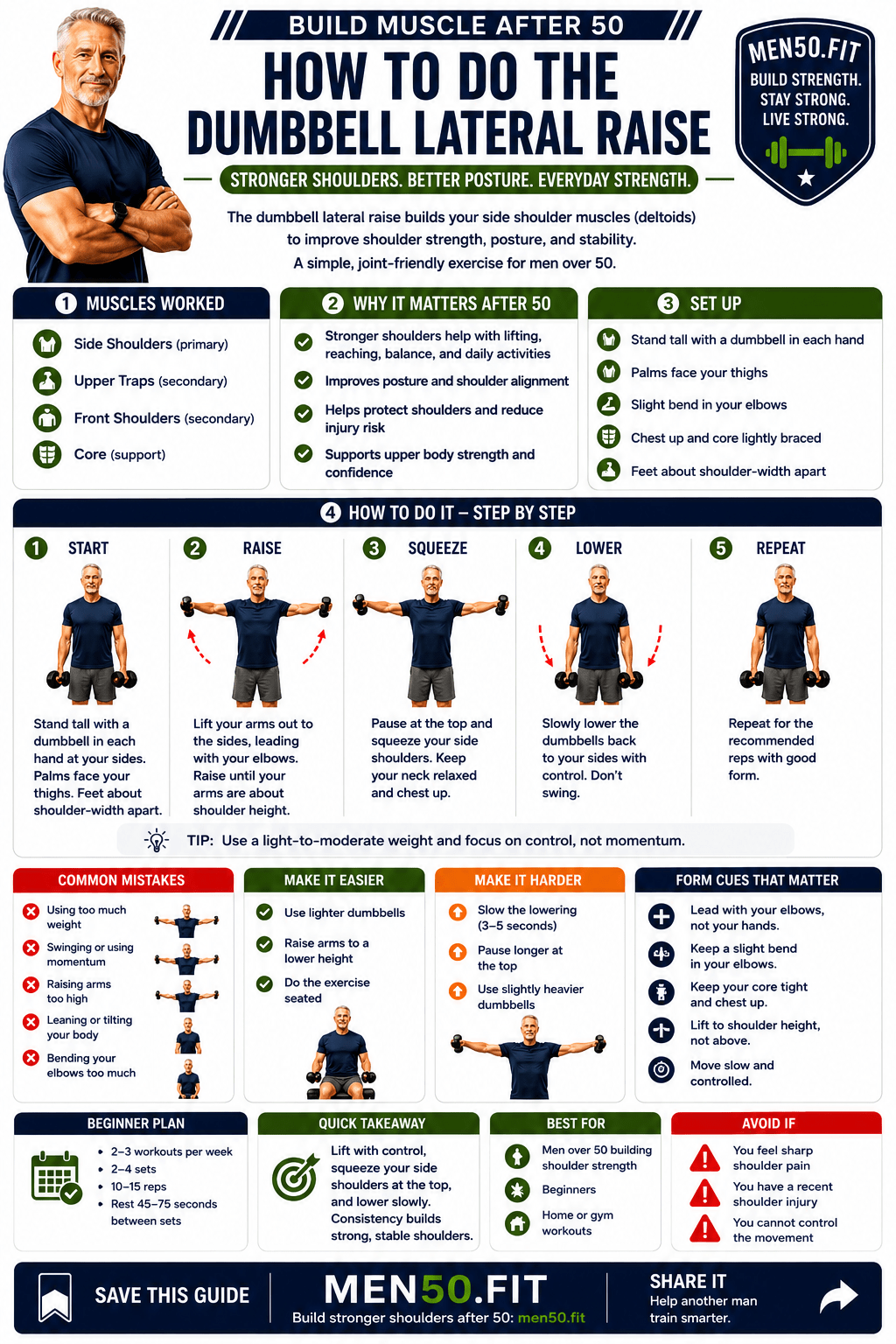
- Stand tall with a dumbbell in each hand at your sides.
- Palms face your thighs (neutral grip).
- Slight bend in the elbows — not locked straight, not bent at 90 degrees.
- Chest up, shoulders relaxed, core lightly braced, feet about shoulder-width apart.
Then the movement:
- Start. Stand tall, dumbbells at your sides, palms facing your thighs. Feet shoulder-width apart. Core engaged.
- Raise. Lift your arms out to the sides, leading with your elbows. Keep the slight bend in the elbows throughout. Raise until your arms are about shoulder height — not higher. Both arms move together.
- Squeeze. Pause at the top and squeeze your side shoulders. Keep your neck relaxed and chest up. Don’t shrug the shoulders toward your ears.
- Lower. Slowly lower the dumbbells back to your sides under control. Take 2–3 seconds on the way down. Don’t let the dumbbells drop or swing.
- Repeat. Quality reps with light weight beat heavy reps with momentum every time.
The cue that matters most: lead with your elbows, not your hands. If you focus on lifting the elbows out to the sides, the side deltoid does the work properly. If you focus on lifting the dumbbells, the upper traps take over and the shoulders shrug.
Why the Dumbbell Lateral Raise Matters After 50
The deltoid muscle has three sections — front, side, and rear. Most pressing exercises (push-ups, bench presses, dumbbell floor presses) train the front deltoid heavily. Pulling exercises like the dumbbell row train the rear deltoid. But the side deltoid — the muscle that gives the shoulder its rounded cap shape and lifts the arm out to the side — gets almost no work from compound exercises. The lateral raise is the most direct, efficient exercise for training it.
This matters more than it sounds for men over 50. The side deltoid is involved in nearly every overhead reach (high cupboards, lifting luggage into overhead bins) and every load you carry out to the side of your body (shopping bags, briefcases, tools). It also contributes meaningfully to shoulder joint stability — strong side deltoids help hold the head of the humerus in place during overhead and lateral motion, which is the same stability the wall angels train through different mechanics.
There’s also a posture angle. Many men over 50 develop forward-rounded shoulders where the side deltoids are weak relative to the chest. The lateral raise — combined with band pull-aparts and doorway chest stretches — helps rebuild the lateral strength that holds the shoulders in a healthy, slightly back-and-down position rather than slumping forward.
The lateral raise won’t transform your physique or make you significantly stronger at compound lifts. What it does is round out shoulder development that compound exercises miss, contribute to joint health, and add the bit of shoulder strength that shows up in real-world reaching and carrying. It’s the small, specific exercise that pays back in details — and the details add up over years.
Sets and Reps
The lateral raise is not where to chase heavy weight. The side deltoid is a small muscle, and the leverage of the movement makes it look much weaker than it is. Light weight, high control.
| Stage | Sets × Reps | Frequency | Load Guide |
|---|---|---|---|
| Beginner | 2 × 10–12 | 2× per week | Very light, focus on form |
| Novice | 2–3 × 10–15 | 2–3× per week | Light, last 2 reps challenging |
| Intermediate | 3 × 12–15 | 2–3× per week | Light to moderate, slow tempo |
| Advanced | 3 × 10–15 | 2–3× per week | Moderate, slow lowering + pause at top |
Rest 45–75 seconds between sets. Pick a weight where the last 2–3 reps feel clearly challenging at clean tempo with no swinging or leaning.
A practical starting load: most men over 50 should start with 5–10 lb (2–4.5 kg) dumbbells. Some progress to 12–15 lbs (5–7 kg) over time. Going heavier than that almost always means swinging the weight up rather than lifting it cleanly — and you’ve stopped training the side deltoid the moment that happens.
Common Mistakes
The five errors that turn a useful exercise into a trap-and-neck exercise:
- Using too much weight. The most common mistake by far. Lateral raises feel deceptively easy when you imagine doing them — then you lift the dumbbells and realise the side deltoid is small and weak compared to your ego. If you can’t lift the weight without swinging, leaning, or shrugging, drop down. 5 lbs done properly beats 15 lbs done badly.
- Swinging or using momentum. Rocking forward and back to launch the dumbbells up turns the lateral raise into a swing. The deltoids barely fire. Stand still, brace the core, lift cleanly.
- Raising arms too high. Lifting the dumbbells higher than shoulder height engages the upper traps and shrugs the shoulders into the ears. Stop at the “T” position — arms parallel to the floor. Higher isn’t better; it’s just shrugging.
- Leaning or tilting your body. Some men lean their torso side-to-side to help lift each dumbbell. Stay vertical and rigid. If you have to lean, the weight is too heavy.
- Bending the elbows too much. Too much elbow bend turns the lateral raise into something closer to an upright row. Keep a slight, consistent bend in the elbows throughout the rep.
Make It Easier or Harder
If standard lateral raises are too challenging:
- Use lighter dumbbells — 2–5 lbs (1–2 kg) is fine to start. There’s no shame in starting light. The deltoid responds to clean reps, not heavy ones.
- Raise arms to a lower height — stop at 70–80% of shoulder height while you build strength.
- Do the exercise seated on a sturdy chair or bench — removes the temptation to swing and lean, and reduces lower-back demand.
To make lateral raises harder once form is solid:
- Slow the lowering phase to 3–5 seconds per rep. Genuinely difficult and very effective.
- Pause longer at the top with arms at shoulder height for 2–3 seconds.
- Use slightly heavier dumbbells — but only when the lighter weight feels easy with clean form. Most men over 50 don’t need to go above 12–15 lbs (5–7 kg).
For variety, try the front raise (raising the dumbbells forward instead of out to the sides) once a week — targets the front deltoid directly. Useful if your pressing exercises have built imbalanced shoulders.
Safety Note
The lateral raise places the shoulder joint in a position that can aggravate impingement in men with existing shoulder issues. If you feel a sharp pinch at the top of the rep (when arms are at shoulder height), stop the lift slightly lower — about 70 degrees rather than 90 — and check that you’re leading with the elbows rather than the hands.
If you have a recent shoulder injury (rotator cuff strain, dislocation, recent surgery, frozen shoulder), skip this exercise until cleared by a physiotherapist. The lateral raise is one of the more demanding exercises for an already-irritated shoulder joint.
If you cannot control the movement without swinging or jerking, the load is too heavy — drop down and rebuild with cleaner reps before adding weight.
Build Your Personal Training Plan
The dumbbell lateral raise is one piece of a complete upper body programme. Get a personalised exercise plan based on your current strength, goals, and any limitations.
Take the Free Fitness Profiler →
FAQs
How heavy should the dumbbells be for lateral raises?
Lighter than your ego suggests. For most men over 50, 5–10 lbs (2–4.5 kg) per hand is the starting range. Some men progress to 12–15 lbs (5–7 kg) after several months. The right weight is one you can lift cleanly to shoulder height with both arms moving evenly, no swinging, and no shrugging. The side deltoid is a small muscle — heavy dumbbells just turn the exercise into a momentum swing that doesn’t train it.
Why do I feel this in my neck and traps instead of my shoulders?
Two causes, both fixable. You’re shrugging — the upper traps are lifting the shoulders toward the ears as the arms come up. Pin the shoulders down and back before each rep and consciously keep them there. You’re leading with the hands instead of the elbows — focus on lifting the elbows out to the sides; the hands just go along for the ride. If both are clean and you still feel it in the traps, the weight is too heavy.
Should I raise the dumbbells higher than shoulder height?
No. The side deltoid does its work between hip height and shoulder height. Beyond shoulder height, the upper traps take over to continue the motion — which is why higher lifts feel like shrugs. Stop at shoulder height (arms parallel to the floor). The “T” position is the target; nothing above that adds shoulder benefit and most of it just shrugs.
Lateral raise vs shoulder press — which is better?
They train different parts of the shoulder. The shoulder press (overhead pressing) heavily targets the front and middle deltoid in a compound movement. The lateral raise isolates the side deltoid specifically — the part overhead presses don’t hit hard. Most men over 50 benefit from including both in a programme: pressing for overall shoulder strength, lateral raises for the specific side-shoulder work that pressing misses. If you have shoulder issues, lateral raises are usually better tolerated than heavy overhead pressing.
Can lateral raises help with rounded shoulders?
Indirectly, yes. Strong side deltoids contribute to a more upright shoulder posture by supporting the joint laterally. But lateral raises alone won’t fix rounded shoulders — the bigger fix is strengthening the upper back and stretching the chest. Pair lateral raises with band pull-aparts, doorway chest stretches, and wall angels for a complete postural fix.
References
- American College of Sports Medicine. Resistance Training for Older Adults Position Stand. acsm.org
- National Institute on Aging. Sarcopenia and Muscle Strength in Older Adults. nia.nih.gov
- Centers for Disease Control and Prevention. Physical Activity Guidelines for Americans, 2nd Edition. cdc.gov
Disclaimer: This article is for educational purposes only and is not medical advice. Consult a qualified healthcare professional before starting any new exercise programme, especially if you have existing shoulder, neck, or back conditions.