
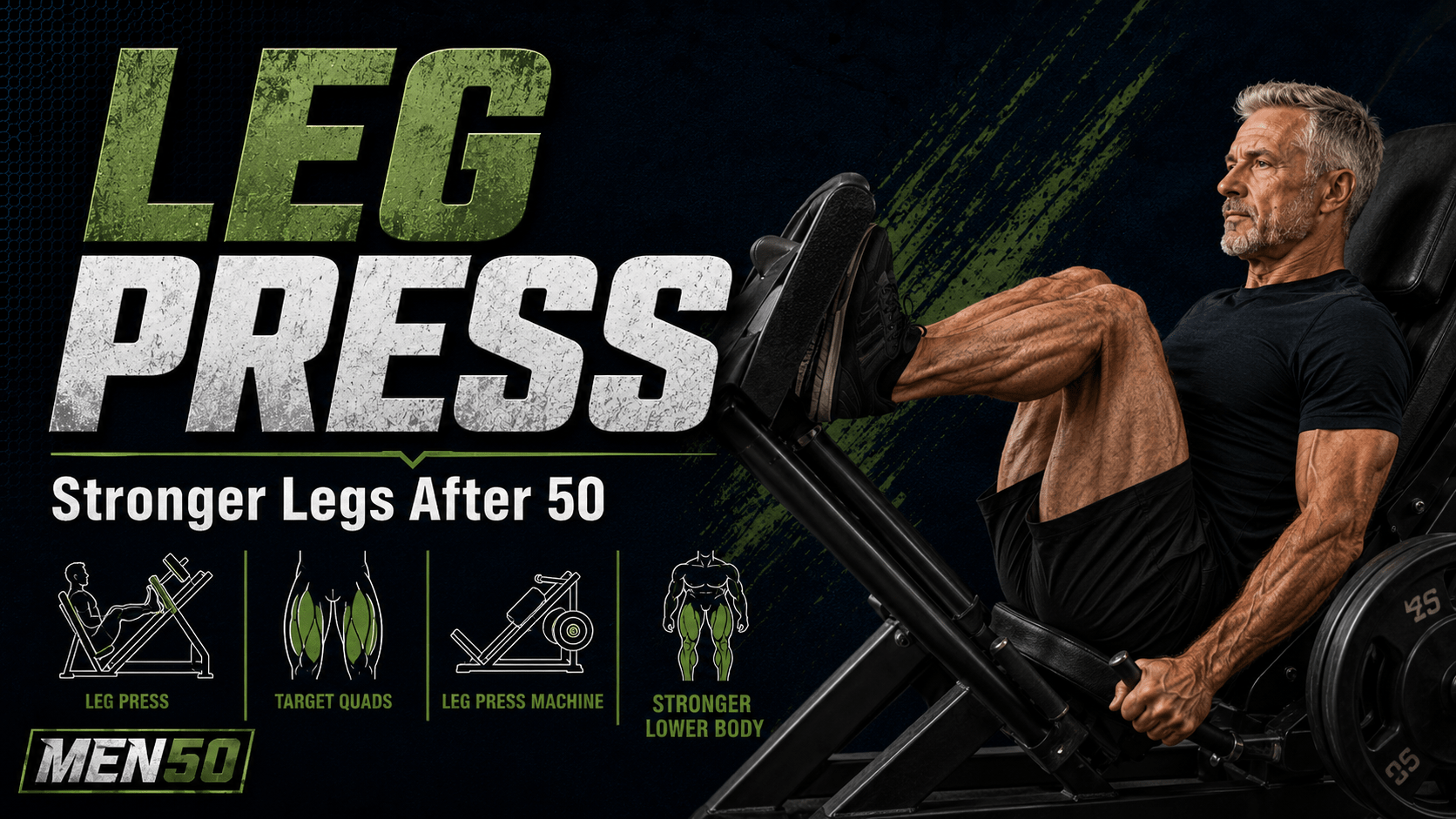
The leg press is the gym-machine version of compound leg strength — and for men over 50, it solves a specific problem that bodyweight squats and goblet squats can’t: heavy loading without lower-back demand. Barbell back squats produce excellent leg strength but require the lower back to support significant load through every rep. For men over 50 with any back history — and that’s a large portion of the demographic — the leg press lets you train the legs with gym-grade resistance while the seat and back pad eliminate the lower-back bracing demand entirely. It’s not a compromise; for many men over 50, it’s the smarter choice.
Part of the Build Muscle After 50 pillar — strength training for men over 50.
Key Takeaways
- The leg press trains the same primary muscles as the squat family (bodyweight squat, goblet squat) — quads, glutes, hamstrings — but with back support and guided movement.
- It’s the gym-machine compound leg exercise that complements the squat family rather than replacing it.
- Programming: 2–4 sets of 8–12 reps, 2–3 times per week. Rest 60–90 seconds between sets.
- Use control, not ego. Push strong, move smooth. Don’t lock out the knees, don’t lift hips off the seat, knees track over toes.
- This completes the gym-machine cluster for men over 50 — pulling (lat pulldown + seated cable row), pressing (machine chest press + pec deck), now lower body.
How to Perform the Leg Press
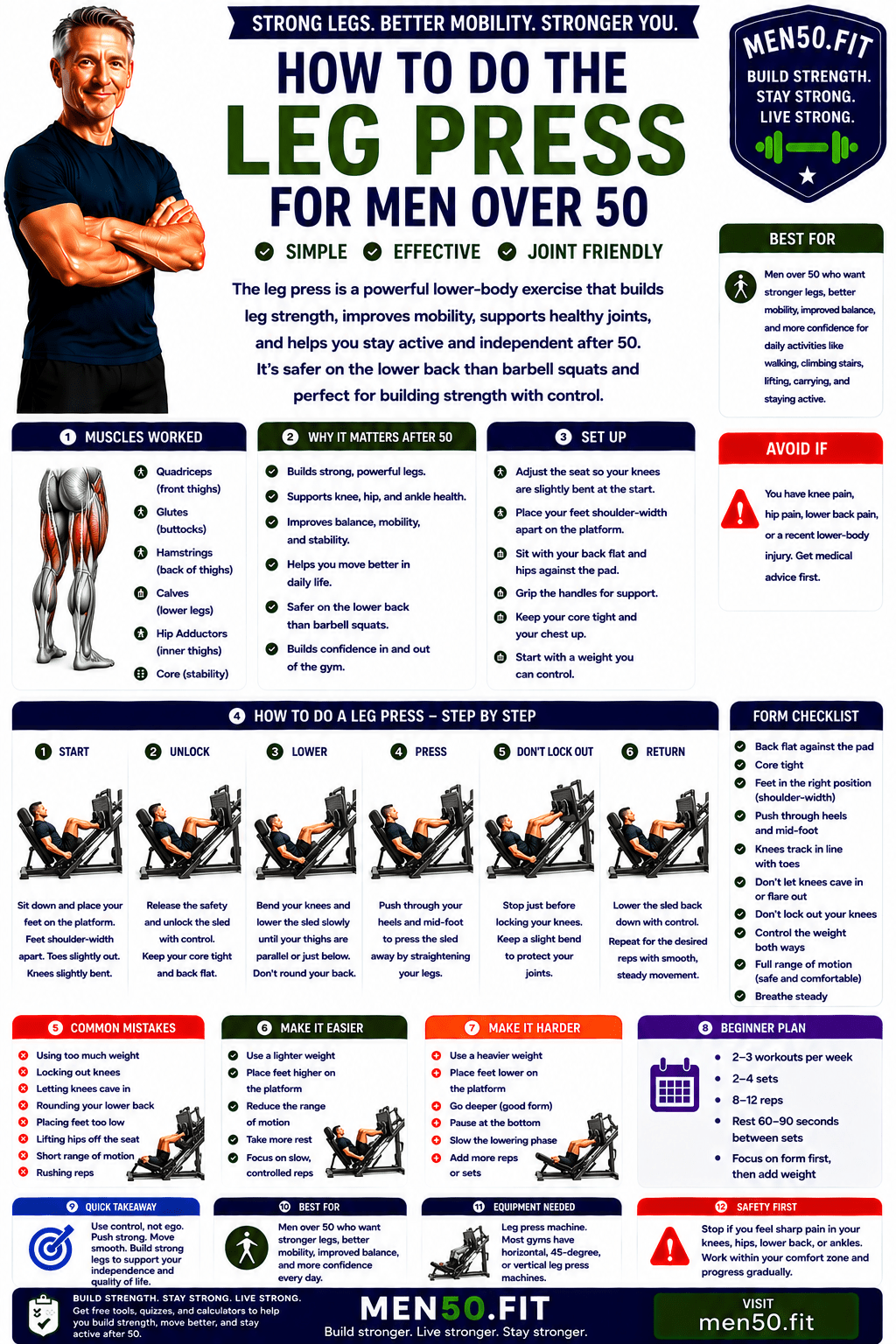
Set up first:
- Adjust the seat so your knees are slightly bent at the start — not bent at 90 degrees, not fully extended.
- Place your feet shoulder-width apart on the platform with toes pointing slightly outward (about 10–15 degrees).
- Sit with your back flat and hips against the pad — no gap, no rounding.
- Grip the handles on the seat for support and to keep your torso stable.
- Keep your core tight and chest up.
- Start with a weight you can control — significantly lighter than you think.
Then the movement:
- Start. Sit down and place your feet on the platform, shoulder-width apart, toes slightly out, knees slightly bent. Body braced, back flat, hips against the pad.
- Unlock. Release the safety bars and unlock the sled with control. Keep your core tight and back flat — the unlocking is the moment when many men injure themselves by letting the sled drop suddenly.
- Lower. Bend your knees and lower the sled slowly until your thighs are parallel or just below parallel to the platform. Take 2–3 seconds on the way down. Don’t round your lower back — if the back starts to round (the hips lift off the seat), you’ve gone too deep. Stop there next time.
- Press. Push through your heels and mid-foot to press the sled away by straightening your legs. Take 1–2 seconds to press up. Lead with the heels, not the toes.
- Don’t lock out. Stop just before locking your knees at the top. Keep a slight knee bend — about 5–10 degrees from full extension. Locking out shifts load from the muscles to the knee joint and can cause hyperextension injuries.
- Return. Lower the sled back down with control. Repeat for the desired reps with smooth, steady movement. End the set by re-engaging the safety bars — never just walk away from a loaded sled.
The cue that matters most: push through your heels and mid-foot, with knees tracking over the toes. Most men over 50 doing leg press intuitively push through the balls of the feet (toes), which shifts work to the quads only and increases knee stress. Heels and mid-foot loads the entire leg chain — quads, glutes, hamstrings — and keeps the knees in their safest position. If you can wiggle your toes during the press, you’re pushing correctly.
Why the Leg Press Matters After 50
Leg strength is one of the strongest predictors of longevity and independence in older adults. The sit-to-stand research from Rikli and Jones (Senior Fitness Test, 1999) and the Sitting-Rising Test from Brito and colleagues (2014) both demonstrated that leg strength in the 50–80 age range predicts all-cause mortality independent of other factors. Loss of leg strength is also the most direct contributor to falls, loss of independence, and the cascade of decline that defines so many men’s later years.
The leg press trains the entire leg chain efficiently:
| Muscle | Role |
|---|---|
| Quadriceps | Primary mover — straightens the knee |
| Glutes | Hip extension during the press |
| Hamstrings | Assist with hip extension, stabilise the knee |
| Hip adductors | Inner thigh, stabilise the knees during the press |
| Calves | Stabilise the ankle during the press |
| Core | Stabilises the spine against the seat pad |
Why the Leg Press Specifically
The leg press has four specific advantages for men over 50:
1. Back support. Unlike barbell squats (which require the entire spine to bear the load through every rep), the leg press has a back pad that supports the spine in a neutral position. This is the single biggest reason it’s recommended over squats for men with any back history — and that’s a large portion of men over 50.
2. Heavy loading capacity. The leg press lets you load the legs significantly heavier than bodyweight squats or goblet squats — typically 2–4× your bodyweight on a 45-degree leg press for experienced lifters. This kind of progressive overload is essential for actual strength building in the legs, not just maintenance. Bodyweight and dumbbell squats max out at relatively modest loads for the leg muscles, especially as men get stronger over months and years of training.
3. Safe to fail. Every leg press machine has safety stops that catch the sled if you can’t complete a rep. This means you can train closer to muscular failure (where strength gains happen) without the risk of getting pinned under a barbell. For men over 50 training without a spotter, this safety feature is genuinely valuable.
4. Foot position adjustments. Where you place your feet on the platform changes muscle emphasis:
- Feet high on the platform: more glutes and hamstrings, less quads, less knee stress
- Feet low on the platform: more quads, more knee stress
- Feet shoulder-width: balanced quad/glute work (the default)
- Feet wider: more inner thigh emphasis
- Feet narrower: more outer quad emphasis
This flexibility lets you target different leg priorities without needing different exercises.
The Squat Family Picture
The leg press doesn’t replace bodyweight squats — it complements them. Here’s the full lower-body knee-dominant progression in the matrix:
| Exercise | Equipment | Best For |
|---|---|---|
| Sit-to-Stand | Chair | Foundation, regression from squats |
| Chair Squat | Chair behind for safety | Building the squat pattern |
| Bodyweight Squat | None | Pattern training, mobility, no equipment |
| Goblet Squat | One dumbbell | Loaded squat pattern, balance, core |
| Leg Press (this article) | Gym machine | Heavy loading, back-friendly |
The complete leg programme: bodyweight or goblet squats for pattern, balance, and core training; leg press for heavy loading. Many men over 50 benefit from doing both within a single workout — squats first (when fresh, for pattern training), leg press second (when pre-fatigued, for heavier loading).
Position in the Gym-Machine Cluster
The leg press completes the gym-machine cluster for men over 50 — five exercises that together form a complete machine-based programme:
| Pattern | Machine Exercise |
|---|---|
| Vertical pulling | Lat Pulldown |
| Horizontal pulling | Seated Cable Row |
| Horizontal pressing | Machine Chest Press |
| Chest isolation | Pec Deck Machine |
| Compound lower body | Leg Press (this article) |
Five joint-friendly, precisely loadable machine exercises. For men over 50 with gym access who want guided progressive training without the technical complexity of barbell work, this cluster is the foundation.
Sets and Reps
Progressive loading is the goal. The leg press tolerates significant progressive overload over months and years.
| Stage | Sets × Reps | Frequency | Load Guide (45-degree leg press) |
|---|---|---|---|
| Beginner | 2 × 8–10 | 2× per week | Sled + small plates (~50–100 lbs / 23–45 kg) |
| Novice | 2–3 × 8–12 | 2–3× per week | Sled + 1 plate per side (~135–180 lbs / 61–82 kg) |
| Intermediate | 3 × 8–12 | 2–3× per week | Sled + 2 plates per side (~225–315 lbs / 102–143 kg) |
| Advanced | 3–4 × 8–12 | 2–3× per week | Heavier with pause + slow lowering |
Rest 60–90 seconds between sets. Pick a weight where the last 2–3 reps feel clearly challenging but you can complete them with: back flat against the pad, hips on the seat (not lifting), knees tracking over toes, no lockout, controlled tempo.
Important load note: leg press weight numbers can be misleading. Different machines have different mechanical advantages — a 45-degree leg press lets you push significantly more than a horizontal leg press because of the angle. The sled itself often weighs 80–125 lbs on plate-loaded machines (varies by manufacturer), so “the sled plus one plate per side” already means 170–215 lbs total. Focus on your progress on a specific machine rather than absolute weight numbers, and especially don’t compare your leg press weight to other men’s at the gym.
Common Mistakes
The eight errors that turn a great leg exercise into a knee or back problem:
- Using too much weight. The leg press’s heavy loading capacity tempts ego-loading. Heavy weights force compensation — partial reps, hip lift, locked knees, knee cave-in. Drop a size if form breaks down. Better to use 200 lbs with perfect form than 400 lbs with visible compensation.
- Locking out knees. Fully straightening the knees at the top shifts load from muscles to the knee joint. Over time, this contributes to knee joint stress and can cause acute knee hyperextension injuries under heavy load. Keep a slight knee bend (5–10 degrees from full extension) at the top of every rep.
- Letting knees cave in. When the legs get tired, the knees often cave inward (valgus collapse), particularly with heavy weight. This stresses the inner knee and the ACL/MCL. Knees track in line with the toes throughout — push the knees out slightly to prevent cave-in.
- Rounding your lower back. The most dangerous mistake. When you go too deep, the pelvis tucks under and the lower back rounds (visible as the hips lifting off the seat). This puts loaded lumbar flexion on the discs — exactly the position associated with disc injuries. Stop the descent before the hips lift off the seat.
- Placing feet too low. Low foot placement increases quadriceps emphasis but also increases knee stress significantly. For most men over 50, shoulder-width and mid-platform is the right default. Don’t place feet at the bottom of the platform unless you have very healthy knees and a specific reason.
- Lifting hips off the seat. Going too deep causes the hips to lift, which rounds the back. Stop just before this happens. If the hips lift even slightly, you’ve gone too deep on that rep — adjust depth on subsequent reps.
- Short range of motion. Pushing through only 1/3 of the available range (with knees barely bending) skips most of the productive work. Aim for thighs parallel to the platform or just below — full safe range, not maximum range.
- Rushing reps. Bouncy quick reps use elastic recoil from the sled and the knee joints. Slow controlled tempo — 2–3 seconds down, brief pause, 1–2 seconds up.
Make It Easier or Harder
If standard leg press reps are too challenging:
- Use a lighter weight — just the sled is plenty for beginners on most machines.
- Place feet higher on the platform — reduces knee demand, increases glute/hamstring emphasis.
- Reduce the range of motion — stop the descent earlier (above parallel) while you build strength and mobility.
- Take more rest — 90–120 seconds between sets if needed.
- Focus on slow controlled reps — clean reps with light weight train the pattern.
To make it harder once form is solid:
- Use a heavier weight — but only when the current weight feels easy with clean form. The leg press tolerates significant progressive overload over months.
- Place feet lower on the platform — increases quadriceps emphasis (and knee demand, so only if knees are healthy).
- Go deeper (thighs to or just below parallel) — but only if the hips stay on the seat and back stays flat.
- Pause at the bottom for 1–2 seconds — eliminates the elastic recoil from the descent.
- Slow the lowering phase to 3–5 seconds per rep — significantly more demanding.
- Add more reps or sets — extend to 12–15 reps before adding load.
For variety, try the single-leg press once a week — one leg at a time, exposes left-right asymmetry similar to the supported split squat. Use significantly lighter weight (~40–50% of bilateral) and follow all the same form principles.
Safety Note
Avoid the leg press if you have knee pain, hip pain, lower back pain, or a recent lower-body injury. Get medical advice first.
Knee pain during the leg press has three common causes. (1) Feet too low on the platform — move feet higher to reduce knee demand. (2) Knees caving inward — push knees out to track over toes. (3) Locking out at the top — keep a slight bend. If pain persists after fixing all three, the leg press may be too aggressive for your current knee status — drop back to goblet squats or bodyweight squats, or see a physiotherapist.
Lower back pain during the leg press is usually caused by going too deep — the hips lift off the seat, the pelvis tucks, and the lower back rounds under load. Stop the descent before the hips lift — typically when thighs are parallel to the platform, sometimes higher for men with limited hip mobility. If pain persists, drop the weight first; if it continues with lighter loads, see a physiotherapist before continuing.
Hip pain is usually a sign of going too deep with limited hip mobility, or of foot position issues. Adjust foot position (try slightly wider) and reduce range first.
Knee hyperextension is an acute injury risk if you slam the knees into lockout under heavy load. Always keep a slight bend at the top. Make this the unbreakable rule of leg pressing — even if you’re maxing out, the knees stay slightly bent.
Always re-engage the safety bars at the end of a set — never just step out of a loaded machine. The sled is heavy; a slip or stumble can cause it to swing and injure you or someone nearby.
If you feel sharp pain anywhere during the rep, stop. Mild muscular fatigue in the legs is normal; sharp joint pain is not.
Build Your Personal Training Plan
The leg press is one piece of a complete lower-body programme. Get a personalised exercise plan based on your current strength, goals, and any limitations.
Take the Free Fitness Profiler →
FAQs
Leg press vs barbell squat — which is better?
For most men over 50, the leg press is the safer compound leg exercise, particularly if you have any back history. Barbell squats produce excellent leg strength but require the entire spine to bear the load through every rep — which becomes the limiting factor for many men over 50 (and the source of back injuries). The leg press provides equivalent leg muscle development at heavier loads with no spinal loading at all. The trade-off: barbell squats also train balance, core bracing, and full-body coordination that the leg press doesn’t. The best approach for most men over 50: skip barbell back squats entirely, use bodyweight squats or goblet squats for pattern and balance training, and use the leg press for heavy loading. This combination delivers all the benefits of squat-based training with significantly less back risk.
Leg press vs goblet squat — which is better?
Different exercises that serve different purposes. The goblet squat trains the squat pattern with balance, core bracing, and full-body coordination demand. The leg press allows much heavier loading of the leg muscles specifically, but without the pattern/balance training. Both belong in a complete leg programme: goblet squats for pattern training and balance (lighter loads, higher reps), leg press for heavy loading and progressive overload (heavier loads, moderate reps). Many men over 50 do both within a single workout — goblet squats first when fresh, leg press second for the heavy loading. Neither is “better” overall — they’re complementary.
Where should I place my feet on the platform?
For most men over 50 starting out: shoulder-width apart, mid-platform, toes slightly out (10–15 degrees). This is the balanced default that loads the quads, glutes, and hamstrings together without excessive knee stress. Variations to try once form is solid: (1) Higher on platform — more glutes and hamstrings, less quads, less knee stress (good if knees are sensitive). (2) Lower on platform — more quads, more knee stress (only if knees are healthy). (3) Wider stance — more inner thigh and glute. (4) Narrower stance — more outer quad. Rotate among these for comprehensive development, or stick with the default if it’s working. Don’t go to extreme positions (very high or very low on platform) without good reason.
How heavy should the weight be?
Heavy enough that the last 2–3 reps feel clearly challenging, but light enough that you can complete the set with: back flat, hips on the seat, knees tracking over toes, no lockout, controlled tempo. For most men over 50 starting out, just the empty sled (which weighs 80–125 lbs depending on the machine) is plenty for the first few weeks. After 3–6 months, many add 1 plate per side (~45 lbs per side) for working sets. Advanced lifters often work in the 2–4 plates per side range. Don’t compare to other gym-goers — different machines have very different mechanical advantages, so absolute weight numbers don’t compare cleanly. Focus on your progress on the specific machine you use.
Why shouldn’t I lock out my knees?
Two reasons. (1) Joint protection — fully straightening the knees under load transfers the resistance from the leg muscles directly to the knee joint structures (ligaments, cartilage). Over time, this contributes to joint stress; under acute heavy load, it can cause knee hyperextension injuries. Men over 50 with reduced joint resilience are particularly vulnerable. (2) Muscle engagement — when the knees lock, the leg muscles stop doing the work because the bones bear the load directly. The chest and back of the exercise (the productive part) ends when you reach the slight-bend position. Keep a slight knee bend (5–10 degrees from full extension) at the top of every rep. This keeps the muscles under tension and protects the knee joint.
References
- Brito LBB, Ricardo DR, Araújo DSMS, et al. Ability to sit and rise from the floor as a predictor of all-cause mortality. European Journal of Preventive Cardiology. 2014;21(7):892-898.
- Rikli RE, Jones CJ. Development and validation of a functional fitness test for community-residing older adults. Journal of Aging and Physical Activity. 1999;7:129-161.
- American College of Sports Medicine. Resistance Training for Older Adults Position Stand. acsm.org
Disclaimer: This article is for educational purposes only and is not medical advice. Consult a qualified healthcare professional before starting any new exercise programme, especially if you have existing knee, hip, or back conditions.