
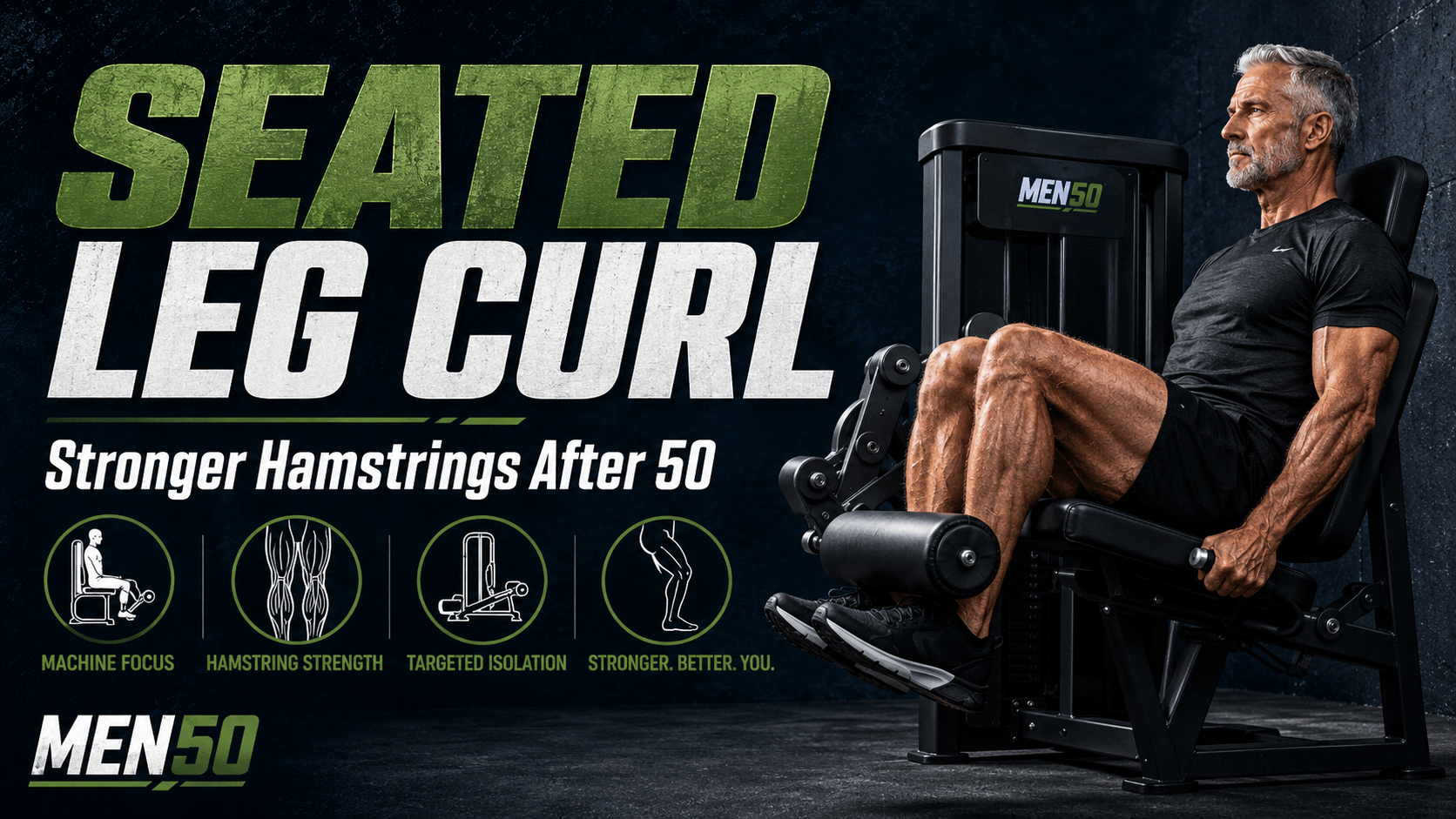
The seated leg curl is the gym-machine hamstring isolation exercise — and it completes the matrix’s quad-hamstring isolation pair alongside the leg extension. For men over 50 specifically, this exercise solves a problem most men don’t know they have: hamstring weakness relative to quad strength. Daily life — walking, climbing stairs, sitting and standing, the leg press — all train the quads constantly. The hamstrings rarely get direct work. Over years, this builds significant quad-hamstring imbalance that contributes to knee instability, hamstring strain risk, and poor lower-body function. The seated leg curl is the most direct fix for this imbalance.
Part of the Build Muscle After 50 pillar — strength training for men over 50.
Key Takeaways
- The seated leg curl is a hamstring isolation exercise — only the knee joint moves, the hamstrings do all the work without help from the glutes or quads.
- It completes the quad-hamstring isolation pair alongside the leg extension — direct training for both sides of the upper leg.
- Programming: 2–4 sets of 8–12 reps, 2–3 times per week. Rest 60–90 seconds between sets.
- Strong hamstrings support your knees, hips, and lower back. Use control, squeeze at the bottom, build strength safely over time.
- Most men over 50 are quad-dominant from daily life and most exercises. The seated leg curl is the most direct fix for the hamstring side of that imbalance.
How to Perform the Seated Leg Curl
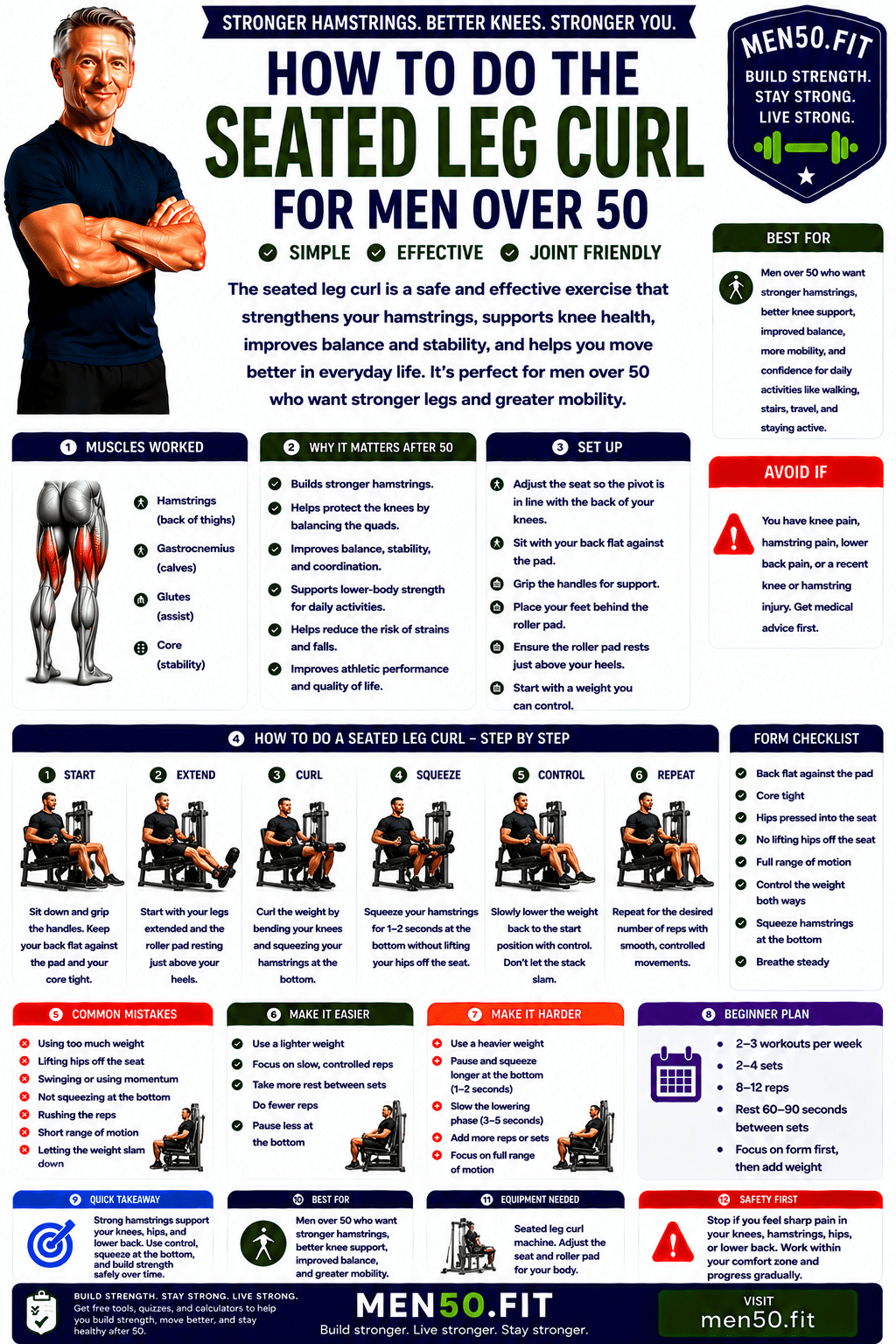
Set up first (machine fit matters significantly here):
- Adjust the seat so the machine’s pivot point is in line with the back of your knees — this is the critical setup detail. If the pivot and knee don’t align, the machine’s lever arm doesn’t match your leg’s lever arm, which creates uneven joint stress.
- Sit with your back flat against the pad — chest up, shoulders down.
- Adjust the roller pad so it rests just above your heels — not on the calves, not on the feet.
- Grip the handles for support and to keep your torso stable.
- Hips pressed into the seat — and they stay there throughout the rep.
- Start with a weight you can control.
Then the movement:
- Start. Sit down and grip the handles. Keep your back flat against the pad and your core tight. Hips pressed firmly into the seat.
- Extend. Start with your legs extended and the roller pad resting just above your heels. Knees nearly (but not fully) straight.
- Curl. Curl the weight by bending your knees and squeezing your hamstrings. Take 1–2 seconds to curl. Lead with the hamstrings, not with momentum.
- Squeeze. Squeeze your hamstrings for 1–2 seconds at the bottom (when the knees are fully bent). Don’t lift your hips off the seat — this is the most common form mistake. The hips stay pressed down throughout the contraction.
- Control. Slowly lower the weight back to the start position with control. Take 2–3 seconds on the return. Don’t let the stack slam — control every rep.
- Repeat. Smooth, controlled movements throughout. Maintain seated position with hips pressed into the seat on every rep.
The cue that matters most: squeeze the hamstrings at the bottom — hips pressed into the seat. Most men over 50 doing leg curls let the hips lift off the seat as the hamstrings fatigue. The lifting hips engage the lower back to compensate and reduce the hamstring work — which means the exercise stops doing its job. Imagine someone is pressing your hips down into the seat throughout the rep. When the hips stay pressed, only the hamstrings can complete the curl.
Why the Seated Leg Curl Matters After 50
The hamstring is one of the most consequential muscle groups for men over 50 — and one of the most under-trained. The hamstrings do critical work:
- Hip extension during walking and stair climbing
- Knee flexion during sitting, kneeling, and squat patterns
- Knee stability — the hamstrings are direct antagonists to the quads
- Hip and lower back support — connects the pelvis and the lower limbs
- Athletic carryover — running, jumping, lateral movement
The Quad-Dominance Problem
Most men over 50 are significantly quad-dominant — meaning their quadriceps are stronger relative to their hamstrings than they should be. Here’s why this happens:
| Activity | Primary Muscle |
|---|---|
| Walking on flat ground | Quads (sustained) |
| Climbing stairs | Quads + glutes |
| Standing up from a chair | Quads |
| Sitting (at desk for hours) | Hip flexors shortened, hamstrings inhibited |
| Bodyweight squat | Quads primary, hamstrings minor |
| Leg press | Quads primary |
| Leg extension | Quads isolated |
Daily life and most exercises load the quads constantly. The hamstrings rarely get direct work. Over months and years, this builds significant strength imbalance.
Why the Imbalance Matters
In healthy young adults, the hamstring-to-quadriceps strength ratio (the H:Q ratio) is typically around 0.6–0.7 — hamstrings about 60–70% as strong as quads. In men over 50 with no specific hamstring training, this ratio often drops to 0.4 or lower.
That imbalance contributes to:
- Knee instability — the hamstrings stabilise the knee against forward shear forces; weakness allows the knee to be less stable
- Hamstring strain risk — weak hamstrings are easier to overload and strain
- Lower back stress — weak hamstrings shift work to the lower back during hip movement
- Poor athletic carryover — sprinting, jumping, and lateral movements all depend on hamstring strength
- Fall risk — hamstrings contribute to balance and ankle stability
Direct hamstring training fixes this imbalance over weeks. The seated leg curl is the most direct tool because it isolates the hamstrings completely — no quad work, no glute help, no compensating muscles.
Why the Seated Version Specifically
The hamstring training in the matrix includes:
- Glute Bridge (hamstrings secondary)
- Single-Leg Glute Bridge (hamstrings secondary)
- Dumbbell Romanian Deadlift (hamstrings primary, but compound)
- Standing Hamstring Curl (isolation, standing/home version)
- Seated Leg Curl (this article — isolation, machine version)
The seated leg curl is the most effective hamstring isolation because:
1. Full hamstring isolation. Unlike the Romanian deadlift (which trains hamstrings + glutes + lower back together), the seated leg curl works only the hamstrings. This means none of the load is absorbed by stronger assistant muscles — every bit goes directly into the hamstrings.
2. Heavier loading than the standing version. The standing hamstring curl is great for home/everyday training but limited in how much load it can apply. The seated version with the weight stack allows significant progressive overload over months.
3. Back-friendly. Unlike Romanian deadlifts (which load the lower back significantly through every rep), the seated leg curl puts no spinal load at all. For men with any back history, this is the safer hamstring exercise.
4. Precise progressive overload. The weight stack allows small increments (5–10 lbs) that the hamstrings can actually absorb.
Position in the Quad-Hamstring Isolation Pair
The seated leg curl completes the upper-leg isolation pair:
| Body Part | Compound Machine | Isolation Machine |
|---|---|---|
| Chest | Machine Chest Press | Pec Deck |
| Quads | Leg Press | Leg Extension |
| Quads + Hamstrings | Leg Press | Leg Extension + Seated Leg Curl |
Same training principle as the chest and quad isolation pairs: compound exercise pairs with isolation to give complete development. For balanced upper-leg training, men over 50 should do both the leg extension AND the seated leg curl — typically with the same number of sets and reps, in the same session. This produces direct quad-hamstring balance over weeks.
Sets and Reps
The seated leg curl is an isolation exercise — moderate rep ranges work better than heavy loading.
| Stage | Sets × Reps | Frequency | Load Guide |
|---|---|---|---|
| Beginner | 2 × 10–12 | 2× per week | Light (20–40 lbs / 9–18 kg) |
| Novice | 2–3 × 8–12 | 2–3× per week | Working (40–60 lbs / 18–27 kg) |
| Intermediate | 3 × 8–12 | 2–3× per week | Moderate (60–80 lbs / 27–36 kg) |
| Advanced | 3–4 × 8–12 | 2–3× per week | Moderate-heavy + pause + slow lowering |
Rest 60–90 seconds between sets. Pick a weight where the last 2–3 reps feel clearly challenging but you can complete them with: back flat, hips pressed into the seat (no lifting), no swinging, full range of motion, controlled tempo both directions.
A practical note: most men over 50 use less weight on the seated leg curl than on the leg extension — typically 60–80% of the leg extension weight. The hamstrings are smaller than the quads and have been under-trained for years in most men over 50. If you leg extend 60 lbs, you’ll probably leg curl 40–50 lbs initially. Don’t try to match your leg extension weight — train the hamstrings where they actually are, then progress them gradually.
Common Mistakes
The seven errors that turn a useful hamstring exercise into a back or knee problem:
- Using too much weight. The single most common mistake on this machine. Heavy weight forces compensation — hips lifting, swinging, half reps, dropped lowering. Drop a size if form breaks down. Hamstring isolation rewards form, not heroic loads.
- Lifting hips off the seat. The defining mistake. As the hamstrings fatigue, the hips want to lift off the seat to recruit the glutes and lower back. This puts the lower back in a vulnerable position and disengages the hamstrings. Hips pressed firmly into the seat throughout — if they lift, the weight is too heavy or the set is over.
- Swinging or using momentum. Kicking the legs into the curl using torso swing or hip drive bypasses the hamstrings. Stay still in the torso; only the lower legs move.
- Not squeezing at the bottom. Rushing through the bottom of the rep skips the most productive contraction. Pause briefly at the bottom with hamstrings squeezed hard — this is where most of the hamstring development happens.
- Rushing the reps. Quick bouncy reps use elastic recoil from the weight stack and the joints. Slow controlled tempo — 1–2 seconds to curl, brief pause at bottom, 2–3 seconds to return.
- Short range of motion. Curling only halfway, or stopping the return before the legs are nearly extended, skips significant working range. Full range — start with legs nearly extended, finish with knees fully bent, return to nearly extended.
- Letting the weight slam down. Dropping the stack at the end of each rep skips the eccentric phase (where significant strength is built) and creates impact loading. Control the return all the way back to the start position.
Make It Easier or Harder
If standard seated leg curl reps are too challenging:
- Use a lighter weight — 15–25 lbs (7–11 kg) is fine for beginners.
- Focus on slow controlled reps — clean reps with light weight train the pattern.
- Take more rest between sets — 90–120 seconds.
- Do fewer reps — start with 2 sets of 6–8 and build up.
- Pause less at the bottom — reduces total time under tension.
To make it harder once form is solid:
- Use a heavier weight — but only when the lighter weight feels easy with clean form.
- Pause and squeeze longer at the bottom — 2–3 seconds with hamstrings fully contracted.
- Slow the lowering phase to 3–5 seconds per rep — significantly more demanding.
- Add more reps or sets — extend to 12–15 reps before adding load.
- Focus on full range of motion — make sure every rep goes from near-extension to full knee bend.
For variety, try the single-leg seated leg curl once a week — one leg at a time, exposes left-right asymmetry, eliminates the stronger side compensating for the weaker. Use significantly lighter weight (~50% of bilateral) for the unilateral version. This is particularly useful because most men over 50 have meaningful hamstring asymmetry from years of one-side-dominant activities.
Safety Note
Avoid the seated leg curl if you have knee pain, hamstring pain, lower back pain, or a recent knee or hamstring injury. Get medical advice first.
Knee pain during the seated leg curl is uncommon (it’s a relatively knee-friendly exercise compared to most leg work) but can occur if (1) the pivot isn’t aligned with the back of your knee — adjust the seat, (2) you’re using too much weight — drop a size, or (3) the roller pad is positioned wrong (on the calf rather than just above the heel). Fix the setup first. If pain persists, see a physiotherapist before continuing.
Hamstring pain during the rep is rare with proper form but worth attention if it occurs. Mild discomfort or “pulling” sensation in the hamstring during the contraction is sometimes the muscle being trained for the first time in years — and it can feel uncomfortable without being injury. Sharp pain in the hamstring, especially at the muscle belly or where the muscle meets the tendon, can indicate strain — stop the exercise and rest.
Lower back pain during the rep almost always means the hips are lifting off the seat — engaging the lower back to compensate for the hamstrings. Press hips firmly into the seat. If you can’t maintain hip contact, the weight is too heavy.
Don’t let the weight stack slam down at the end of a set. Control the legs back to the start position throughout the entire rest stroke.
If you feel sharp pain anywhere during the rep, stop. Mild muscular fatigue in the hamstrings is normal (and welcome — most men over 50 haven’t felt this); sharp joint or muscle-belly pain is not.
Build Your Personal Training Plan
The seated leg curl is one piece of a complete lower-body programme. Get a personalised exercise plan based on your current strength, goals, and any limitations.
Take the Free Fitness Profiler →
FAQs
Seated leg curl vs Romanian deadlift — which is better?
Different exercises that train hamstrings differently. The dumbbell Romanian deadlift is a compound hip-dominant exercise — the hamstrings work alongside the glutes and lower back through hip extension. The seated leg curl is an isolation knee-flexion exercise — only the hamstrings work, through knee bending. Both belong in a complete hamstring programme: the RDL trains the hamstrings the way they actually work in daily life (hip extension while standing); the seated leg curl directly isolates them for maximum hamstring stimulus. For men over 50 with any back history, the seated leg curl is significantly safer than the RDL (no spinal loading). For men with healthy backs, both are valuable — RDL for compound strength, seated curl for direct hamstring development. Neither is “better” overall.
Seated leg curl vs standing hamstring curl — which is better?
For men over 50 with gym access, the seated version is generally more effective — heavier loading possible, more stable position, easier to isolate the hamstrings without compensating with the standing leg. The standing hamstring curl has practical advantages: no gym needed, can be done with a band or ankle weight at home, works one leg at a time (exposes asymmetry). For men with gym access, the seated leg curl is the better default; for men training at home or while travelling, the standing version is fine. Many men over 50 do both — seated curl for primary hamstring training, standing version for variety, asymmetry work, or home training days.
Why is quad-hamstring balance important?
The hamstring-to-quadriceps strength ratio (H:Q ratio) is well-established in sports medicine as an indicator of knee stability and injury risk. Healthy young adults typically have a ratio of 0.6–0.7 — hamstrings about 60–70% as strong as quads. In men over 50 with no specific hamstring training, this ratio often drops to 0.4 or lower because daily life and most exercises load the quads heavily while neglecting the hamstrings. The imbalance contributes to knee instability (the hamstrings stabilise the knee against forward shear forces), hamstring strain risk (weak hamstrings overload more easily), lower back stress (weak hamstrings shift hip work to the back), and poor athletic carryover. Training the hamstrings directly — particularly with the seated leg curl — fixes this imbalance over weeks. For men with any knee issues, restoring the H:Q ratio is one of the most useful things you can do for knee health.
How heavy should the weight be?
Heavy enough that the last 2–3 reps feel clearly challenging, but light enough that you can complete the set with: back flat, hips pressed into the seat, no swinging, full range of motion, controlled tempo. For most men over 50 starting out, 20–40 lbs (9–18 kg) on the weight stack. After 3–6 months of training, many progress to 40–60 lbs (18–27 kg). Advanced lifters often work in the 60–80 lb (27–36 kg) range. Expect to use 60–80% of your leg extension weight — the hamstrings are smaller and have been under-trained for years in most men over 50. If your hips start lifting off the seat, the weight is too heavy regardless of the number.
Why is hamstring training important after 50?
Three specific reasons. (1) Quad-hamstring balance — most men over 50 are significantly quad-dominant (see the FAQ above), which contributes to knee instability and strain risk. Direct hamstring training restores the balance. (2) Knee stability — the hamstrings are direct antagonists to the quads at the knee joint and stabilise against forward shear forces. Strong hamstrings protect the knee, particularly during functional movements like walking down stairs. (3) Lower back support — weak hamstrings shift hip-extension work to the lower back, which contributes to chronic low-grade back pain. Strong hamstrings reduce this load. For men over 50 with any combination of knee issues, hamstring strain history, or chronic back issues, direct hamstring training (seated leg curl + Romanian deadlift) is often one of the most useful interventions in a strength programme.
References
- American College of Sports Medicine. Resistance Training for Older Adults Position Stand. acsm.org
- National Institute on Aging. Sarcopenia and Muscle Strength in Older Adults. nia.nih.gov
- Coombs R, Garbutt G. Developments in the use of the hamstring/quadriceps ratio for the assessment of muscle balance. Journal of Sports Science & Medicine. 2002;1(3):56-62.
Disclaimer: This article is for educational purposes only and is not medical advice. Consult a qualified healthcare professional before starting any new exercise programme, especially if you have existing knee, hamstring, or back conditions.