
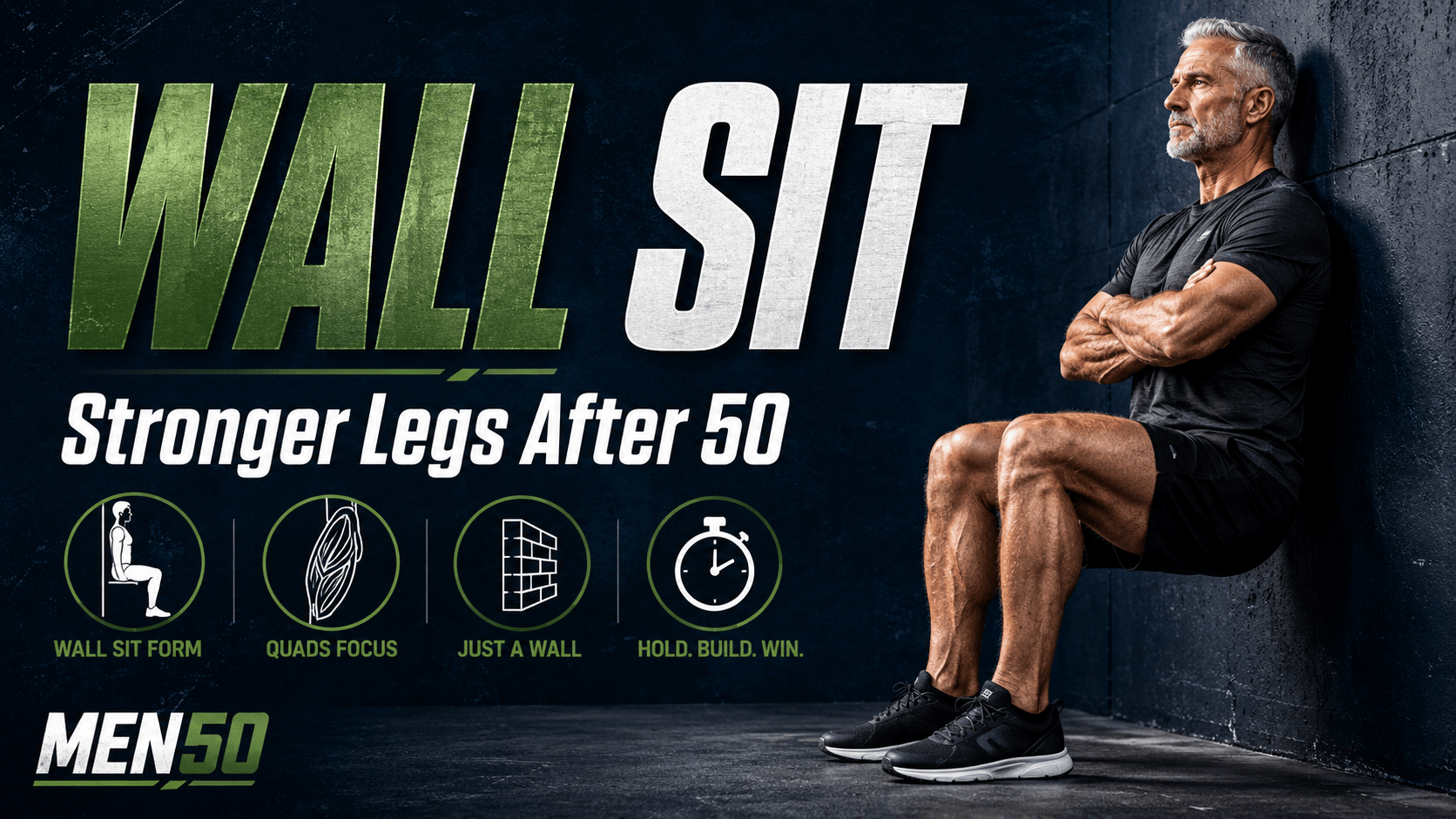
The wall sit is the only true isometric strength exercise in the matrix — a static hold, time-based rather than rep-based, building leg endurance and strength without any equipment. It deserves attention from men over 50 for two specific reasons: it’s knee-friendly in a way that few loaded leg exercises are (back supported, no impact, no momentum), and recent research has identified isometric exercise — wall sits specifically — as one of the most effective forms of exercise for lowering blood pressure. For men over 50 dealing with or at risk for hypertension (which is most men over 50), that second point matters significantly.
Part of the Build Muscle After 50 pillar — strength training for men over 50.
Key Takeaways
- The wall sit is an isometric exercise — a static hold rather than a dynamic rep. The legs work hard without the joints moving.
- It builds the same muscles as the bodyweight squat and leg press — quads (primary), hamstrings, glutes, and core — through sustained tension rather than repeated movement.
- Programming: 2–4 sets of 20–30 seconds, 2–3 times per week. Rest 30–60 seconds between sets.
- Back flat, thighs parallel, knees over toes, weight in heels, breathe steady. Small holds today, stronger legs tomorrow.
- Isometric exercise has unique benefits beyond strength — including research-supported improvements in resting blood pressure.
How to Perform the Wall Sit
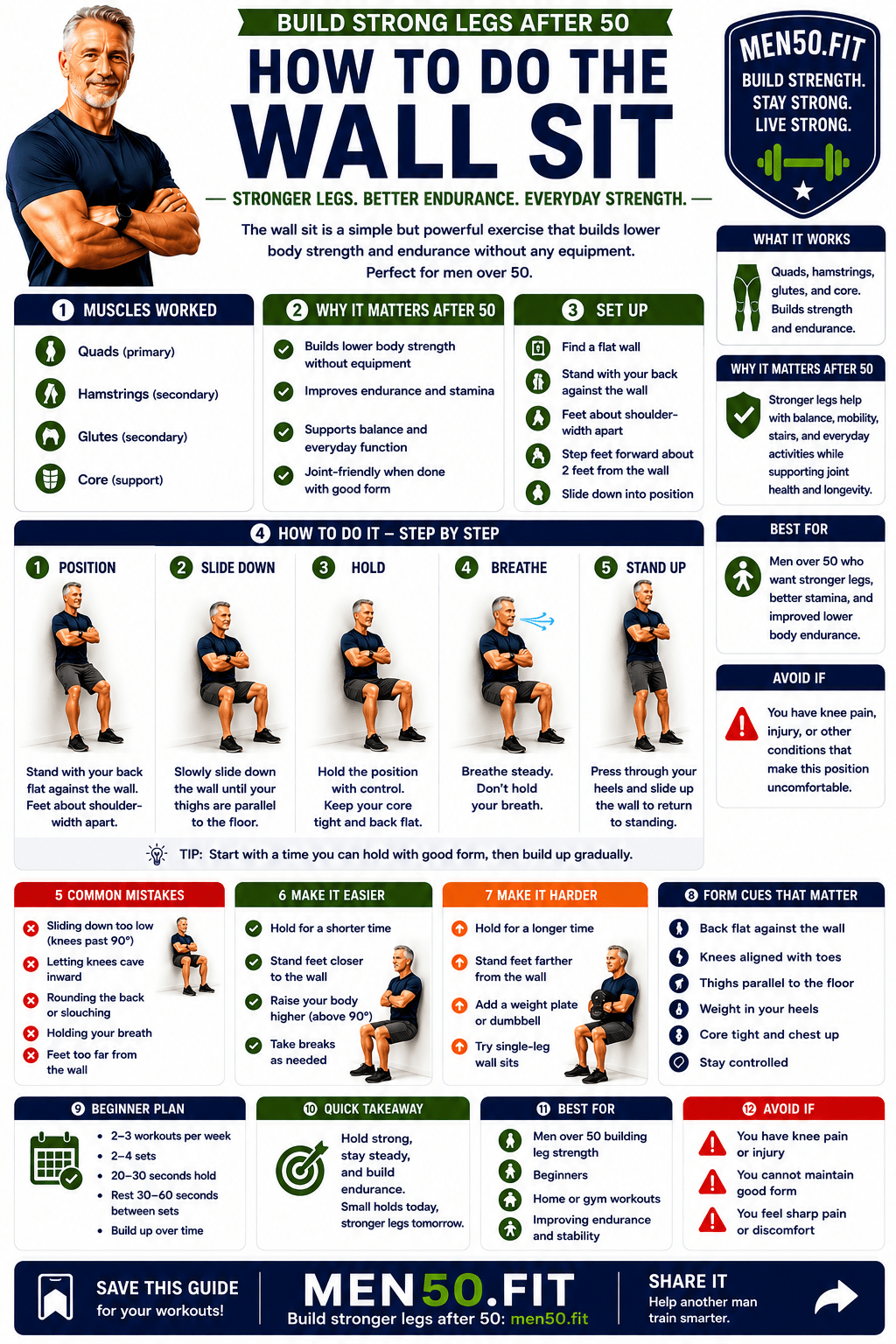
Set up first:
- Find a flat wall with no obstructions for at least 4–5 feet from the surface.
- Stand with your back against the wall, feet about shoulder-width apart.
- Step feet forward about 2 feet from the wall — this distance is critical and you’ll adjust based on your height and leg length.
- Get ready to slide down.
Then the position and hold:
- Position. Stand with your back flat against the wall, feet shoulder-width apart, about 2 feet from the wall.
- Slide down. Slowly slide down the wall until your thighs are parallel to the floor — knees bent at 90 degrees, hips at 90 degrees. Don’t go lower than parallel. Your back stays flat against the wall throughout.
- Hold. Hold the position with control. Keep your core tight and back flat against the wall. Weight should be in your heels, not your toes. Knees aligned with toes (not caving inward).
- Breathe. Breathe steady throughout. Don’t hold your breath. This is critical — breath-holding raises blood pressure significantly during isometric exercise.
- Stand up. When time is up (or before form breaks), press through your heels and slide up the wall to return to standing. Don’t push off your knees with your hands — let the legs do the work.
The cue that matters most: back flat against the wall, weight in the heels, breathe steady. Three things to monitor throughout the hold:
- The wall contact: keep your entire back pressed against the wall — lower back, mid back, and upper back. If the lower back wants to arch away, your core has stopped working.
- Weight in heels: if your weight shifts to the toes, you’re being pulled forward and the knees take more load. Press through the heels to keep weight back.
- Steady breathing: 3–4 seconds in, 3–4 seconds out, sustained through the whole hold. Breath-holding turns this into a Valsalva manoeuvre that spikes blood pressure.
Why the Wall Sit Matters After 50
The wall sit’s training stimulus is completely different from rep-based exercises — and that difference has unique benefits for men over 50:
1. The Blood Pressure Benefit
A 2023 network meta-analysis published in the British Journal of Sports Medicine (Edwards and colleagues) analysed 270 randomised controlled trials covering over 15,000 participants to compare different forms of exercise for blood pressure reduction. The results were unexpected and significant: isometric exercise produced the largest reductions in resting blood pressure — larger than aerobic exercise, larger than dynamic resistance training, larger than HIIT. And the most effective single exercise in the included studies was the wall sit.
The mechanism appears to be that sustained muscle contraction restricts blood flow temporarily, and when the contraction ends and flow resumes, the resulting reactive response improves vascular function over time. For men over 50, where hypertension is extremely common, this matters.
The blood-pressure-focused programming differs from the strength-focused programming in the infographic. For strength and endurance (the standard programme): 20–30 second holds, 2–4 sets, 2–3 times per week. For blood pressure (the research-supported protocol): 2-minute holds at moderate intensity, 4 sets, with 1–2 minutes rest, 3 times per week, sustained over 8+ weeks. Most men over 50 work toward the longer holds gradually over months.
This isn’t a fringe claim. The Edwards et al. (2023) BJSM analysis is being incorporated into emerging exercise guidelines for cardiovascular health. If you have or are at risk for hypertension, the wall sit is uniquely valuable.
2. Knee-Friendly Loading
Most leg exercises load the knees dynamically — the knee bends and straightens repeatedly under load. For men with patellofemoral pain, mild knee arthritis, or any knee history, this can be irritating regardless of form. The wall sit eliminates the knee movement entirely. The quads work hard, but the knee joint stays at a fixed 90-degree angle throughout the hold. There’s no impact, no momentum, no repeated joint loading.
Research on knee rehabilitation specifically uses wall sits and similar isometric exercises as early-phase rehabilitation because the muscle gets trained while the joint is protected. For men over 50 with knee sensitivity who can’t tolerate squats or lunges, the wall sit is often the best-tolerated leg strength exercise in any programme.
3. Endurance vs Strength
The other knee-dominant exercises in the matrix train maximal strength through heavy(ish) loading and 8–12 rep ranges. The wall sit trains strength endurance — the ability of the legs to sustain force production over time. This is the quality used in:
- Standing for long periods (work, parties, travel)
- Walking long distances or hiking
- Climbing many flights of stairs
- Hold positions when carrying loads (squat-holding to pick something up)
Endurance is a different physiological quality than maximal strength, and men over 50 benefit from training both. The wall sit fills the endurance gap in a leg programme dominated by rep-based work.
4. No Equipment Required
Most exercises in the gym-machine cluster require gym access. The wall sit requires only a wall. For men over 50 who travel, train at home, or need a fall-back exercise on days when the gym isn’t available, the wall sit is genuinely universal.
Position in the Knee-Dominant Cluster
The wall sit adds the missing isometric endurance dimension to the comprehensive knee-dominant leg cluster:
| Exercise | Type | Best For |
|---|---|---|
| Sit-to-Stand | Dynamic, regression | Foundation |
| Chair Squat | Dynamic, pattern | Building the squat motion |
| Bodyweight Squat | Dynamic, no load | Pattern + mobility |
| Goblet Squat | Dynamic, loaded | Strength with free weight |
| Leg Press | Dynamic, machine compound | Heavy loading, back-friendly |
| Leg Extension | Dynamic, machine isolation | Direct quad work |
| Wall Sit (this article) | Isometric endurance | Endurance + knee-friendly + blood pressure |
Seven knee-dominant leg exercises covering every loading style — dynamic regressions, dynamic foundations, dynamic loaded, dynamic compound, dynamic isolation, and now isometric. Most fitness content for men over 50 doesn’t include any isometric work. The wall sit fills that gap.
Sets and Reps
The wall sit is time-based, not rep-based — measure progress by hold duration rather than reps.
Strength and Endurance Programme (the default)
| Stage | Sets × Time | Frequency | Rest |
|---|---|---|---|
| Beginner | 2 × 20 seconds | 2× per week | 60 seconds |
| Novice | 2–3 × 30 seconds | 2–3× per week | 45–60 seconds |
| Intermediate | 3 × 45–60 seconds | 2–3× per week | 30–45 seconds |
| Advanced | 3 × 60–90 seconds + load | 2–3× per week | 30 seconds |
Blood Pressure Programme (research-supported)
| Stage | Sets × Time | Frequency | Rest |
|---|---|---|---|
| Working up | 4 × 30–60 seconds | 3× per week | 90 seconds |
| Target | 4 × 2 minutes | 3× per week | 1–2 minutes |
Pick the duration where the last 5 seconds of the hold feel clearly challenging but you can complete them with: back flat, thighs parallel, knees over toes, breathing steady. Build duration gradually — most men over 50 progress from 20-second holds to 60-second holds over 8–12 weeks.
The blood pressure programme is genuinely demanding — 2-minute wall sit holds are tough even for trained men. Build toward this gradually if cardiovascular health is your primary goal. Don’t start at 2 minutes; build there over months.
Common Mistakes
The five errors that turn a useful exercise into a knee or back problem:
- Sliding down too low (knees past 90°). Going lower than parallel (knees bent more than 90 degrees) significantly increases knee compression and pushes the quads past the point where the hold is productive. Thighs parallel to floor — knees at 90 degrees, hips at 90 degrees. Use a mirror or phone video to check your position the first few times.
- Letting knees cave inward. As fatigue sets in, the knees want to drift toward each other (valgus collapse). This stresses the inner knee and ACL/MCL ligaments. Knees aligned with toes throughout — actively press the knees outward to maintain alignment.
- Rounding the back or slouching. When the legs fatigue, the back wants to round forward away from the wall. This breaks the support that makes the wall sit knee-friendly. Back flat against the wall — entire spine in contact. If the lower back arches away, your core has stopped working.
- Holding your breath. The single most consequential mistake — and one men over 50 should avoid carefully. Breath-holding during isometric exercise creates a Valsalva manoeuvre that spikes blood pressure dramatically (the opposite of the chronic benefit). For men with hypertension, this can be genuinely dangerous. Breathe steady throughout — 3–4 seconds in, 3–4 seconds out, sustained through the hold.
- Feet too far from the wall. If the feet are too far forward (knees still bent at 90 degrees but the body is leaning back excessively), weight shifts toward the lower back. If the feet are too close (knees forward of toes), the knees take excessive load. Adjust foot position so that when in the hold, the knees are directly over the ankles — not in front of or behind them.
Make It Easier or Harder
If standard wall sits are too challenging:
- Hold for a shorter time — start with 10–15 seconds and build up gradually.
- Stand feet closer to the wall — easier on the legs, more weight in the back position.
- Raise your body higher (knees at 100–120 degrees rather than 90) — significantly less demanding while you build strength.
- Take breaks as needed — pause mid-set if form starts breaking. Better to do 2x15s with good form than 1x30s with bad form.
To make it harder once form is solid:
- Hold for a longer time — extend toward 60-second, then 90-second holds.
- Stand feet farther from the wall — increases the angle and the quad demand.
- Add a weight plate or dumbbell — hold the weight against your chest or on your thighs during the hold.
- Try single-leg wall sits — lift one foot slightly off the floor; the working leg does all the work. Significantly more demanding even for short holds. Switch legs between sets.
For variety, try the wall sit with calf raise — from the standard hold position, lift the heels off the floor and hold the elevated position. Adds calf work to the leg endurance training.
Safety Note
Avoid the wall sit if you have knee pain, injury, or other conditions that make this position uncomfortable. Get medical advice first.
Knee pain during the wall sit usually means (1) going too deep (knees past 90°), (2) knees caving inward, or (3) feet too close to the wall. Adjust the position first before continuing. Some men with patellofemoral pain actually find the wall sit easier to tolerate than dynamic squats because there’s no knee movement under load — but if the static position causes sharp pain, stop and assess.
Lower back pain during the hold usually means the back is arching away from the wall (core not engaged) or the feet are too close to the wall (forcing the lower back forward). Press the entire back against the wall and adjust foot position.
Light-headedness or dizziness during the hold can occur if you’re holding your breath. This is a serious warning sign — stop the hold immediately, breathe deeply, and recover. The next set, focus deliberately on steady breathing throughout. If light-headedness recurs even with controlled breathing, the wall sit may be aggravating blood pressure issues — consult a doctor before continuing.
High blood pressure considerations: men with uncontrolled or severely elevated blood pressure should not start wall-sit-based programmes without medical clearance. The exercise has been shown to lower blood pressure over time with consistent training, but the acute hemodynamic response during the hold can transiently spike pressure — particularly if you breath-hold. If you have hypertension that isn’t controlled, talk to your doctor before starting.
Sharp pain anywhere during the hold — stop. Mild muscular burning in the quads is normal and expected; sharp joint pain is not.
Build Your Personal Training Plan
The wall sit is one piece of a complete lower-body programme. Get a personalised exercise plan based on your current strength, goals, and any limitations.
Take the Free Fitness Profiler →
FAQs
Wall sit vs squat — which is better?
Different exercises that train legs differently. The bodyweight squat is a dynamic exercise — the knees bend and straighten through full range of motion under load. The wall sit is an isometric exercise — the joints stay at fixed angles while the muscles work continuously. Squats train maximal strength and movement coordination; wall sits train strength endurance and have unique cardiovascular benefits (blood pressure reduction). Most men over 50 benefit from both — squats for primary strength, wall sits for endurance and joint-friendly loading. For men with knee issues that prevent squatting, wall sits often work where squats don’t, because there’s no knee movement under load. Neither is “better” overall — they’re complementary at different stages of a programme.
How long should I hold a wall sit?
Depends on your goal:
- For general strength and endurance: 20–30 seconds per set for beginners, building to 60–90 seconds over months. 2–4 sets, 2–3 times per week.
- For blood pressure improvement specifically (research-supported): build toward 2-minute holds, 4 sets, with 1–2 minutes rest between, 3 times per week. This is genuinely demanding and shouldn’t be attempted by beginners.
- For knee rehabilitation: 10–20 seconds per set is often appropriate, very gradually building duration. Work with a physiotherapist on progression.
Start where your form holds up. If you can do a clean 30-second hold but the 31st second is a slouch, the right duration for you is 30 seconds — not 45 with broken form.
Is the wall sit bad for the knees?
This question gets asked a lot, and the answer is more nuanced than internet opinions usually treat it. Done badly — knees past 90°, knees caving inward, weight on the toes, feet positioned wrong — the wall sit can stress the knee joint significantly. Done well — thighs parallel (not lower), knees aligned with toes, weight in heels, proper foot position — the wall sit is knee-friendlier than most dynamic leg exercises because there’s no movement under load. Research on knee rehabilitation specifically uses wall sits and similar isometric exercises in early-phase rehab because they train the muscle while protecting the joint. For most men over 50 with healthy or mildly compromised knees, the wall sit is genuinely safe. For men with significant knee structural issues (advanced arthritis, recent meniscus tears), consult a physiotherapist first.
Can I do this every day?
Light wall sits — yes, daily practice is fine and supported by research. The recent isometric exercise blood-pressure research used 3x weekly programmes, but daily light wall sit practice (20–30 seconds, 1–2 sets) is well-tolerated and produces meaningful endurance development. Heavy wall sits (60+ seconds, multiple sets) need recovery time — 48 hours between hard sessions. Most men over 50 do well with 2–3 dedicated wall-sit sessions per week plus occasional light daily practice (one 20-second hold while waiting for coffee to brew, for example).
Do wall sits really lower blood pressure?
According to current research, yes — and significantly. The 2023 Edwards et al. network meta-analysis in British Journal of Sports Medicine analysed 270 randomised controlled trials and found isometric exercise (with wall sits as a primary form studied) produced the largest reductions in resting blood pressure among all exercise types studied — including aerobic exercise, dynamic resistance training, and HIIT. The protocol used in many of the included trials: 4 sets of 2-minute wall sit holds, 3 times per week, sustained over 8+ weeks. This isn’t a small claim — it’s based on a high-quality meta-analysis of well-designed trials, and it’s beginning to influence exercise guidelines for cardiovascular health. For men over 50 with hypertension or at risk for it (which is most men over 50), the wall sit may be one of the most directly useful exercises in the matrix. Note: this doesn’t replace blood pressure medication if it’s been prescribed — work with your doctor on integration. But as a non-pharmaceutical complement, the evidence is genuinely strong.
References
- Edwards JJ, Deenmamode AHP, Griffiths M, et al. Exercise training and resting blood pressure: a large-scale pairwise and network meta-analysis of randomised controlled trials. British Journal of Sports Medicine. 2023;57(20):1317-1326.
- American College of Sports Medicine. Resistance Training for Older Adults Position Stand. acsm.org
- National Institute on Aging. Sarcopenia and Muscle Strength in Older Adults. nia.nih.gov
Disclaimer: This article is for educational purposes only and is not medical advice. Consult a qualified healthcare professional before starting any new exercise programme, especially if you have existing knee conditions, hypertension, or other relevant medical conditions.