
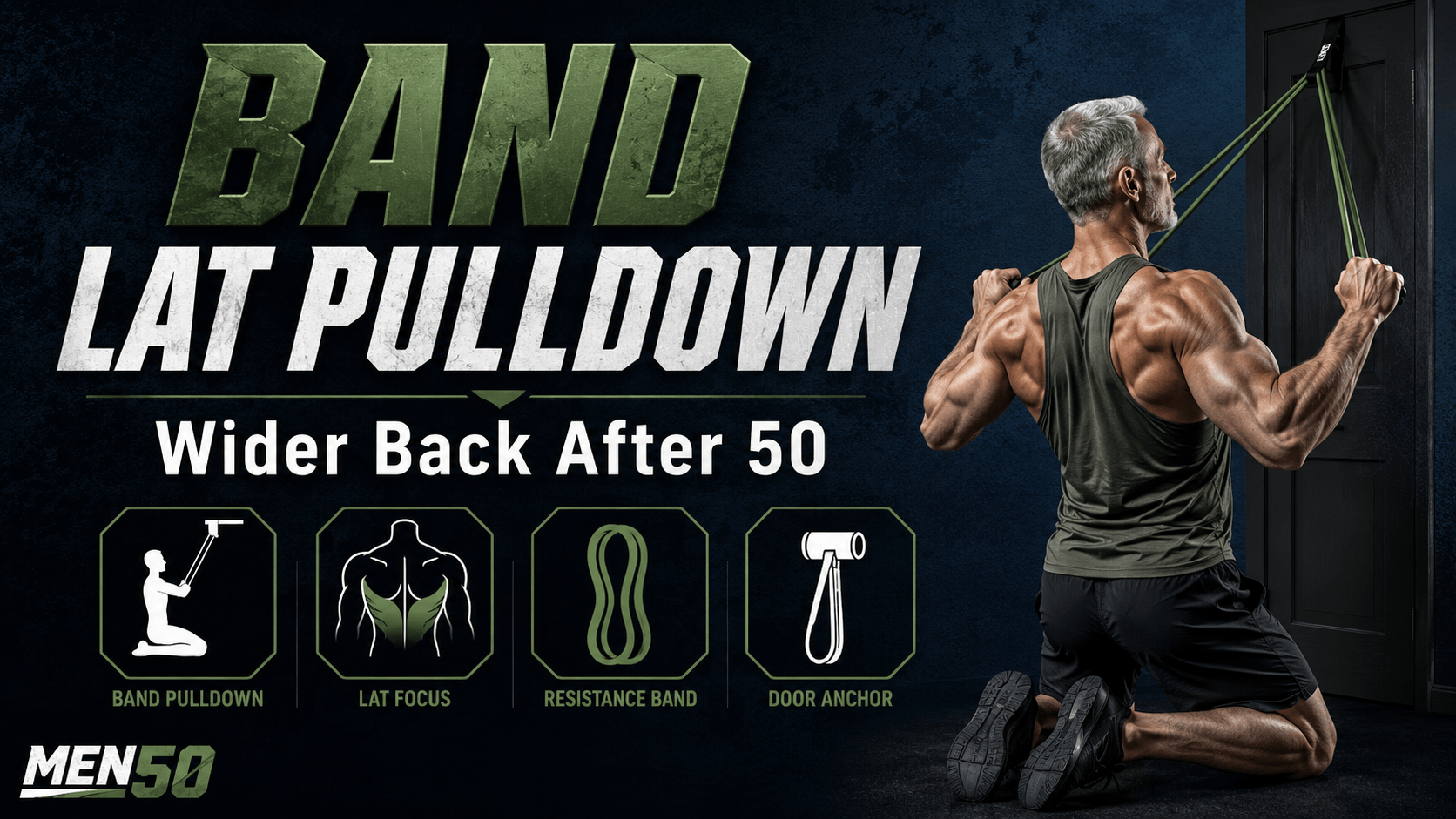
The band lat pulldown is the first vertical pulling exercise in the men50.fitness matrix — and that matters. Rows (the horizontal pulling exercises) train the rhomboids and mid-back. Vertical pulling — pulling things down from overhead, or pulling yourself up — trains the lats, the broad muscles on the sides of the back that create the V-taper shape and handle every overhead pulling movement in daily life. Most men over 50 can’t do pull-ups yet, and most don’t have a lat pulldown machine at home. The band version solves both problems: it trains the lats specifically, with light equipment, in any room with a door.
Part of the Build Muscle After 50 pillar — strength training for men over 50.
Key Takeaways
- The band lat pulldown directly trains the latissimus dorsi (lats) — the broad back muscles that compound rowing exercises only train as a secondary muscle.
- It’s the vertical pulling companion to the horizontal pulling exercises (rows, band rows, chest-supported rows) — both planes belong in a complete back programme.
- Programming: 2–4 sets of 8–15 reps, 2–3 times per week. Rest 45–75 seconds between sets.
- Pull with your elbows, squeeze your lats, and control the band on the way up. Consistency builds a stronger back.
- This is the fifth piece of the band-based home training system — pair with band pull-aparts, band rows, band chest presses, and band triceps pressdowns for complete upper-body coverage with one band kit.
How to Perform the Band Lat Pulldown
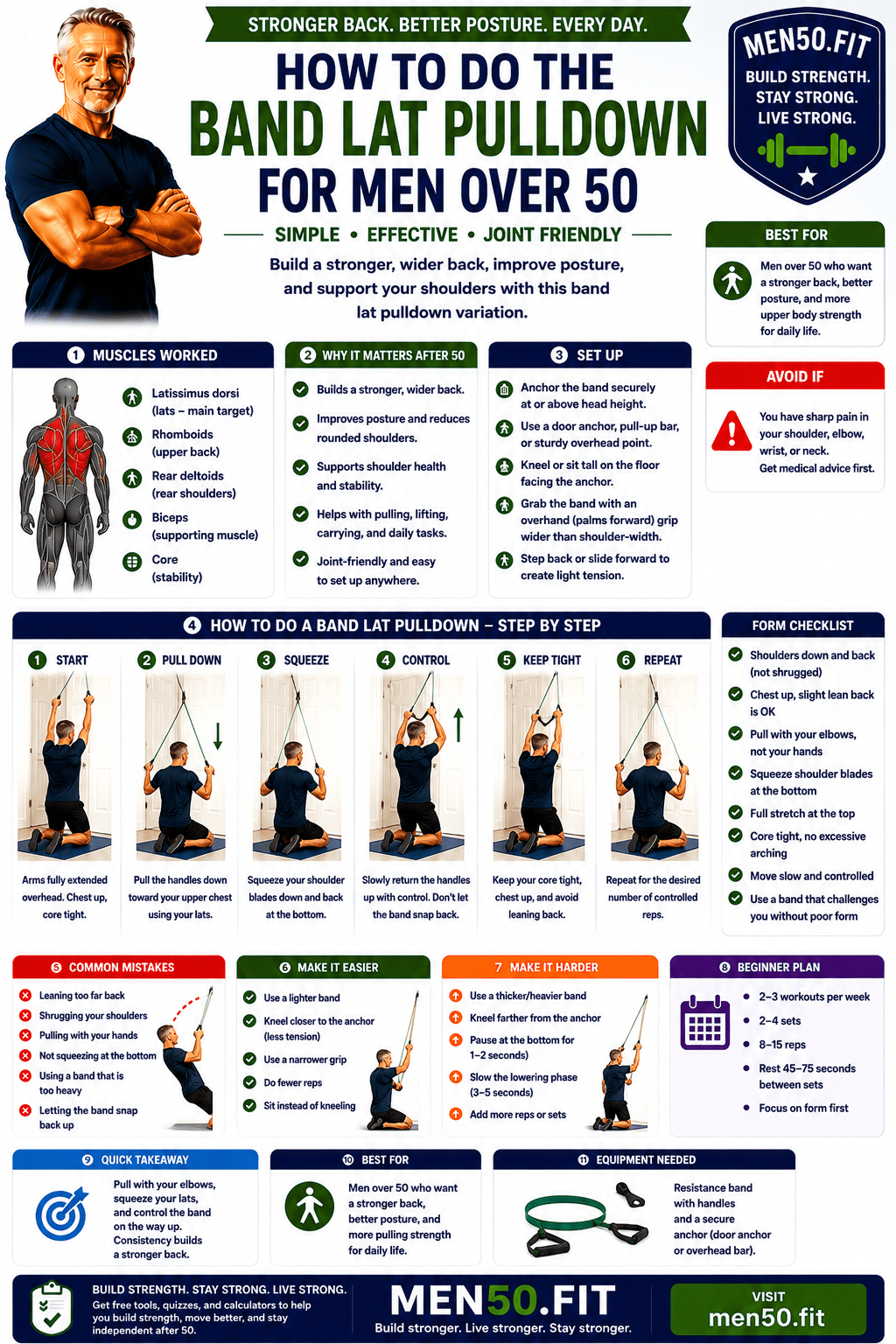
Set up first:
- Anchor the band securely at or above head height — a door anchor (with the door closed and locked), a pull-up bar, or a sturdy overhead point rated for resistance training.
- Kneel or sit tall on the floor facing the anchor.
- Grab the band with an overhand grip (palms facing forward), hands slightly wider than shoulder-width apart.
- Step back or slide forward to create light tension at the starting position.
Then the movement:
- Start. Arms fully extended overhead, chest up, core tight. There should be some tension in the band — not slack.
- Pull down. Pull the handles down toward your upper chest using your lats. Lead with your elbows; the hands go along for the ride. Take 1–2 seconds on the way down.
- Squeeze. At the bottom, with the handles near your upper chest, squeeze your shoulder blades down and back. Feel the lats engage on both sides.
- Control. Slowly return the handles overhead with control. Take 2–3 seconds on the way up. Don’t let the band snap back — the return phase is where most of the strength gets built.
- Keep tight. Throughout every rep, keep your core engaged, chest up, and avoid leaning back excessively. A slight lean back (10–15 degrees) is fine; leaning to 45 degrees is using the body, not the lats.
- Repeat. Maintain clean form on every rep. Smooth, controlled, with the lats genuinely doing the work.
The cue that matters most: pull with your elbows, not your hands. If you focus on dragging the elbows down and back toward your sides, the lats fire properly. If you focus on the hands, the biceps take over and the lats barely engage.
Why the Band Lat Pulldown Matters After 50
The latissimus dorsi (lats) are the largest muscles in your back. They run from the lower spine up to the upper arm, fanning across the back like a pair of wings. The lats are responsible for pulling things down from overhead (reaching up and pulling down) and for pulling the body upward when you grip something above your head (think pull-up motion).
In daily life, you use the lats for: pulling clothes off a high shelf, hoisting yourself out of a swimming pool, reaching up to grab a railing, pulling open a heavy garage door, and the climbing-style motions that come up surprisingly often. Without direct training, the lats are one of the muscle groups that decline noticeably after 50.
There’s a critical distinction between horizontal and vertical pulling that most men over 50 don’t realise:
Horizontal pulling (rows — pulling things toward your torso from in front of you):
- Primary muscles: rhomboids, mid-traps, rear deltoids
- Examples: Dumbbell row, resistance band row, chest-supported dumbbell row
- Trains: mid-back, posture between the shoulder blades
Vertical pulling (pulldowns — pulling things down from overhead):
- Primary muscles: lats
- Examples: pull-ups, lat pulldowns, band lat pulldown
- Trains: the broad muscles down the sides of the back
These are different exercises that train different parts of the back. A complete back programme needs both. Most men over 50 do plenty of rowing (horizontal pulling) and zero pulldowns (vertical pulling) — which leaves the lats underdeveloped and contributes to incomplete back strength.
The band lat pulldown is the most accessible vertical pulling option. Pull-ups require enough relative strength to lift your entire body — most men over 50 can’t do them (and many shouldn’t try without significant preparation). Lat pulldown machines require a gym. Bands need only an overhead anchor — a door anchor on a closed door works perfectly. And like all band exercises, you can scale the tension by adjusting your distance from the anchor or changing band thickness.
There’s also a shoulder health angle. The lats contribute to shoulder joint stability during overhead motion. Strong lats help control the descent when you lower something from overhead, which protects against the eccentric-loading injuries (the “I just lowered something and felt a twinge”) that account for many shoulder problems in men over 50.
Push-pull balance continues to apply: for every set of pressing exercises, do equivalent pulling. The band lat pulldown adds a new dimension to that pulling work — vertical, not just horizontal — and rounds out the upper-body training.
Sets and Reps
Like all band-based back exercises, tolerates higher rep ranges than dumbbell or barbell variations because the resistance is variable and joint-friendly.
| Stage | Variation | Sets × Reps | Frequency |
|---|---|---|---|
| Beginner | Light band, sit close to anchor | 2 × 8–10 | 2× per week |
| Novice | Light or medium band, standard distance | 3 × 10–15 | 2–3× per week |
| Intermediate | Medium band, slow return | 3 × 12–15 | 2–3× per week |
| Advanced | Heavier band, pause at the bottom | 3–4 × 10–15 | 2–3× per week |
Rest 45–75 seconds between sets. Pick a band tension where the last 2–3 reps feel clearly challenging but you can complete them with: shoulders down and back, no excessive lean, elbows leading the pull, controlled return.
Adjust tension by distance from anchor: kneel farther from the anchor to add tension; closer to reduce it. This makes the band lat pulldown one of the easiest exercises to fine-tune without changing equipment. Stepping back 12 inches noticeably increases the difficulty.
Common Mistakes
The six errors that turn a great lat exercise into a momentum exercise:
- Leaning too far back. A slight lean back (10–15 degrees) is fine and even helpful for engaging the lats. Leaning to 45 degrees means you’re using your bodyweight to “throw” the handles down, not pulling them with your lats. Stay roughly upright; chest up, core engaged.
- Shrugging your shoulders. As the handles come down, the upper traps want to lift the shoulders toward the ears. Pin the shoulders down and back before each rep and consciously keep them there. Shrugged shoulders mean you’re training the traps and neck, not the lats.
- Pulling with your hands. Focusing on moving the hands recruits the biceps as the primary mover. The lats become a secondary muscle. Lead with the elbows — drive them down and toward your sides. The hands follow.
- Not squeezing at the bottom. Rushing through the bottom position without consciously contracting the lats wastes the most productive moment of the rep. Pause briefly at the bottom and squeeze the lats hard — feel them work.
- Using a band that is too heavy. Heavy bands force compensation — excessive leaning, shrugging, jerky pulls. Drop a size and rebuild with clean form. A light band done properly trains the lats more than a heavy band done with momentum.
- Letting the band snap back up. The return phase is where most of the strength gets built. Take 2–3 seconds on the way up. Don’t let the band rip the handles out of control.
Make It Easier or Harder
If standard band lat pulldowns are too challenging:
- Use a lighter band — most band kits include several tensions.
- Kneel closer to the anchor to reduce starting tension.
- Use a narrower grip — slightly easier than a wide grip for most men.
- Do fewer reps — start with 2 sets of 6–8 and build up.
- Sit instead of kneeling — sitting on the floor with legs extended gives a more stable base than kneeling.
To make it harder once form is solid:
- Use a thicker/heavier band — but only when the lighter band feels easy with clean form.
- Kneel farther from the anchor — adds tension without changing equipment.
- Pause at the bottom for 1–2 seconds with shoulder blades squeezed.
- Slow the lowering (return) phase to 3–5 seconds per rep.
- Add more reps or sets — extend sets to 15–20 reps before adding band tension.
For variety, try the single-arm band lat pulldown (one handle at a time) — exposes left-right imbalances and lets you focus on each lat individually. Use lighter tension; single-arm work is more demanding than it looks.
Safety Note
Anchor safety is critical. A band snapping free under tension while you’re pulling down from overhead can hit your face or eyes. Use a proper door anchor with the door closed and locked from the opposite side, a pull-up bar rated for resistance training loads, or a wall-mounted hook designed for the purpose. Inspect bands periodically for nicks or wear. If you can’t anchor safely, skip this exercise — there’s no good way to do a vertical pulldown without a secure overhead anchor.
If you feel sharp pain in your shoulder, elbow, wrist, or neck during the pulldown, stop. Adjust grip width, reduce band tension, or check that you’re not shrugging. The lat pulldown puts the shoulder in an overhead position briefly at the start of each rep — men with current shoulder impingement or rotator cuff issues should consult a physiotherapist before doing overhead pulling work.
If you’ve never trained your lats before, expect some soreness in the sides of the back (just below the armpits and down the rib cage) the day after your first few sessions. This is normal and fades within a couple of weeks of consistent training.
Build Your Personal Training Plan
The band lat pulldown is one piece of a complete upper body programme. Get a personalised exercise plan based on your current strength, goals, and any limitations.
Take the Free Fitness Profiler →
FAQs
Band lat pulldown vs pull-up — what’s the difference?
Both are vertical pulling exercises that train the lats — but the band lat pulldown is dramatically more accessible. Pull-ups require you to lift your entire bodyweight, which most men over 50 simply can’t do (and shouldn’t try without significant preparation). They also require a sturdy bar that costs more than a band kit. The band lat pulldown scales to any strength level — light band for beginners, heavier band as you progress. For most men over 50, the band version is genuinely sufficient for lat development. If you eventually want pull-ups, band lat pulldowns are an excellent training step toward them.
What anchor point works best for this exercise?
The best options are: a door anchor on a closed door (use the side that opens away from you so band tension pulls the door more firmly closed); a pull-up bar mounted in a doorway or wall; or a wall-mounted resistance training hook. The anchor should be at or above head height — high enough that the band pulls downward against you when you’re kneeling or sitting. Don’t use anything that might pull free under tension. If your only available anchor is at chest height, do resistance band rows instead — rows can use a chest-height anchor; pulldowns need overhead.
Why isn’t a row enough to train the back?
Because rows and pulldowns train different parts of the back. Rows are horizontal pulling — they primarily train the rhomboids, mid-traps, and rear deltoids (the muscles between and around the shoulder blades). The lats — the broad muscles down the sides of the back — are involved in rows but only as a secondary muscle. To train the lats as the primary muscle, you need vertical pulling (pulldowns or pull-ups). A complete back programme includes both planes. Most men over 50 with strong rowing routines and no pulldowns have under-developed lats.
How do I know if I’m using the right band tension?
The right tension lets you complete your full rep range with clean form — shoulders down, no excessive lean, elbows leading the pull, controlled return — but the last 2–3 reps feel clearly challenging. If you can rip through 15 reps without effort, the band is too light. If you can’t hit 10 with clean form, it’s too heavy. The simplest adjustment: if the band feels too heavy, kneel closer to the anchor. If it feels too light, kneel farther back. You can fine-tune intensity without changing bands.
Should I kneel or sit?
Either works. Kneeling is the standard position — knees on the floor, hips upright, torso tall. This gives you stability and lets you use both lower legs as a base. Sitting on the floor with your legs extended in front of you is more stable still, removes any balance demand, and is the easier option if your knees don’t tolerate kneeling. Most men over 50 do well with one or the other based on knee comfort. Both train the lats equally; pick what feels right for your body.
References
- Janda V. Muscles, Central Nervous Motor Regulation and Back Problems. In: Korr IM (ed). The Neurobiologic Mechanisms in Manipulative Therapy. Plenum Press; 1978. (Upper Crossed Syndrome framework.)
- American College of Sports Medicine. Resistance Training for Older Adults Position Stand. acsm.org
- National Institute on Aging. Sarcopenia and Muscle Strength in Older Adults. nia.nih.gov
Disclaimer: This article is for educational purposes only and is not medical advice. Consult a qualified healthcare professional before starting any new exercise programme, especially if you have existing shoulder, elbow, wrist, or back conditions.