
The hammer curl is the more functional cousin of the standard biceps curl — and for many men over 50, the better choice. The neutral grip (palms facing in) shifts the work away from the biceps brachii and onto the brachialis (the muscle underneath the biceps) and the brachioradialis (the top of the forearm). It’s also significantly easier on the elbow and wrist joints than a supinated curl. If you’ve ever tried biceps curls and had elbows complain, the hammer curl is usually the version that lets you keep training.
Part of the Build Muscle After 50 pillar — strength training for men over 50.
Key Takeaways
- The hammer curl trains the brachialis, brachioradialis, biceps, and grip muscles — more thoroughly than the standard biceps curl.
- The brachialis is technically the strongest pure elbow flexor in your arm. Training it directly with hammer curls builds more functional pulling strength than biceps curls alone.
- Programming: 2–4 sets of 8–12 reps, 2–3 times per week. Rest 45–75 seconds between sets.
- Keep your grip neutral, move with control, and build stronger arms one rep at a time. Quick takeaway, exactly the right principle.
- The neutral grip is genuinely gentler on wrists and elbows than a supinated curl — useful for men with mild elbow tendinopathy or wrist issues.
How to Perform the Hammer Curl
Set up first:
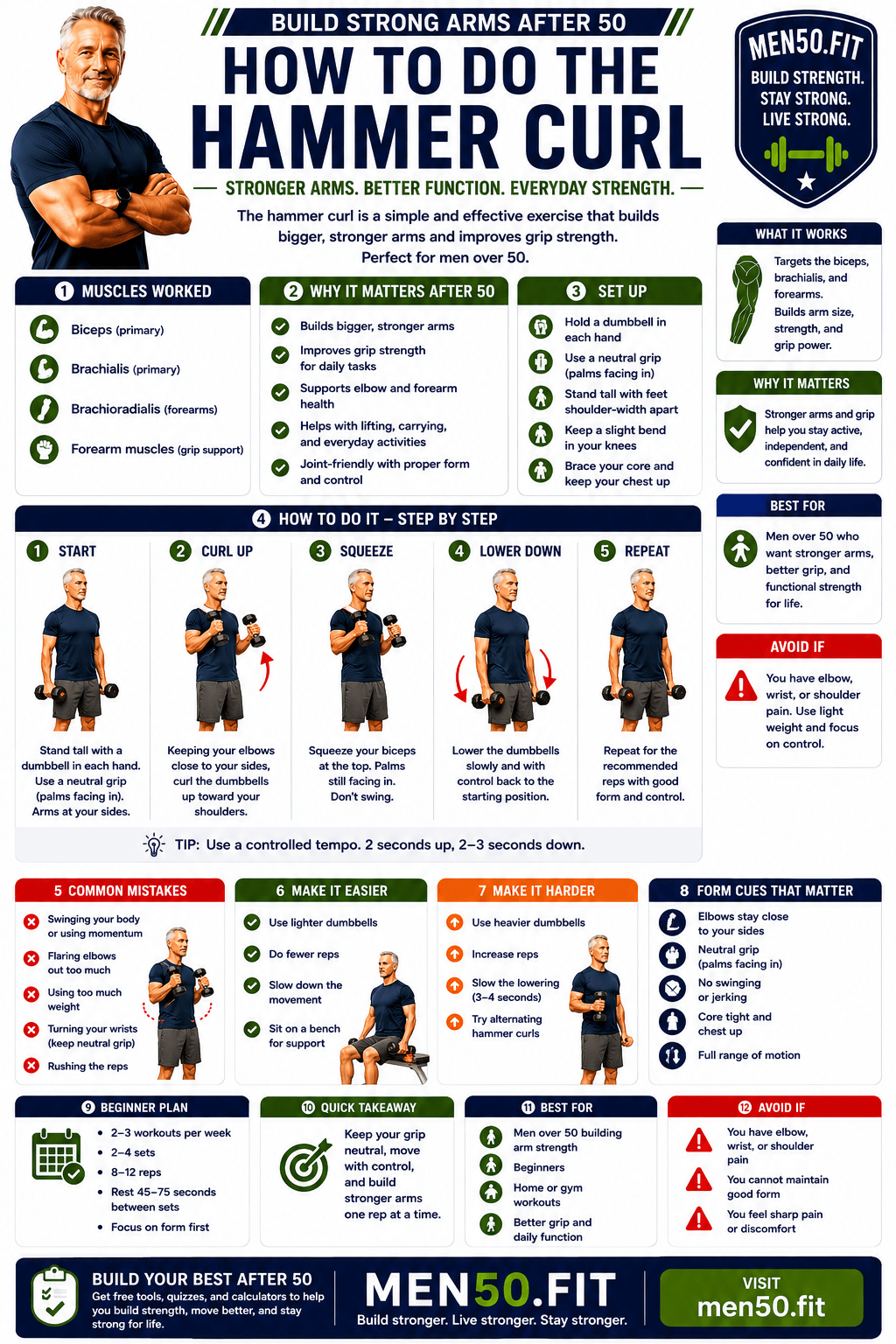
- Hold a dumbbell in each hand using a neutral grip (palms facing in toward your thighs, thumbs pointing forward).
- Stand tall with feet shoulder-width apart.
- Keep a slight bend in your knees.
- Brace your core and keep your chest up.
Then the movement:
- Start. Stand tall with a dumbbell in each hand. Arms relaxed at your sides. Palms face in toward your thighs. Grip the dumbbells firmly but don’t crush them.
- Curl up. Keeping your elbows close to your sides, curl the dumbbells up toward your shoulders. Maintain the neutral grip throughout — palms continue to face in (toward each other) as the dumbbells rise.
- Squeeze. Pause briefly at the top with the dumbbells near your shoulders. Squeeze the muscles in the front of your upper arm. Palms still face in. Don’t swing.
- Lower down. Slowly lower the dumbbells back to the starting position. Take 2–3 seconds on the way down — this is where most of the strength gets built.
- Repeat. Maintain clean form on every rep. Five clean hammer curls do more than fifteen sloppy ones.
The cue that matters most: keep your grip neutral, move with control, and build stronger arms one rep at a time. The neutral grip is what makes this exercise different — turning the wrist or letting the palm rotate up at the top turns it back into a standard biceps curl with all the elbow stress that comes with it.
Why the Hammer Curl Matters After 50
Most men know the biceps brachii — the muscle that pops out when you flex your arm. Fewer know about the brachialis, which sits underneath the biceps and is technically the strongest pure elbow flexor in your arm. The biceps gets more attention because it’s visible from the front; the brachialis matters more for actual pulling strength. The hammer curl trains the brachialis directly because the neutral grip removes the biceps’ mechanical advantage and forces the brachialis to do more of the work.
There’s also the brachioradialis — the muscle running along the top of your forearm from the elbow to the wrist. It’s the muscle you see flex when someone holds a hammer or carries a heavy suitcase. The hammer curl is one of the most efficient exercises for training it. Combined with the brachialis work, this gives the hammer curl more comprehensive arm development than the standard biceps curl.
The grip strength angle is the same one we’ve covered across the farmer’s carry and dumbbell row articles. The 2015 PURE study by Leong and colleagues found that grip strength predicted all-cause mortality and cardiovascular events more strongly than systolic blood pressure across 140,000 adults in 17 countries. Hammer curls train grip in the same gripping-from-above pattern you use to carry tools, hold a hammer, or lift a briefcase by the handle. That functional carryover is direct.
The other genuine reason to choose hammer curls over biceps curls: they’re easier on the joints. The neutral grip removes the wrist supination (palm rotated up) that aggravates wrist tendons and elbow tendons in men with even mild tendinopathy. For men with a history of tennis elbow, golfer’s elbow, or wrist arthritis, the hammer curl is often the only direct arm-flexion exercise they can do without irritation.
Sets and Reps
Moderate load, controlled tempo, clean reps. The hammer curl isn’t where to chase heavy weight.
| Stage | Sets × Reps | Frequency | Load Guide |
|---|---|---|---|
| Beginner | 2 × 8–10 | 2× per week | Light dumbbells, focus on form |
| Novice | 2–3 × 8–12 | 2–3× per week | Moderate, last 2 reps challenging |
| Intermediate | 3 × 8–12 | 2–3× per week | Working weight, RPE 7–8 |
| Advanced | 3–4 × 8–12 | 2–3× per week | Heavier, slow lowering, pause at top |
Rest 45–75 seconds between sets. Pick a weight where the last 2–3 reps feel clearly challenging but you don’t need to swing your body, flare your elbows, or turn your wrists to complete them.
A practical starting load: most men over 50 begin with 10–20 lb (4.5–9 kg) dumbbells. After 3–6 months of training, many men progress to 20–30 lbs (9–14 kg). Don’t rush the load — slow controlled reps with lighter dumbbells build more strength than heavy reps with swinging.
You can usually use slightly heavier dumbbells for hammer curls than for biceps curls because the brachialis and brachioradialis assist more effectively in the neutral grip position. Most men find their working hammer curl weight is 2–5 lbs heavier than their working biceps curl weight.
Common Mistakes
The five errors that turn a great exercise into a wasted one:
- Swinging your body or using momentum. Rocking forward and back to launch the dumbbells up turns the curl into a swing. The arm muscles barely fire; the lower back takes the load. If you can’t lift the weight without swinging, drop a size and use control.
- Flaring elbows out too much. As fatigue sets in, the elbows want to drift outward. Keep them pinned to your sides throughout — they shouldn’t move forward, backward, or out. If elbows drift, the front shoulders take over the lift.
- Using too much weight. The most common mistake by far. Heavier dumbbells don’t make stronger arms when they force you to compensate with momentum and poor form. Lighter weight with clean tempo builds more strength.
- Turning your wrists. Rotating the palm up at the top of the rep (supinating the wrist) turns the hammer curl back into a standard biceps curl. Keep the palms facing in (toward each other) throughout every rep. This is the entire reason for choosing the hammer version — protect it.
- Rushing the reps. Speed lets you cheat. Slow tempo — 2 seconds up, 2–3 seconds down — forces the brachialis and brachioradialis to do the work properly.
Make It Easier or Harder
If standard hammer curls are too challenging:
- Use lighter dumbbells — 5–10 lbs (2–4.5 kg) is fine to start. Strength is built from where you are.
- Do fewer reps — start with 2 sets of 6–8 reps and build from there.
- Slow down the movement — counterintuitively, slower can sometimes feel harder because momentum disappears, but it removes the compensations that make heavy lifting easier.
- Sit on a bench for support — removes the temptation to use the legs and lower back to help, and lets you focus on arm form.
To make hammer curls harder once form is solid:
- Use heavier dumbbells — but only when the lighter weight feels easy with clean form.
- Increase reps — extend the working set to 12–15 reps with the same weight.
- Slow the lowering phase to 3–4 seconds per rep.
- Try alternating hammer curls — one arm at a time, alternating, which keeps tension on one side while the other lowers. Adds time under tension and exposes left-right imbalances.
For variety once standard form is solid, try the cross-body hammer curl — curl one dumbbell across your body toward the opposite shoulder. Hits the brachialis slightly differently and adds some core anti-rotation work.
Safety Note
If you feel sharp pain in the elbow, wrist, or shoulder during the hammer curl, stop. Mild muscular fatigue in the arms is normal; sharp joint pain is not. Adjust the weight first — heavier dumbbells are the most common cause of elbow irritation in curl variations.
Men with lateral epicondylitis (tennis elbow) or medial epicondylitis (golfer’s elbow) often tolerate hammer curls better than supinated biceps curls because the neutral grip reduces forearm tendon load. But if pain persists with hammer curls too, drop to very light weights or pause direct arm work entirely for 2–3 weeks to let the tendons settle. The band pull-apart and resistance band row still train the arms indirectly with much less elbow load.
If you cannot maintain good form — body still, elbows pinned, wrist neutral — the weight is too heavy. Drop a size before continuing.
Build Your Personal Training Plan
The hammer curl is one piece of a complete upper body programme. Get a personalised exercise plan based on your current strength, goals, and any limitations.
Take the Free Fitness Profiler →
FAQs
Hammer curl vs biceps curl — which is better?
Different exercises, different purposes. The biceps curl emphasises the biceps brachii specifically — the muscle that creates the visible bicep peak. The hammer curl emphasises the brachialis and brachioradialis — the muscles underneath the biceps and along the forearm that contribute more to functional pulling strength. For men over 50, the hammer curl is typically more functional and joint-friendly, but most well-designed programmes include both. Many men do biceps curls one session per week and hammer curls another.
Are hammer curls easier on the elbows?
For most men, yes. The neutral grip (palms in) removes the wrist supination of a standard biceps curl, which reduces strain on the forearm tendons and the elbow joint itself. Men with mild elbow tendinopathy (tennis elbow or golfer’s elbow) often tolerate hammer curls well after biceps curls have started aggravating them. But “easier on the elbows” doesn’t mean “always painless” — if you have moderate-to-severe tendinopathy, even hammer curls may need to wait until the tendons settle.
How heavy should the dumbbells be?
Heavy enough that the last 2–3 reps feel clearly challenging, light enough that you can do them with clean form — body still, elbows pinned, wrist neutral. For most men over 50 starting out, that’s 10–20 lbs (4.5–9 kg) per hand. After 3–6 months of training, many men progress to 20–30 lbs (9–14 kg). You’ll usually be able to handle slightly heavier hammer curls than standard biceps curls because the neutral grip recruits more muscle.
Should I alternate arms or curl both at once?
Both work. Curling both arms together is more time-efficient. Alternating (curl right, lower, curl left, lower) keeps continuous tension on the resting arm and lets you focus on form one side at a time. Most men over 50 benefit from rotating between the two — both arms together one session, alternating the next. If one arm is clearly weaker, alternating helps the weaker side catch up because you’re doing the same work on each side.
Can I do hammer curls and biceps curls in the same session?
Yes — they’re complementary, not competing. A common pairing: 3 sets of hammer curls, then 2 sets of standard biceps curls, all in one session. Or alternate: hammer curls one workout, biceps curls the next. Don’t do extensive direct arm work more than 2–3 times per week, regardless of which variation — the small muscles need recovery time.
References
- Leong DP, Teo KK, Rangarajan S, et al. Prognostic value of grip strength: findings from the Prospective Urban Rural Epidemiology (PURE) study. The Lancet. 2015;386(9990):266-273.
- American College of Sports Medicine. Resistance Training for Older Adults Position Stand. acsm.org
- National Institute on Aging. Sarcopenia and Muscle Strength in Older Adults. nia.nih.gov
Disclaimer: This article is for educational purposes only and is not medical advice. Consult a qualified healthcare professional before starting any new exercise programme, especially if you have existing elbow, wrist, or shoulder conditions.