
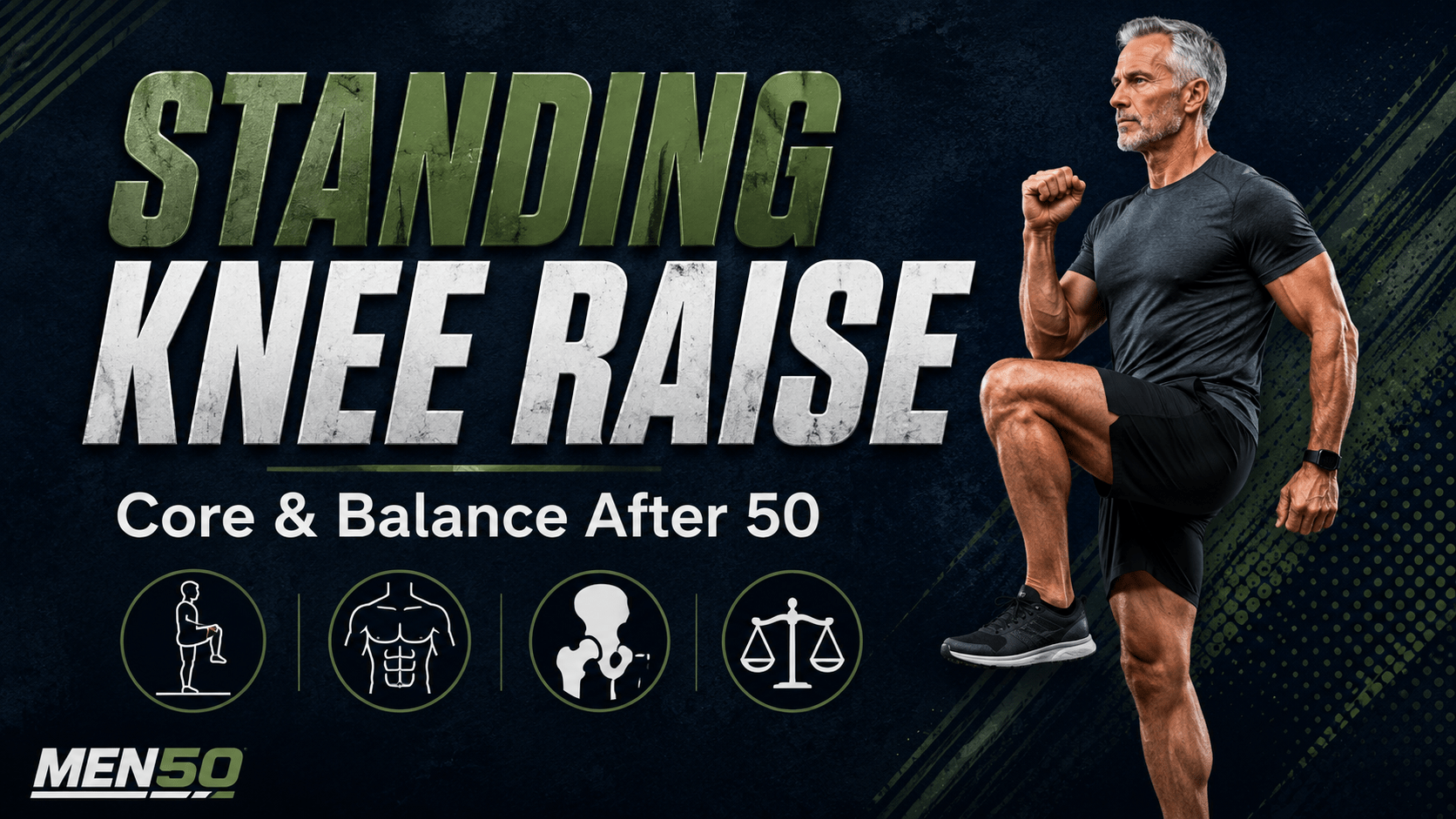
The standing knee raise is one of the most practical core exercises a man over 50 can do — and you don’t have to get down on the floor to do it. It trains the core, hip flexors, and balance in a single standing position, which is exactly how your body uses these systems in real life. No mat, no equipment, no awkward floor exits. Just stand up, lift one knee, and you’re working.
Part of the Build Muscle After 50 pillar — strength training for men over 50.
Key Takeaways
- The standing knee raise trains the hip flexors, lower abs, and balance — all in a standing position that mirrors real-world movement.
- It’s a “no-floor” core exercise, which makes it ideal if getting down to and up from the floor is difficult or uncomfortable.
- Programming: 2–3 sets of 8–15 reps per leg, 3–5 days per week. Quality beats quantity every rep.
- Lift with your hip, not your back. If your torso leans backward to “help” the knee up, the lower back is doing the work the hip flexor should be doing.
- Most men over 50 have both tight and weak hip flexors — this exercise addresses the weakness while the hip flexor stretch addresses the tightness.
How to Perform the Standing Knee Raise
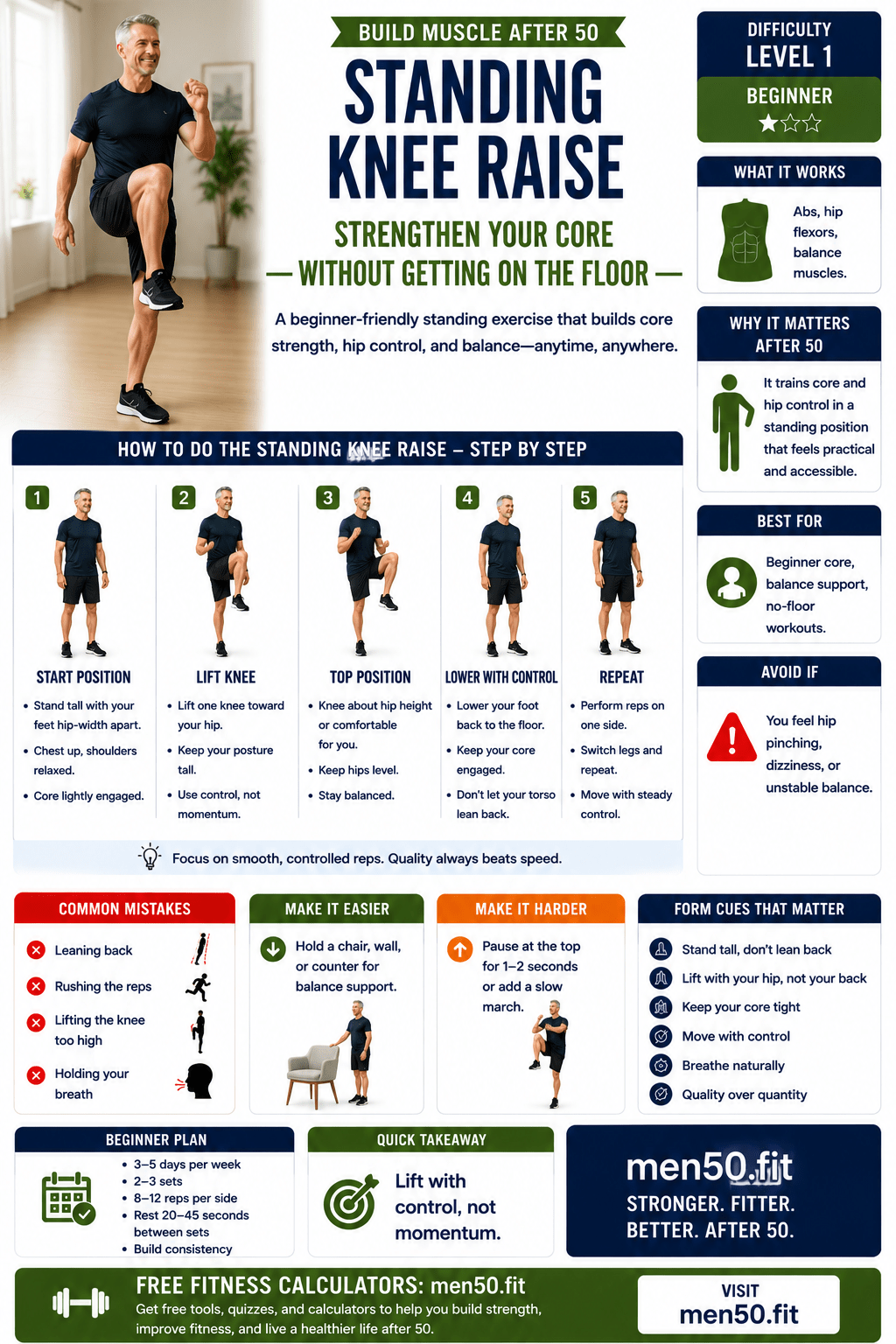
- Start position. Stand tall with feet hip-width apart, chest up, shoulders relaxed, core lightly engaged. Hands on hips, or one hand on a chair back or wall for balance support.
- Lift the knee. Shift your weight onto one foot, then lift the opposite knee toward your chest. Aim for the thigh roughly parallel to the floor — knee at hip height — but only as high as feels comfortable. Stay tall throughout. Use control, not momentum.
- Top position. Knee at hip height. Pause briefly. Keep hips level — don’t let the standing-leg hip hike up. Stay balanced.
- Lower with control. Bring the foot back to the floor slowly. Keep the core engaged and the torso upright — don’t let the chest dip forward or lean back as the foot lowers.
- Repeat. Complete the reps on one side, then switch legs. Or alternate side-to-side if you want a steadier rhythm — both work.
The single most important cue: lift with your hip, not your back. The torso should stay in the same position the whole rep. If you find yourself leaning backward to bring the knee up higher, the lower back is taking over and the hip flexor isn’t really working.
Why the Standing Knee Raise Matters After 50
Most men over 50 have hip flexors that are simultaneously tight (from sitting) and weak (from never being trained against resistance). The two aren’t contradictory — a chronically shortened muscle gets weaker in the lengthened part of its range. That’s why simply stretching the hip flexors only solves half the problem. The standing knee raise loads the hip flexors actively, which builds strength in the position you actually use them: walking, climbing stairs, getting in and out of cars.
It’s also a standing core exercise, which matters more than most men realise. Crunches and sit-ups train the core in a lying-down position your body almost never uses outside of bed. The standing knee raise forces the deep abs and the obliques to stabilise the spine while one leg moves — the same demand they face every time you step off a kerb, navigate uneven ground, or carry groceries upstairs.
And there’s the balance component. Every rep is technically a brief single-leg stance, which trains the small ankle and hip stabilisers that maintain balance. Hip flexor strength and balance both correlate with reduced fall risk in older adults — and balance, like muscle, is a use-it-or-lose-it system. Training it for 30 seconds a day adds up.
Finally, this is the most accessible core exercise in the matrix for men with knee, back, or hip issues that make getting onto the floor uncomfortable. No floor exit required.
Sets and Reps
Build consistency before you build difficulty. The standing knee raise rewards frequency more than intensity.
| Stage | Sets × Reps per Leg | Frequency | Variation |
|---|---|---|---|
| Beginner | 2 × 8–10 | 3–4× per week | Hand on chair/wall for support |
| Novice | 2–3 × 10–12 | 3–5× per week | Hands on hips, no support |
| Intermediate | 3 × 12–15 | 3–5× per week | Pause 1–2 seconds at top |
| Advanced | 3 × 10–12 | 3–5× per week | Slow 3-second lowering, or add a band around thighs |
Rest 20–45 seconds between sets. If you’re using this as a daily habit rather than a workout, one or two sets at a time spread through the day works just as well as doing it all in one session.
Common Mistakes
The four errors that turn a useful exercise into a wasted one:
- Leaning back. The most common compensation. As the knee comes up, the torso leans backward to make it easier. The lower back ends up doing the work the hip flexor should be doing. Keep the torso vertical — even if it means lifting the knee less high.
- Rushing the reps. Speed turns this into a cardio shuffle rather than a strength exercise. Each rep should take 2–3 seconds up, 2–3 seconds down. Quality always beats speed.
- Lifting the knee too high. Trying to get the knee above hip height pulls the lower back into the movement and shifts you out of good posture. Hip height is the target; below hip height is fine for beginners.
- Holding your breath. Most men hold their breath when concentrating on balance. Breathe out as you lift, in as you lower. Steady breathing also helps the core engage properly.
Make It Easier or Harder
If standing knee raises feel unstable, hold a chair back, wall, or kitchen counter with one hand for support. This is the right starting point for most men with balance concerns or knee issues. Reduce the height of the knee lift as needed — even raising the knee to mid-shin height is useful while you build strength.
To make it harder once basic form is solid: pause at the top for 1–2 seconds, slow the lowering phase to 3 seconds, add a slow march (alternating legs continuously for 30–60 seconds), or wrap a light resistance band around your thighs to increase the load on the hip flexors. Don’t add band resistance until the bodyweight version feels easy and clean.
Safety Note
Always work near a chair, wall, or counter when first learning — even if you don’t think you’ll need balance support. Reduce knee height immediately if you feel hip pinching, dizziness, or unstable balance.
If you have a history of hip flexor strain, groin injury, or labral issues in the hip, start with a lower lift height (mid-shin) and build gradually. Don’t round the lower back to compensate for limited hip flexibility — it’s better to lift the knee less high with clean posture than to force the range and load the lumbar spine.
Build Your Personal Training Plan
The standing knee raise is one piece of a complete core and lower-body programme. Get a personalised exercise plan based on your current strength, mobility, and any limitations.
Take the Free Fitness Profiler →
FAQs
How high should I lift my knee?
Hip height — thigh parallel to the floor — is the target once you’ve built up. Beginners should start lower, around mid-shin height, and progress as posture and balance allow. Going higher than hip height isn’t more effective; it just pulls the lower back into the movement. Better to lift to hip height with perfect posture than to chest height with a leaning torso.
What’s the difference between standing knee raises and high knees?
Standing knee raises are controlled, slow, single-leg strength reps with a brief pause and a deliberate lowering phase. High knees are fast continuous cardio — alternating legs as quickly as possible. Different exercises, different goals. The standing knee raise builds hip flexor strength and balance; high knees build cardiovascular conditioning. Most men over 50 are better served by mastering the controlled version first.
Can standing knee raises replace sit-ups?
For most men over 50, yes — and that’s probably an upgrade. Sit-ups load the lower back and don’t train the core in any position you actually use. Standing knee raises train the core in standing, which is more functionally useful. Pair them with the dead bug and a side plank for a more complete core programme than any amount of sit-ups can give you.
Why does my standing leg get tired faster than the lifting leg?
Because the standing leg is doing the harder job. It’s holding your entire bodyweight while also stabilising your balance — work that’s usually shared between both legs in normal standing. That’s a feature, not a bug: the exercise is training the small stabilising muscles in the standing leg as well as the hip flexors in the lifting leg. Both sides get trained when you switch.
Will this exercise help with stair climbing?
Yes, directly. Climbing stairs is essentially a series of single-leg knee raises with bodyweight load. Strengthening the hip flexors and improving single-leg balance in standing translates straight to easier stair climbing — particularly the first few steps after long periods of sitting, when the hip flexors are at their stiffest.
References
- National Institute on Aging. Exercise & Physical Activity: Your Everyday Guide. nia.nih.gov
- American College of Sports Medicine. Resistance Training for Older Adults Position Stand. acsm.org
- Centers for Disease Control and Prevention. Older Adult Falls: A Growing Danger. cdc.gov
Disclaimer: This article is for educational purposes only and is not medical advice. Consult a qualified healthcare professional before starting any new exercise programme, especially if you have existing hip, knee, back, or balance conditions.