
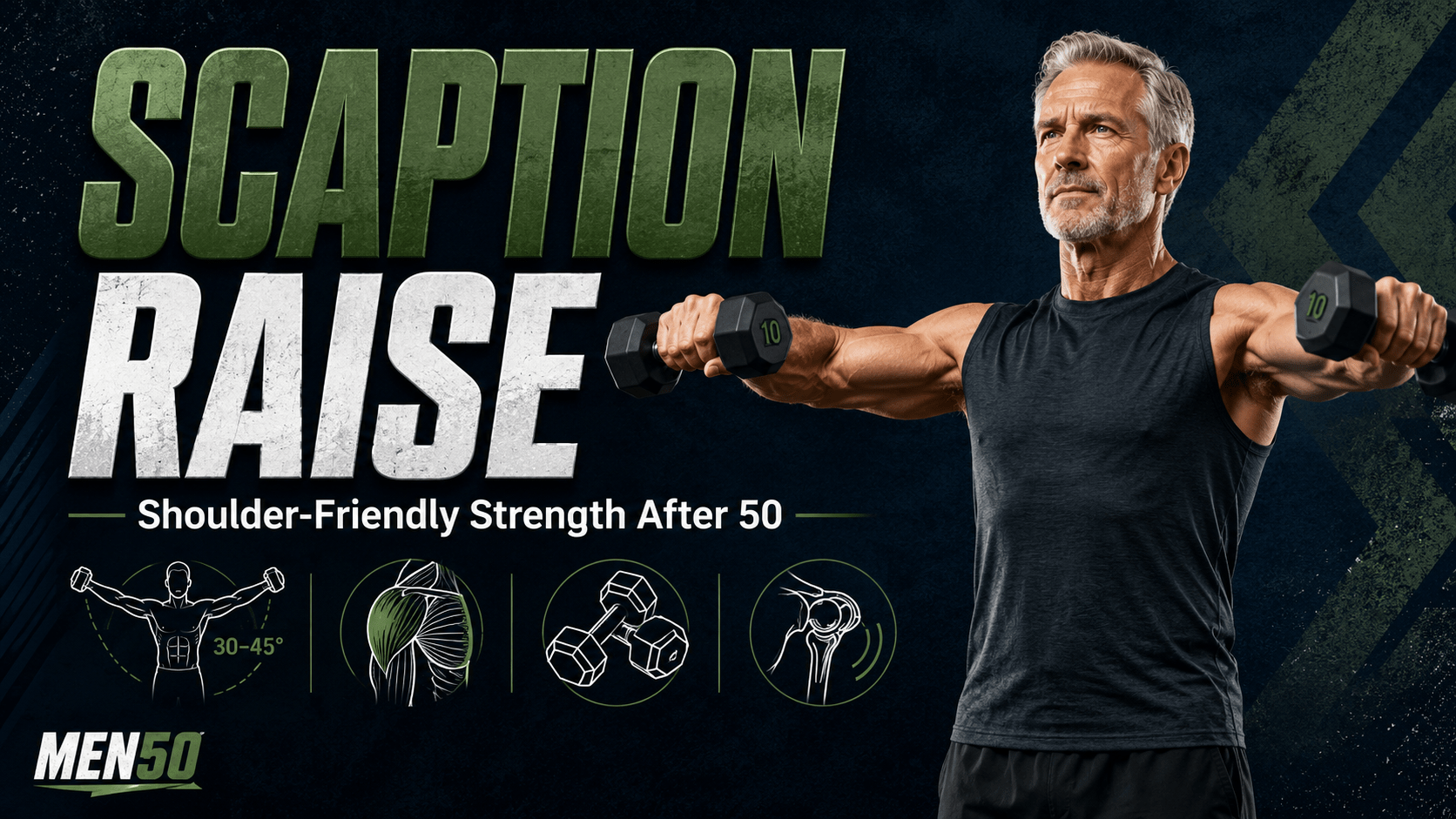
The scaption raise is one of the most undervalued shoulder exercises for men over 50 — and one of the most important. Where the standard lateral raise lifts the arms straight out to the sides (90 degrees from the torso), the scaption raise lifts them at a 30–45 degree angle in front of the body — in the scapular plane. That small angle change makes a dramatic difference for shoulder health. Physiotherapists prescribe scaption raises for rotator cuff rehabilitation precisely because the scapular plane is the shoulder’s most efficient and least stressful position to work in. For men over 50 with any shoulder concerns — or anyone who wants to avoid developing them — this is often the better default choice.
Part of the Build Muscle After 50 pillar — strength training for men over 50.
Key Takeaways
- The scaption raise lifts the arms in the scapular plane (30–45° in front of the body) — the shoulder’s natural plane of motion.
- Trains the same primary muscles as the lateral raise (deltoids) but with significantly less rotator cuff stress.
- Routinely prescribed in physiotherapy for rotator cuff rehabilitation and shoulder impingement recovery.
- Programming: 2–4 sets of 10–15 reps, 2–3 times per week. Rest 45–60 seconds between sets.
- Lift in the right angle, keep your shoulders down, and move with control. Strong shoulders support a stronger life.
How to Perform the Scaption Raise
Set up first:
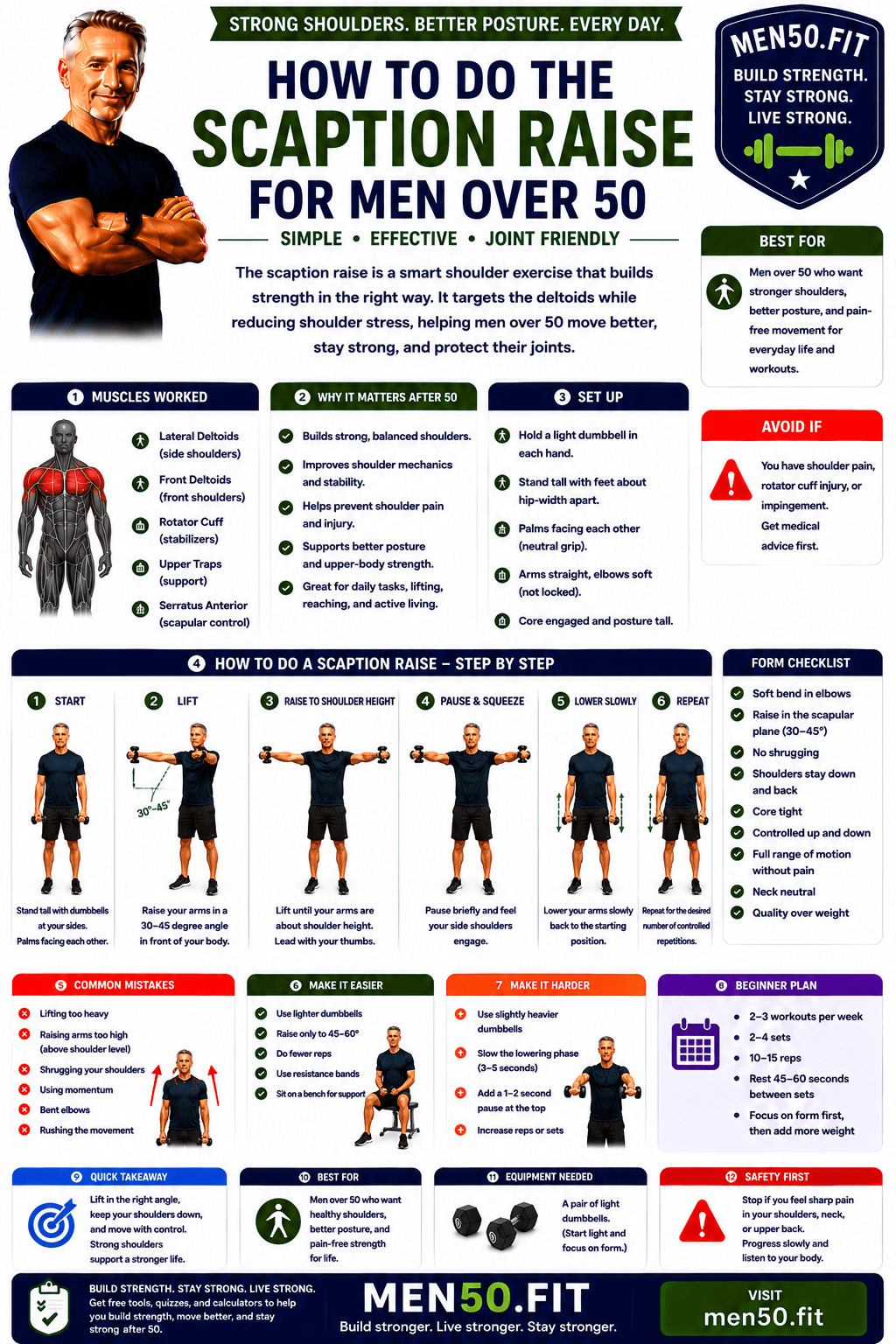
- Hold a light dumbbell in each hand. The scaption raise uses surprisingly light weight.
- Stand tall with feet about hip-width apart.
- Palms facing each other (neutral grip) — this is important; we’ll come back to it.
- Arms straight at your sides, elbows soft (not locked, slight bend).
- Core engaged, posture tall, shoulders down and back.
Then the movement:
- Start. Stand tall with dumbbells at your sides. Palms facing each other. Soft bend in elbows. Core engaged.
- Lift. Raise your arms up and slightly forward in a 30–45 degree angle in front of your body — not straight out to the sides like a lateral raise, and not straight in front like a front raise. Lead with your thumbs (thumbs up slightly) — this keeps the shoulders in external rotation, which is the safe position.
- Raise to shoulder height. Lift until your arms are about shoulder height. Don’t go higher — above shoulder level the upper traps take over and the deltoids stop doing the work efficiently.
- Pause & squeeze. Pause briefly at the top and feel your side shoulders (lateral deltoids) and front shoulders (anterior deltoids) actively engage. Keep shoulders pinned down and back — no shrugging.
- Lower slowly. Lower your arms slowly back to the starting position. Take 2–3 seconds on the way down. Don’t let the dumbbells drop — control the descent on every rep.
- Repeat. Maintain clean form on every rep. Quality over weight always.
The cue that matters most: lead with your thumbs at a 30–45 degree angle in front of your body. The thumb position keeps the shoulder externally rotated (safe). The 30–45 degree angle keeps the arms in the scapular plane (safe). Get those two things right and the exercise nearly trains itself.
Why the Scaption Raise Matters After 50
To understand why the scaption raise is so important for men over 50, you need to understand the scapular plane. The shoulder blade (scapula) doesn’t sit flat against your back — it sits at an angle, oriented about 30–45 degrees forward relative to the back of your torso. The shoulder joint follows this orientation. When the arm moves in this same 30–45 degree plane, the shoulder joint, rotator cuff, and scapula all work together in their most efficient, most stable position.
This matters specifically for men over 50 because the standard lateral raise — arms straight out to the sides at 90 degrees from the torso — pulls the shoulder out of its natural plane. This produces a small but real increase in rotator cuff stress and a known association with shoulder impingement (the most common shoulder injury in men over 50). The scaption raise eliminates this by keeping the arm in the shoulder’s natural plane of motion. Same deltoid work, dramatically less joint stress.
The Physiotherapy Connection
This isn’t a fringe idea. The scaption raise is routinely prescribed in physiotherapy for:
- Rotator cuff rehabilitation (after impingement, tear, or surgery)
- Shoulder impingement recovery
- Frozen shoulder rehab
- Returning to lifting after shoulder injury
- Subacromial bursitis recovery
It’s the first deltoid exercise many physiotherapists clear patients to do because it loads the shoulder in the safest possible position. For men over 50 with any history of shoulder issues, the scaption raise should generally be chosen over the lateral raise — and once form is solid, used as the default shoulder isolation exercise.
Scaption vs Lateral Raise — The Comparison
| Exercise | Arm Position | Best For |
|---|---|---|
| Lateral Raise | Straight out to sides (90° from torso) | Healthy shoulders, classical deltoid training |
| Scaption Raise | 30–45° in front of body (scapular plane) | Shoulder-friendly default for men over 50 |
| Front Raise | Straight in front of body (0° from torso) | Front delt isolation (less commonly needed) |
For men over 50 without shoulder issues, both lateral and scaption raises have their place. For men with shoulder issues, the scaption raise is the better default. For everyone, the scaption raise is the safer starting point.
The Bigger Postural Picture
The scaption raise also connects to the broader postural correction work in the matrix. Vladimir Janda’s upper crossed syndrome — the rounded-shoulder pattern in men over 50 from desk work and screen time — produces shoulder blades that sit even further forward than the natural scapular plane. The scaption raise trains the deltoids in the correct anatomical position while reinforcing the proper scapular orientation — making it a complementary exercise to the postural work covered in wall angels, band pull-aparts, and band face pulls.
There’s also a scapular dyskinesis connection. Research by Kibler and Sciascia (2010, British Journal of Sports Medicine) on scapular dyskinesis — abnormal scapular movement, common in men over 50 — found that exercises performed in the scapular plane produced better scapular control and less compensation than exercises performed in the frontal plane (like a lateral raise). The scaption raise trains the deltoids while also training proper scapular mechanics.
Sets and Reps
This is a moderate-rep isolation exercise. Use lighter weight than ego suggests.
| Stage | Sets × Reps | Frequency | Load Guide |
|---|---|---|---|
| Beginner | 2 × 10–12 | 2× per week | Very light (2–5 lbs / 1–2 kg) |
| Novice | 2–3 × 10–15 | 2–3× per week | Light (5–8 lbs / 2–3.5 kg) |
| Intermediate | 3 × 10–15 | 2–3× per week | Moderate (8–12 lbs / 3.5–5.5 kg) |
| Advanced | 3–4 × 10–15 | 2–3× per week | Moderate + slow lowering + pause at top |
Rest 45–60 seconds between sets. Pick a weight where the last 2–3 reps feel clearly challenging but you can complete them with: shoulders pinned down (no shrugging), thumbs leading slightly upward, arms in the scapular plane at 30–45 degrees, no swinging, no momentum.
A practical starting load: most men over 50 should start with 5–8 lb (2–3.5 kg) dumbbells. Some progress to 10–15 lbs (4.5–7 kg) over months. Going heavier than that almost always causes form breakdown — shrugging, swinging, or angle drift toward a lateral raise. The deltoids are small muscles in this isolation pattern; they don’t need or benefit from heavy load.
Common Mistakes
The six errors that turn a great shoulder-friendly exercise into a shoulder problem:
- Lifting too heavy. The single most common mistake. Heavy weights force compensation — shrugging, swinging, angle drift. The deltoids are small muscles in isolation. Five pounds done with clean form trains them better than fifteen pounds done with momentum.
- Raising arms too high (above shoulder level). Above shoulder height, the upper traps take over the lift and the deltoids stop doing the work efficiently. Stop at shoulder height. No higher.
- Shrugging your shoulders. As the arms rise, the upper traps want to lift the shoulders toward the ears. This recruits the wrong muscle. Pin the shoulders down before each rep and consciously keep them there throughout.
- Using momentum. Swinging the dumbbells up with body sway turns the exercise into a swing. The deltoids barely fire. Keep the torso still; only the arms move. Slow, controlled tempo throughout.
- Bent elbows. Allowing the elbows to bend significantly during the lift turns the scaption raise into a different exercise (closer to an upright row). Keep elbows in a soft bend — same slight angle from start to finish.
- Rushing the movement. Quick reps use elastic recoil. Slow controlled reps build strength. Use 1–2 seconds up, brief pause at the top, 2–3 seconds down.
Make It Easier or Harder
If standard scaption raises are too challenging:
- Use lighter dumbbells — 2–3 lbs (1 kg) is fine for beginners or those returning from injury.
- Raise only to 45–60° — partial range still trains the deltoids while building strength.
- Do fewer reps — start with 2 sets of 6–8 and build up.
- Use resistance bands instead of dumbbells — variable resistance can feel easier at the start of the lift.
- Sit on a bench for support — removes the temptation to use legs and lower back for momentum.
To make it harder once form is solid:
- Use slightly heavier dumbbells — but only when the lighter weight feels easy with clean form.
- Slow the lowering phase to 3–5 seconds per rep — significantly more demanding than it sounds.
- Add a 1–2 second pause at the top with shoulders pinned down and deltoids engaged.
- Increase reps or sets before adding load.
For variety, try the single-arm scaption raise with the non-working hand resting on a wall or chair for stability — eliminates trunk compensation and produces an even cleaner deltoid stimulus.
Safety Note
Avoid the scaption raise if you have acute shoulder pain, current rotator cuff injury, or active impingement that hasn’t been cleared by a physiotherapist. Even though this is the shoulder-friendliest version of a shoulder raise, acute injuries need professional assessment first.
If you feel sharp pain in your shoulders, neck, or upper back during the movement, stop. Mild muscular fatigue in the deltoids is normal; sharp joint pain is not.
For men working through known shoulder issues (impingement history, rotator cuff irritation, post-surgery rehab), start with very light weight (2–5 lbs / 1–2 kg) and a reduced range (only to 60 degrees, not full shoulder height). Build up gradually over weeks. If pain increases, back off. Most physiotherapists clear patients to do scaption raises before any other deltoid work — but with strict load and range limits initially.
Avoid going above shoulder height. Above 90 degrees, the rotator cuff tendons can pinch under the acromion bone — the exact mechanism behind impingement. Stop at shoulder height regardless of how strong you feel.
Build Your Personal Training Plan
The scaption raise is one piece of a complete upper body programme. Get a personalised exercise plan based on your current strength, shoulder health, and any limitations.
Take the Free Fitness Profiler →
FAQs
Scaption raise vs lateral raise — which is better?
For men over 50, the scaption raise is the safer default. Both train the deltoids effectively, but the scaption raise loads the shoulder in its natural plane of motion (the scapular plane, 30–45 degrees in front of the body), which significantly reduces rotator cuff stress and impingement risk. The lateral raise (arms straight out to the sides) is fine for men with healthy shoulders, but the small angle change to scaption makes it dramatically more shoulder-friendly. If you have any shoulder history, do scaption raises. If your shoulders are healthy, both have their place — many men over 50 alternate between the two for training variety. Most physiotherapists recommend the scaption raise as the default for men over 50.
What is the scapular plane?
The scapular plane is the angle at which your shoulder blade naturally sits relative to your back. It’s not flat against the rear of your torso — it’s angled about 30–45 degrees forward. The shoulder joint follows the same orientation. When the arm moves in this same plane (30–45 degrees in front of the body rather than straight out to the sides), the shoulder joint, rotator cuff muscles, and scapula all work together in their most efficient and stable position. This is why the scaption raise is so much safer than the lateral raise: it respects the shoulder’s natural anatomy instead of fighting it.
How is this used in physiotherapy?
The scaption raise is one of the most commonly prescribed exercises in shoulder rehabilitation. Physiotherapists use it for: rotator cuff rehab (after impingement, tear, or surgery), shoulder impingement recovery, frozen shoulder rehabilitation, return-to-lifting protocols after shoulder injury, and subacromial bursitis recovery. The reason: it loads the deltoids and rotator cuff in the shoulder’s safest position, allowing strengthening without aggravating existing problems. Patients often start with very light loads (2–5 lbs) and reduced range (only to 45–60 degrees), then progress over weeks. For men over 50 working through any shoulder issues, this exercise is often the first one cleared.
How heavy should the dumbbells be?
Lighter than ego suggests. For most men over 50 starting out, 5–8 lbs (2–3.5 kg) per hand is the right range. Some progress to 10–15 lbs (4.5–7 kg) over months. The right weight lets you complete the rep range with: shoulders pinned down (no shrugging), thumbs leading slightly upward, arms in the scapular plane, no swinging, controlled tempo. The deltoids are small muscles, especially in this isolation pattern. They don’t need heavy load to develop. Going above 15 lbs per hand almost always means swinging the weight up rather than lifting it cleanly. If you feel like you’re crushing 20 lb scaption raises, you’re almost certainly using too much body momentum.
Can I do this every day?
For light-load work (5–8 lbs), yes — the muscles involved respond well to frequent low-intensity practice. For heavier loads (10–15+ lbs), 2–3 times per week is the sweet spot, with 48 hours between sessions for recovery. Daily light scaption raises are particularly useful for men working through shoulder rehabilitation — light loading with high frequency promotes healing better than infrequent heavy loading. Many physiotherapists prescribe daily scaption raises in early-stage shoulder rehab specifically for this reason.
References
- Kibler WB, Sciascia A. Current concepts: scapular dyskinesis. British Journal of Sports Medicine. 2010;44(5):300-305.
- Janda V. Muscles, Central Nervous Motor Regulation and Back Problems. In: Korr IM (ed). The Neurobiologic Mechanisms in Manipulative Therapy. Plenum Press; 1978. (Upper Crossed Syndrome framework.)
- American College of Sports Medicine. Resistance Training for Older Adults Position Stand. acsm.org
Disclaimer: This article is for educational purposes only and is not medical advice. Consult a qualified healthcare professional before starting any new exercise programme, especially if you have existing shoulder, neck, or rotator cuff conditions.