
The dumbbell biceps curl gets dismissed as “vanity exercise” more often than any other movement in the gym. That’s wrong for men over 50. The biceps is one of the muscles that loses strength fastest after 50 if not trained, and you use it every time you carry shopping, lift a suitcase, pick up a grandchild, or hold a phone to your ear for 20 minutes. Curls aren’t just about how your arms look — they’re about whether you can still do the lifting and carrying that fills daily life. And the grip strength they build is one of the most predictive markers of longevity in older men.
Part of the Build Muscle After 50 pillar — strength training for men over 50.
Key Takeaways
- The biceps curl trains the biceps, forearms, and grip — three muscle groups that quietly decline after 50 if not trained.
- Programming: 2–3 sets of 8–12 reps, 2–3 times per week. Rest 45–75 seconds between sets.
- Keep your elbows close and control the weight both up and down. The single most important cue. Swinging the weight up trains nothing.
- The lowering phase is where most of the strength is built. Take 2–3 seconds on the way down every rep.
- Curls aren’t a vanity exercise for men over 50 — they’re a functional one. Real arm strength carries over to carrying, lifting, and everyday tasks.
How to Perform the Dumbbell Biceps Curl
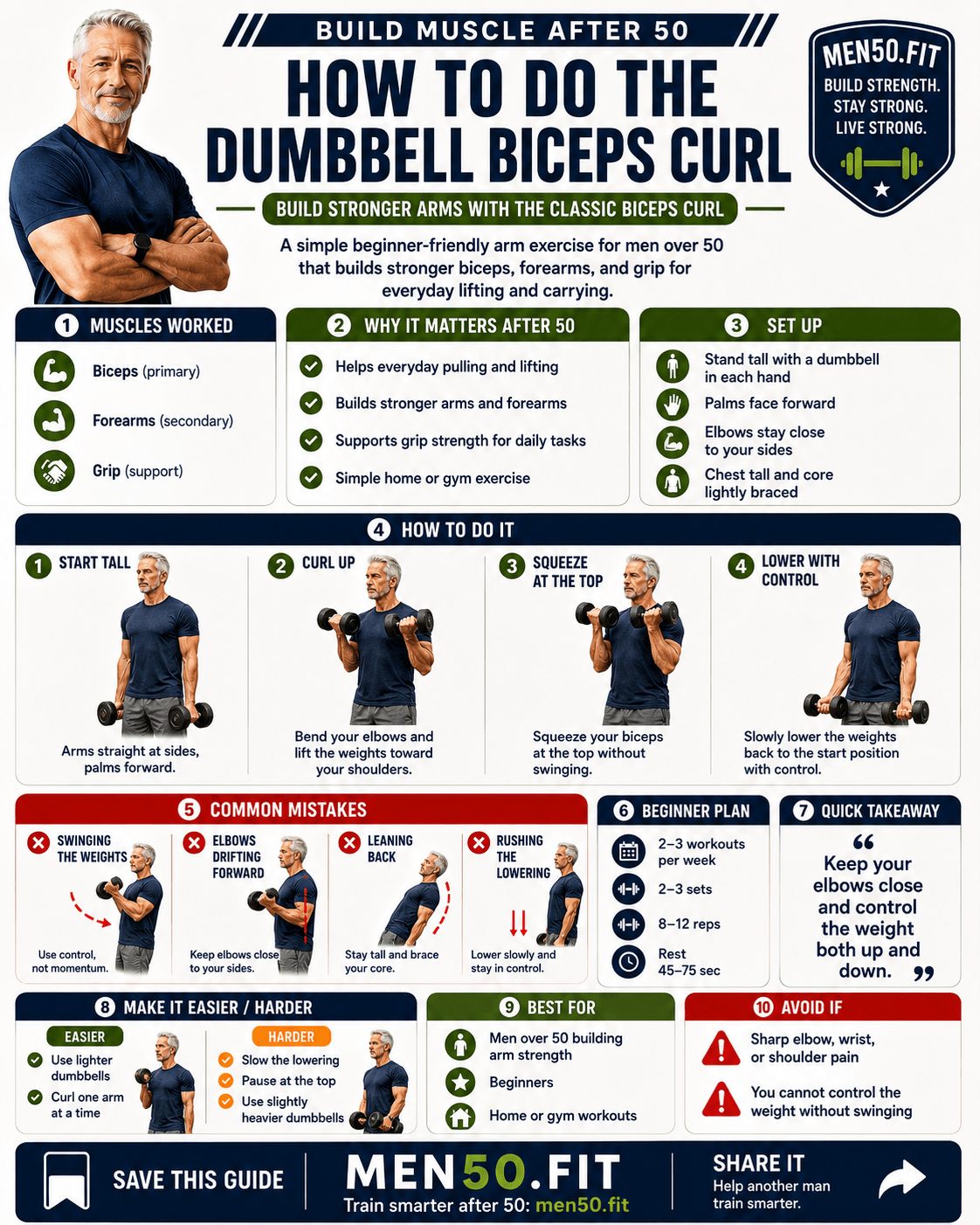
Set up first:
- Stand tall with a dumbbell in each hand, arms relaxed at your sides.
- Palms face forward (supinated grip).
- Elbows stay close to your sides — this is the position you maintain through every rep.
- Chest tall, shoulders down and back, core lightly braced.
Then the movement:
- Start tall. Arms straight at your sides, palms facing forward, dumbbells held with a firm but not crushing grip.
- Curl up. Bend at the elbows and lift the weights toward your shoulders. Keep the elbows pinned to your sides — they should not drift forward as you curl. Drive the weight up over 1–2 seconds.
- Squeeze at the top. Pause for 1 second at the top with the dumbbells near your shoulders. Squeeze the biceps actively. Don’t swing or use momentum to “finish” the rep.
- Lower with control. Slowly lower the weights back to the start over 2–3 seconds. This is where most of the strength gets built. Don’t drop the weights down or let gravity do the work — control the descent on every rep.
The cue that matters most: keep your elbows close and control the weight both up and down. Once the elbows drift forward or the torso swings to help, the biceps stops doing the work.
Why the Dumbbell Biceps Curl Matters After 50
Arm strength declines faster than most men expect after 50. The biceps and forearms are involved in nearly every daily lifting and carrying motion — picking up shopping bags, lifting a toolbox, holding a coffee mug for the morning newspaper, hoisting a suitcase into an overhead bin. Lose this strength gradually over a decade and the daily functional consequences accumulate quietly. By 65, many men who never trained their arms find themselves struggling with bags they used to carry easily at 45.
The biceps curl directly trains the biceps brachii (the muscle on the front of the upper arm), the brachialis (underneath the biceps, the strongest pure elbow flexor), and the forearms (which grip the weight). All three contribute to functional arm strength in different ways. Compound exercises like the dumbbell row also train the biceps, but as a secondary muscle — direct curl work is more efficient for pure biceps strength and size.
There’s also the grip strength angle, which we’ve covered before in this matrix. The 2015 PURE study (Leong et al., The Lancet) followed 140,000 adults across 17 countries and found that grip strength was a stronger predictor of all-cause mortality and cardiovascular events than systolic blood pressure. Every 5 kg drop in grip strength was associated with a 17% higher risk of cardiovascular death. Biceps curls train grip strength under sustained moderate load — the kind of grip work that contributes to the longevity-relevant capacity that the farmer’s carry also targets.
The honest case for curls: they’re not the most important exercise in the matrix, but they are a useful one. Every man over 50 who lifts and carries in daily life benefits from training the muscles that do the lifting and carrying. The 10 minutes per week curls take is a high-return investment.
Sets and Reps
The biceps respond well to moderate load and moderate volume. Curls are not where to chase heavy weights.
| Stage | Sets × Reps | Frequency | Load Guide |
|---|---|---|---|
| Beginner | 2 × 8–10 | 2× per week | Light dumbbells, focus on form |
| Novice | 2–3 × 8–12 | 2–3× per week | Moderate weight, last 2 reps challenging |
| Intermediate | 3 × 8–12 | 2–3× per week | Working weight, RPE 7–8 |
| Advanced | 3 × 6–12 | 2–3× per week | Heavier weight, slow lowering, pause at top |
Rest 45–75 seconds between sets. Pick a weight where the last 2–3 reps feel clearly challenging but you don’t need to swing your body to complete them.
A practical starting load: most men over 50 begin with 10–20 lb (4.5–9 kg) dumbbells. After 3–6 months of consistent training, many men progress to 20–30 lbs (9–14 kg) per hand. Don’t chase heavy numbers — chase clean reps. A 15 lb curl done with perfect form does more for your biceps than a 30 lb curl with swinging and back arching.
Common Mistakes
The four errors that turn a great arm exercise into an elbow problem:
- Swinging the weights. Using hip and torso momentum to launch the weights up turns the curl into a swing. The biceps barely fires; the lower back takes the load. If you can’t lift the weight without swinging, the dumbbells are too heavy. Drop a size and use control.
- Elbows drifting forward. As fatigue sets in, the elbows want to drift forward in front of the body to make the lift easier. This recruits the front shoulders and reduces biceps work. Keep elbows pinned to your sides through the entire rep, every rep.
- Leaning back. Some men extend the lower back as they curl to help the weight up — essentially using the back to “throw” the dumbbells forward. Stay tall, brace the core, ribs down. If you have to lean to finish the rep, the weight is too heavy.
- Rushing the lowering. Letting the weights drop quickly back to the start skips the most productive part of the rep. Take 2–3 seconds on the way down — this is where most of the strength and size gets built.
Make It Easier or Harder
If standard curls are too challenging:
- Use lighter dumbbells — 5–10 lbs (2–4.5 kg) per hand is fine for beginners or men returning to training. Strength is built from where you are.
- Curl one arm at a time — supporting yourself with the free hand on a chair, table, or your own thigh removes some of the postural demand and lets you focus on the working arm.
- Reduce reps — start with 2 sets of 6–8 reps and build up.
To make curls harder once form is solid:
- Slow the lowering to 3–4 seconds per rep — significantly more challenging than it sounds.
- Pause for 1–2 seconds at the top with biceps fully squeezed.
- Use slightly heavier dumbbells — but only after you’ve earned them with clean form at the lighter weight.
For variety, try the hammer curl (palms facing each other instead of forward) — works the brachialis and forearms more than the standard curl. Useful as a once-a-week variation.
Safety Note
If you feel sharp pain in the elbow, wrist, or shoulder during the curl, stop. Mild muscular fatigue in the biceps is normal; sharp joint pain is not. Adjust the weight, hand position, or range of motion before continuing.
Men with lateral epicondylitis (tennis elbow) or medial epicondylitis (golfer’s elbow) should start with very light weights and shorter ranges of motion — and may benefit from a few weeks of band pull-aparts and grip work before adding heavy biceps curls. If pain persists, see a physiotherapist before continuing.
Avoid the curl if you cannot control the weight without swinging — that’s a signal that either the load is too heavy or your core bracing isn’t yet strong enough.
Build Your Personal Training Plan
The dumbbell biceps curl is one piece of a complete upper body programme. Get a personalised exercise plan based on your current strength, goals, and any limitations.
Take the Free Fitness Profiler →
FAQs
How heavy should the dumbbells be?
Heavy enough that the last 2–3 reps of each set feel clearly challenging, but light enough that you can complete the set with elbows pinned, no swinging, and no leaning back. For most men over 50 starting out, that’s 10–20 lbs (4.5–9 kg) per hand. After 3–6 months of training, many men progress to 20–30 lbs (9–14 kg). The right weight is the one your form can handle for the prescribed reps — not the heaviest you can swing up.
Are biceps curls really useful or just a vanity exercise?
For men over 50, genuinely useful. Real-world lifting (groceries, suitcases, toolboxes, grandchildren) uses the biceps directly, and the biceps loses strength faster than most muscles after 50 if not trained. The curl is the most efficient exercise for training that strength. The “vanity exercise” framing applies more to advanced bodybuilders who already have plenty of arm strength — for older men rebuilding capacity, curls are functional work. Don’t skip them.
Should I curl with both arms together or one at a time?
Both work. Double-arm curls are more time-efficient and slightly more challenging to your core stability. Single-arm curls (alternating, or completing all reps on one side then switching) let you focus on form on each side individually and expose left-right strength imbalances. For most men over 50, alternating works well — curl the right, lower, curl the left, lower, repeat. Some weeks do both arms together; other weeks do one at a time. Both train the biceps the same.
Why do my elbows hurt during curls?
Three common causes. Weight too heavy — the elbow joint takes excessive load when the muscles can’t manage it cleanly. Grip too tight — crushing the dumbbell creates extra tension up through the forearm and elbow tendons. Existing tendinopathy — tennis or golfer’s elbow can flare up under direct biceps load. If the pain is sharp or persistent, drop the weight to something very light, focus on slow controlled reps, and consider 2–3 weeks of grip and forearm work (band pull-aparts, light farmer’s carries) before returning to curls. If pain persists, see a physiotherapist.
Can I do curls every day?
Better not to. The biceps is a small muscle group that responds best to 2–3 sessions per week with 48 hours of recovery between sessions. Daily curls usually lead to elbow joint irritation and reduced rather than improved strength gains. If you want to train pulling more often, alternate curl days with resistance band rows or dumbbell rows — both train the biceps secondarily without direct elbow-flexion fatigue.
References
- Leong DP, Teo KK, Rangarajan S, et al. Prognostic value of grip strength: findings from the Prospective Urban Rural Epidemiology (PURE) study. The Lancet. 2015;386(9990):266-273.
- American College of Sports Medicine. Resistance Training for Older Adults Position Stand. acsm.org
- National Institute on Aging. Sarcopenia and Muscle Strength in Older Adults. nia.nih.gov
Disclaimer: This article is for educational purposes only and is not medical advice. Consult a qualified healthcare professional before starting any new exercise programme, especially if you have existing elbow, wrist, or shoulder conditions.