
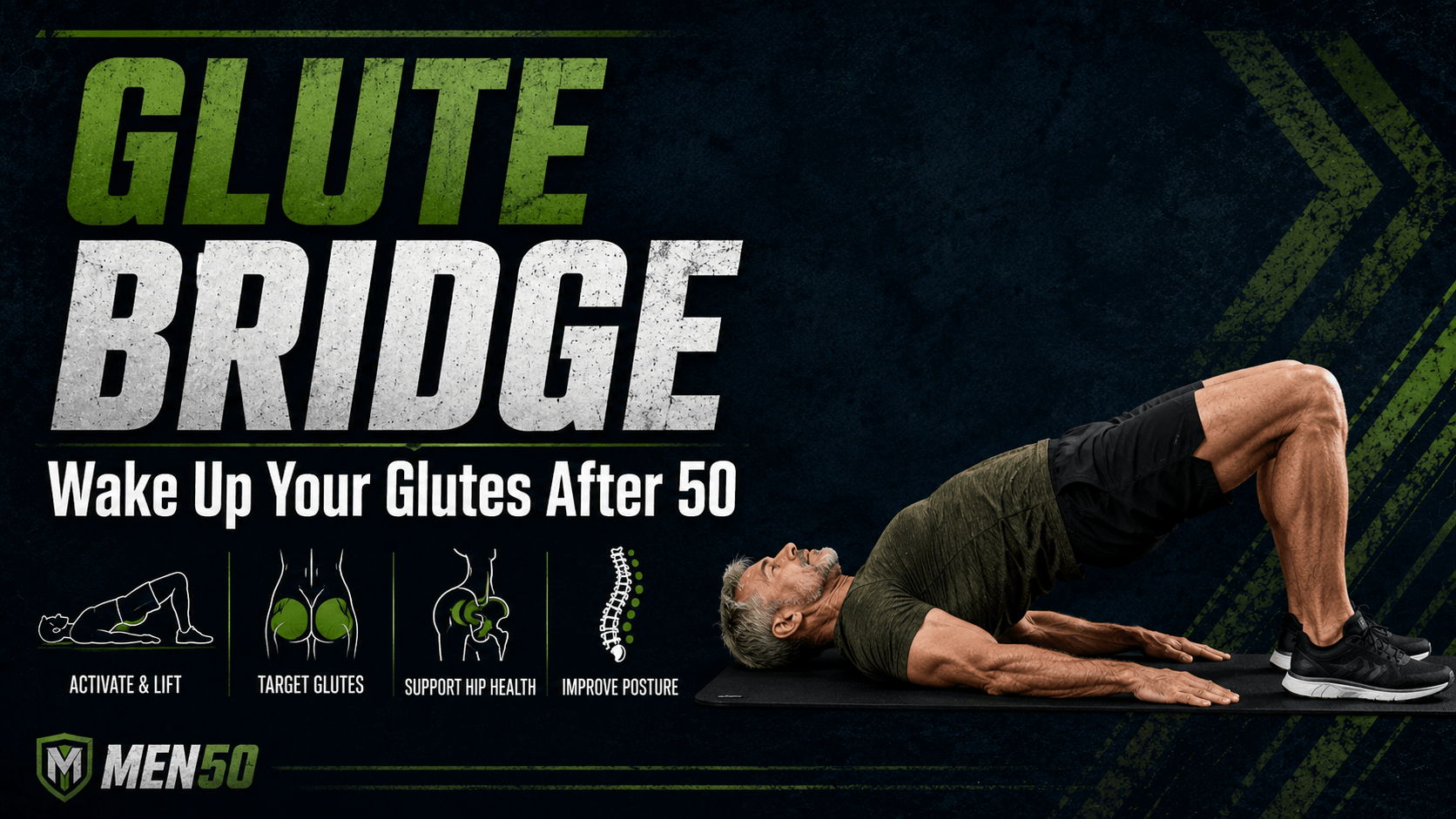
The glute bridge is one of the most important exercises a man over 50 can do, and almost no one does it. It directly trains the glutes — the largest, most powerful muscle group in the body and the one that weakens fastest from decades of sitting. It also strengthens the hamstrings, protects the lower back, and improves hip extension strength, which research consistently links to reduced fall risk in older adults. No equipment, lying on the floor, five minutes a day. The return on investment is enormous.
Part of the Build Muscle After 50 pillar — strength training for men over 50.
Key Takeaways
- The glute bridge trains the glutes, hamstrings, hips, and core in a position that places almost no stress on the spine.
- “Gluteal amnesia” — the brain forgetting how to properly fire the glutes after years of sitting — is genuinely common in men over 50. The glute bridge is the simplest exercise for retraining the pattern.
- Programming: 3 sets of 10–15 reps with a 2-second squeeze at the top, 2–4 times per week.
- Squeeze the glutes, not the lower back. If you feel the work in your spine, the glutes haven’t engaged and the back is compensating.
- Pair with the hip flexor stretch. Together they fix both halves of “lower crossed syndrome”: tight hips and weak glutes.
How to Perform the Glute Bridge
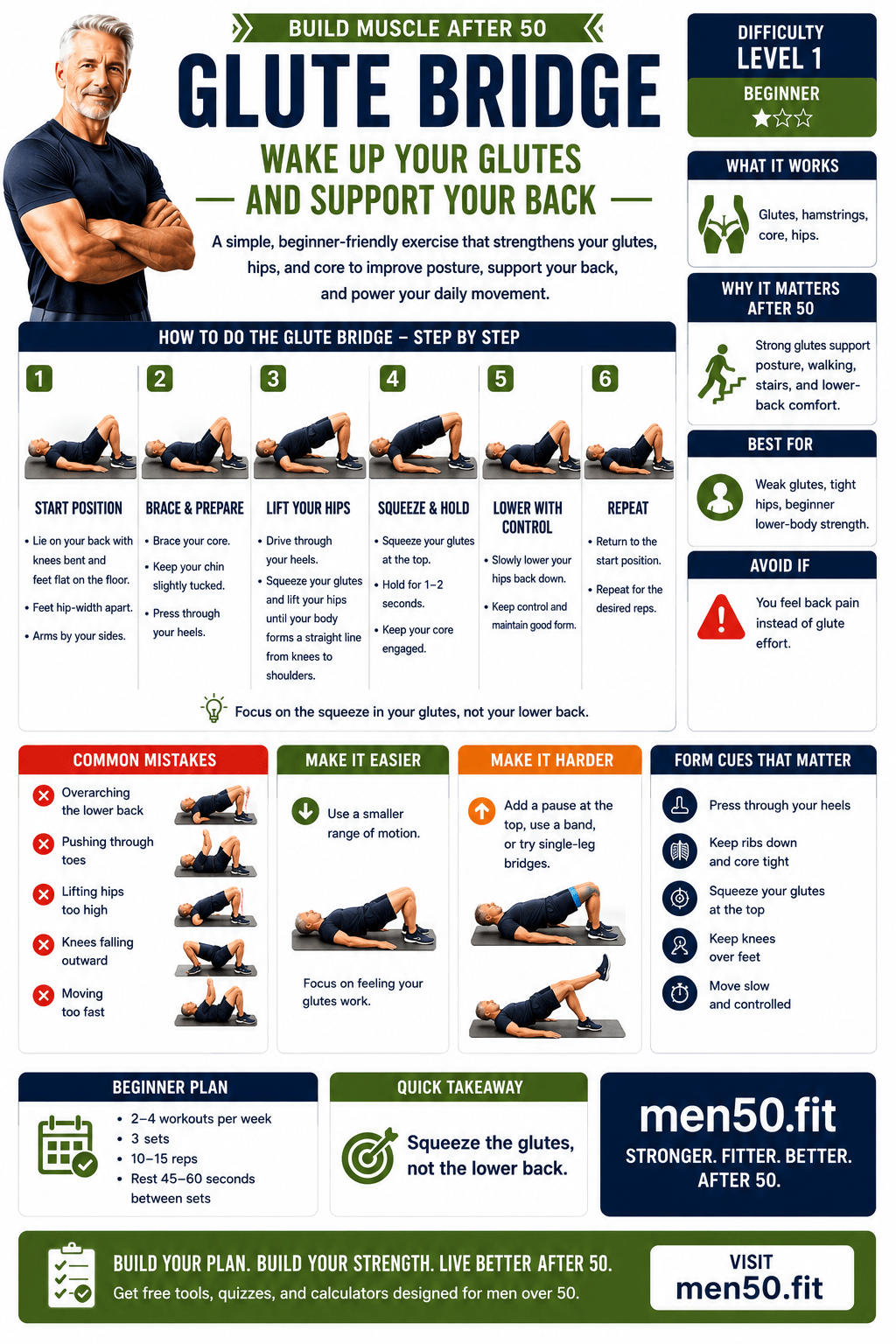
- Start position. Lie on your back with your knees bent, feet flat on the floor hip-width apart, roughly 12 inches (30 cm) from your glutes. Arms by your sides, palms down.
- Brace and prepare. Brace your core. Tuck your chin slightly so the back of your neck is long. Press your feet firmly into the floor through the heels.
- Lift your hips. Drive through your heels (not your toes), squeeze your glutes, and lift your hips toward the ceiling. Stop when your body forms a straight line from knees to shoulders. Don’t lift higher than that.
- Squeeze and hold. Hold the top position for 1–2 seconds. Really squeeze the glutes — don’t just push the hips up, actively contract the muscle. Keep the core engaged so the lower back doesn’t hyperextend.
- Lower with control. Slowly lower your hips back to the floor over 2–3 seconds. Don’t drop. Maintain glute engagement on the way down.
- Repeat. Quality over quantity. Five clean glute bridges where you actually feel the glutes working will do more than fifteen sloppy reps where the back is doing the lifting.
The cue that matters most: squeeze the glutes, not the lower back. If your back is doing the work, you’ll feel a pinch or arch sensation at the top. Reset, brace the core harder, and consciously squeeze the glutes before lifting.
Why the Glute Bridge Matters After 50
Spine biomechanist Stuart McGill popularised the term “gluteal amnesia” — the brain effectively forgetting how to fire the glutes properly after years in a seated position. Modern men sit for an average of 8–10 hours per day, and chronically shortened hip flexors send a neurological signal that inhibits the glutes from firing fully (the body won’t fire two opposing muscle groups at full strength against each other). Over decades, the brain reduces the recruitment signal to the glutes, and the larger, more powerful muscle progressively switches off.
The visible effect is what gym coaches call “flat butt syndrome.” The functional effect is more serious. When the glutes aren’t firing, the lower back and hamstrings take over as the primary hip extensors during every walking step, every stair climbed, every standing-up movement. The lumbar erectors and hamstrings weren’t designed for this volume of work — they’re support muscles, not prime movers — and they fatigue, tighten, and refer pain. This is one of the major mechanisms behind chronic lower back pain in men over 50.
Janda’s framework for this pattern is lower crossed syndrome:
- Tight: hip flexors, lumbar erectors
- Weak: glutes, deep abdominals
The complete fix has four parts. The hip flexor stretch lengthens the tight hip flexors. The glute bridge strengthens the weak glutes. The dead bug trains the weak deep abdominals. Mobility work for the lumbar erectors completes the pattern. Of these four, the glute bridge is the most directly powerful — most men over 50 see noticeable changes in walking power, stair climbing, and lower back comfort within 3–4 weeks of consistent glute bridge training.
There’s also a fall prevention angle. Hip extension strength (the force the glutes produce when pushing the leg backward) correlates closely with reduced fall risk in older adults. Strong glutes mean a more powerful push-off during walking, faster recovery if you stumble, and better single-leg stability when navigating uneven ground.
Sets and Reps
Build the activation pattern first, then build the strength. Quality of glute engagement matters more than load.
| Stage | Variation | Sets × Reps | Frequency | Load |
|---|---|---|---|---|
| Beginner | Standard glute bridge, 2-second pause | 2–3 × 10–12 | 2–3× per week | Bodyweight |
| Novice | Glute bridge, 3-second pause + slow lowering | 3 × 12–15 | 2–4× per week | Bodyweight |
| Intermediate | Mini-band around the knees | 3 × 12–15 | 2–4× per week | Bodyweight + band |
| Advanced | Single-leg glute bridge | 3 × 8–10 per leg | 2–3× per week | Bodyweight |
Rest 45–60 seconds between sets. If you’re using glute bridges as a daily habit rather than a workout (which works well), one set of 12–15 reps morning and evening adds up quickly.
A common honest finding: many men over 50 don’t feel their glutes during the first 2–3 weeks of training. The mind-muscle connection is rusty. Don’t add load until you can clearly feel the glutes contract on every rep — adding load too early just reinforces the back-and-hamstring compensation pattern.
Common Mistakes
The five errors that turn a back-protecting exercise into a back-irritating one:
- Overarching the lower back. Lifting the hips so high that the back hyperextends moves the work from the glutes to the lumbar spine. The body should form a straight line from knees to shoulders at the top — not a U-shape.
- Pushing through the toes. Driving through the balls of the feet shifts work to the quads and hamstrings. Push through the heels — you should be able to wiggle your toes at the top of the rep.
- Lifting the hips too high. Related to overarching. Higher isn’t better. Stop when knees, hips, and shoulders form a straight line.
- Knees falling outward. Often the opposite problem — knees collapsing inward. Both indicate weak glute medius (the side glute). Keep knees stacked over the heels throughout. A mini-band around the knees provides instant feedback if you drift inward.
- Moving too fast. Bouncing through reps trains the wrong muscles. Lift over 2 seconds, hold 1–2 seconds, lower over 2–3 seconds.
Make It Easier or Harder
If standard glute bridges don’t feel like glute work, reduce the range of motion — lift only halfway up and focus entirely on the glute squeeze rather than chasing height. This is more useful than full range with no glute activation. Some men also benefit from doing a few “glute squeeze only” reps before each set — lying on the floor, squeeze the glutes hard for 5 seconds without lifting at all. Three sets of these as a warm-up wakes up the activation pattern.
To progress once the basic version is clean:
- Add a longer pause at the top — 3–5 seconds with a hard glute squeeze.
- Place a mini-band around the knees and press outward against the band on every rep — adds glute medius (side glute) work.
- Single-leg glute bridge — extend one leg straight out, lift the hips with the planted leg only. Significantly harder, also identifies left-right imbalances.
- Elevated feet — heels on a low step or low bench. Increases range of motion and load on the hamstrings.
The advanced progression is the barbell hip thrust (back on a bench, weight across the hips), but that’s gym-level work for most men over 50. Single-leg glute bridges at home will keep most men progressing for 6–12 months.
Safety Note
Avoid hyperextending the lower back at the top of the movement. Hips level with shoulders is the target — not hips above shoulders. If you feel lower back strain rather than glute activation, stop, reset, and focus on squeezing the glutes harder before lifting. Reduce the range if the back continues to take over.
If you have a current lower back injury, the glute bridge is generally one of the safer exercises to keep doing — but during an acute flare-up, reduce range to 50% and stop if symptoms worsen. If you have a recent hip or knee injury, get clearance from a physiotherapist before adding load (bands or single-leg variations).
Build Your Personal Training Plan
The glute bridge is one piece of a complete lower-body and core programme. Get a personalised exercise plan based on your current strength, mobility, and any limitations.
Take the Free Fitness Profiler →
FAQs
How do I know if my glutes are firing during the exercise?
Place a hand on your glute during the rep — you should feel it contract hard at the top. If you only feel the back of your thigh (hamstring) or your lower back (lumbar erectors), the glutes aren’t doing their share of the work. Try squeezing the glute before lifting the hips — the conscious activation helps wake up a neglected motor pattern. Most men over 50 need 2–3 weeks of consistent practice before the glute engagement feels automatic.
Why does my lower back hurt instead of my glutes?
Three common causes. First, you’re hyperextending — lifting the hips too high so the lower back arches. Second, the glutes aren’t firing strongly enough so the back is compensating. Third, the core isn’t braced. The fix for all three is the same: brace the core, reduce range of motion slightly, and consciously squeeze the glutes before each lift. If the issue persists, drop to half-range reps with hard glute squeezes for 2–3 weeks.
Should I do glute bridges every day?
You can — they’re low-load, low-injury-risk, and target a muscle group that benefits from frequent practice. Many men over 50 get good results doing 2–3 sets daily as a morning or evening habit, or splitting into two short sessions through the day. If you’re adding load (bands, single-leg work), 3–4 days per week with 48 hours between higher-intensity sessions is enough.
What’s the difference between a glute bridge and a hip thrust?
The glute bridge is performed on the floor with no equipment, knees bent, hips lifting from floor level. The hip thrust uses a bench (upper back rests on the bench, hips lift from a lower start position) and typically uses heavier load like a barbell across the hips. The hip thrust has a longer range of motion and allows much heavier loading, but the glute bridge is a better starting point for most men over 50 — easier on the lower back, no equipment needed, easier to master the activation pattern.
Can glute bridges help with lower back pain?
For most non-acute lower back pain, yes — they directly strengthen the muscles that take load off the lumbar spine during daily activity. The glute bridge is also one of the safer exercises during back recovery because it doesn’t compress or twist the spine. Pair with the dead bug and bird dog for a complete back-protection routine. During an acute flare-up or with a diagnosed condition, check with a physiotherapist first.
References
- McGill SM. Low Back Disorders: Evidence-Based Prevention and Rehabilitation (3rd ed.). Human Kinetics. (Gluteal amnesia framework.)
- Janda V. Muscles, Central Nervous Motor Regulation and Back Problems. In: Korr IM (ed). The Neurobiologic Mechanisms in Manipulative Therapy. Plenum Press; 1978. (Lower Crossed Syndrome framework.)
- American College of Sports Medicine. Resistance Training for Older Adults Position Stand. acsm.org
Disclaimer: This article is for educational purposes only and is not medical advice. Consult a qualified healthcare professional before starting any new exercise programme, especially if you have existing back, hip, or knee conditions.