
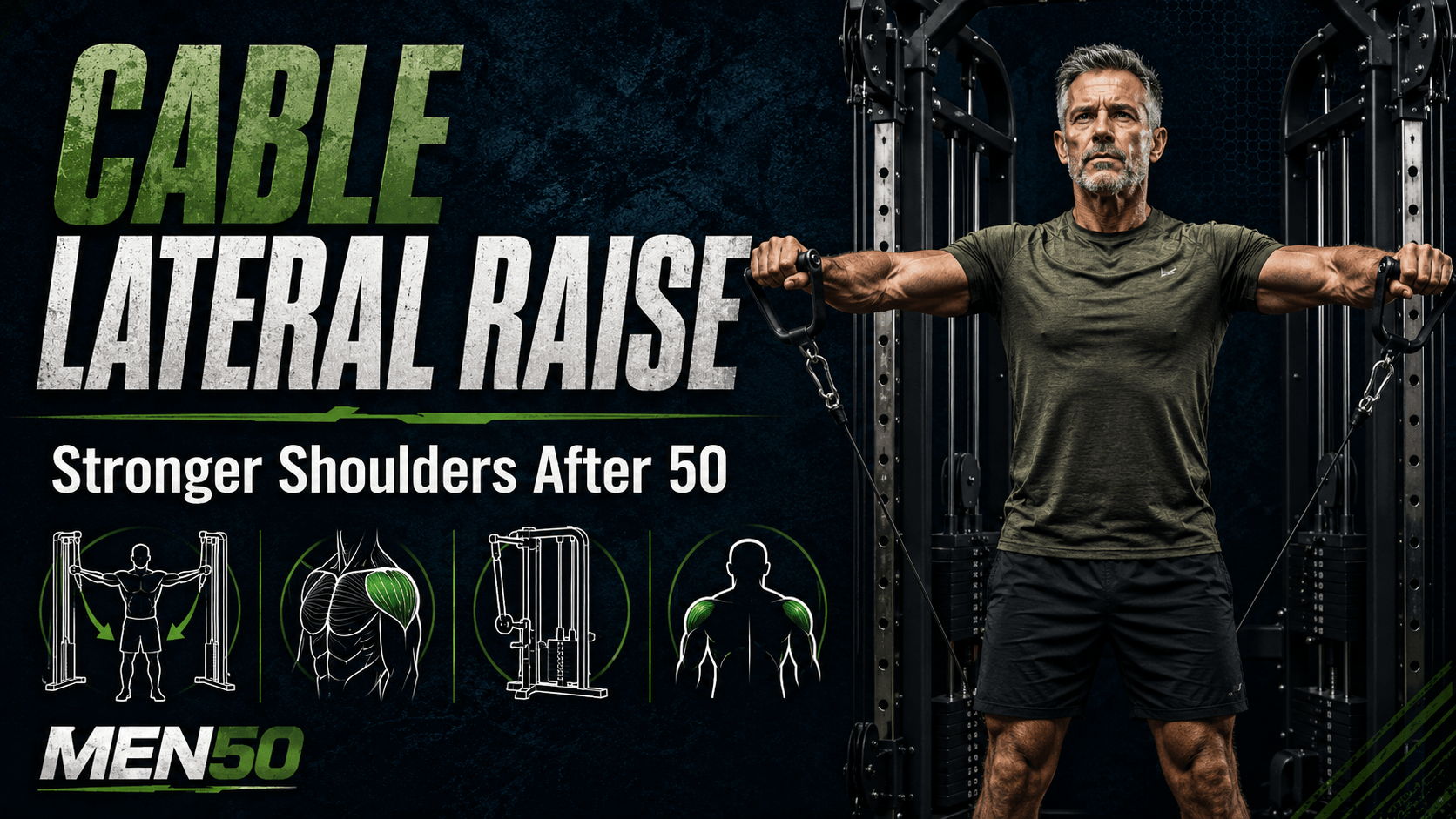
The cable lateral raise is the cable-machine version of the dumbbell lateral raise — and for the side deltoids specifically, it’s often the more effective version. Here’s why: dumbbells produce maximum tension at the top of the rep (when the arms are horizontal and gravity is perpendicular to the lever arm) and zero tension at the bottom (when the arms hang straight down and gravity pulls straight through the dumbbell). The cable does the opposite — maximum tension at the bottom and through the middle, which is exactly where the side deltoid does most of its work. For men over 50 with gym access, the cable lateral raise is often the better choice for side delt development.
Part of the Build Muscle After 50 pillar — strength training for men over 50.
Key Takeaways
- The cable lateral raise targets the side deltoids specifically — the part of the shoulder that creates the broader, more capped shoulder appearance.
- The cable provides constant tension throughout the rep, especially at the bottom where dumbbells lose tension entirely.
- Programming: 2–3 sets of 10–15 reps, 1–2 times per week. Rest 45–60 seconds between sets.
- Use light to moderate weight and focus on side delts. Control every rep. Quality beats weight every time.
- Critical safety rule: raise only to shoulder height, never above. Going above shoulder height puts the shoulder in the impingement-prone position.
How to Perform the Cable Lateral Raise
Set up first:
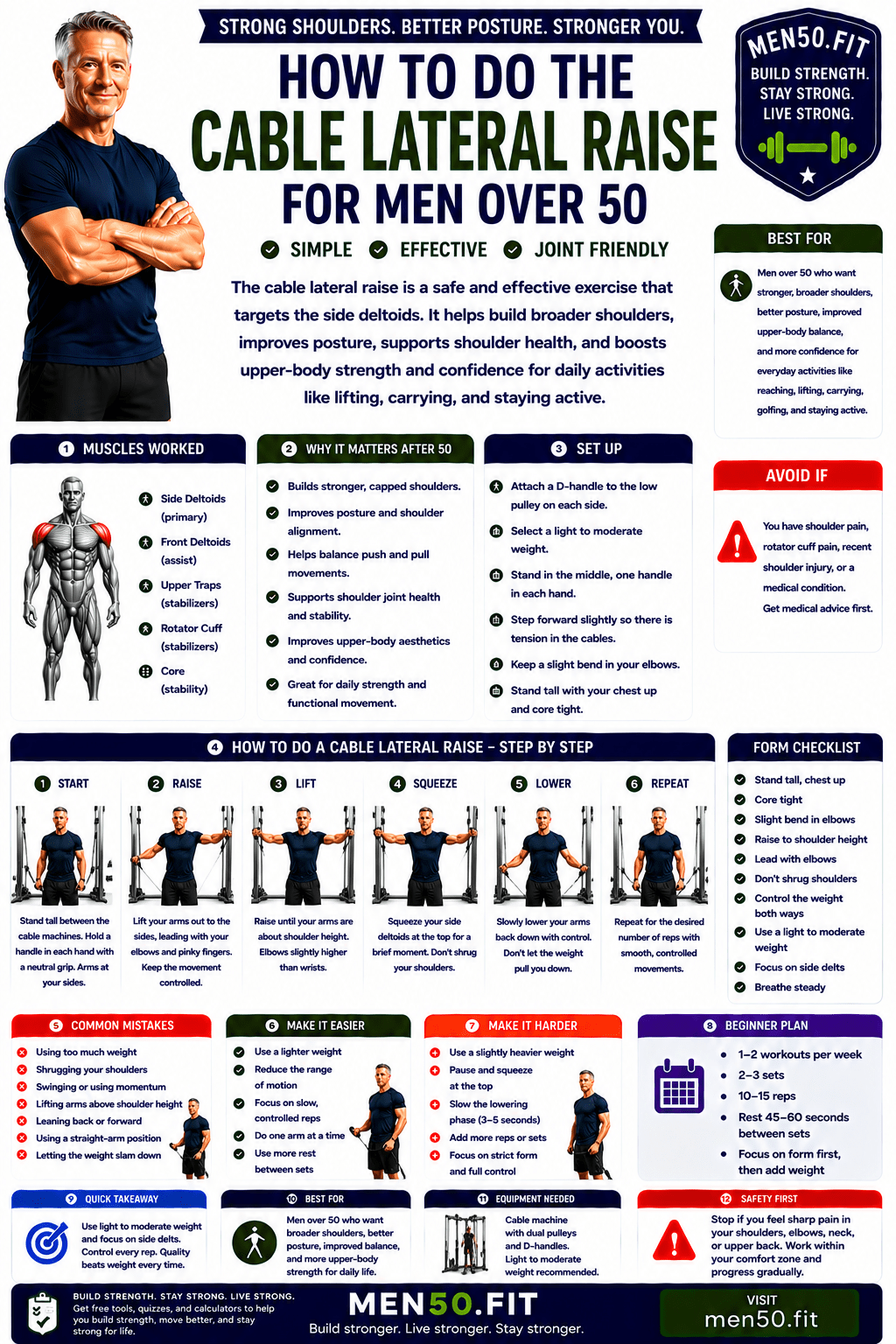
- Attach a D-handle to the low pulley on each side of a dual cable machine (the kind with cables on both sides of a frame).
- Select a light to moderate weight — this is genuinely a light exercise. Start with 5–10 lbs (2–5 kg) per side.
- Stand in the middle of the cable machine, one handle in each hand. The cables run from the low pulleys on each side, across in front of your body, to the opposite hand.
- Step forward slightly so there is tension in the cables even at the bottom of the rep (arms by your sides). This pre-tension is the whole point of using cables.
- Keep a slight bend in your elbows — about 10–15 degrees, fixed throughout the rep.
- Stand tall with your chest up, core tight, shoulders down and back.
Then the movement:
- Start. Stand tall between the cable machines. Hold a handle in each hand with a neutral grip. Arms at your sides, slight elbow bend. Cables under tension.
- Raise. Lift your arms out to the sides, leading with your elbows and pinky fingers. Take 1–2 seconds to lift. Keep the movement controlled.
- Lift. Raise until your arms are about shoulder height. Elbows slightly higher than wrists. Do not lift above shoulder height — stop exactly at shoulder level.
- Squeeze. Squeeze your side deltoids at the top for a brief moment. Don’t shrug your shoulders — keep shoulders pinned down, only the arms move up.
- Lower. Slowly lower your arms back down with control. Take 2–3 seconds on the way down. Don’t let the weight pull you down — control every rep, especially the eccentric.
- Repeat. Smooth, controlled movements throughout. Maintain upright posture without leaning forward or back.
The cue that matters most: lead with the elbows and pinky fingers, not the hands. This is the same principle established across the matrix’s shoulder isolation work (dumbbell lateral raise, rear delt fly, scaption raise) — when the elbows lead, the deltoids do the work; when the hands lead, the body recruits compensators (front delts, biceps, traps) instead. Think “pour out a glass of water” — the pinky-side of the hand tilts up slightly as you raise, which keeps the side deltoid in the working position.
Why the Cable Lateral Raise Matters After 50
The side deltoid is the part of the shoulder responsible for the broader, more capped appearance that distinguishes well-trained shoulders from undertrained ones. Beyond aesthetics, it has functional importance for men over 50:
| Daily Activity | Side Delt Role |
|---|---|
| Reaching laterally (cupboards, shelves) | Primary mover |
| Carrying bags away from the body | Stabiliser |
| Putting on a jacket | Active mover |
| Lifting objects to chest height from the floor | Assistance |
| Maintaining shoulder joint stability | Continuous |
Side delt weakness shows up as narrow-looking shoulders, difficulty with lateral reaching tasks, and poor shoulder joint stability during compound pressing exercises.
Why the Cable Version Specifically
The dumbbell lateral raise and cable lateral raise train the same muscle — but the resistance curves are completely different:
| Position | Dumbbell Tension | Cable Tension |
|---|---|---|
| Arms at sides (bottom) | Zero | Maximum |
| Arms at 45° | Low | High |
| Arms at horizontal (top) | Maximum | High |
With dumbbells, the side deltoid does almost no work at the bottom of the rep (gravity pulls straight through the dumbbell, no torque on the shoulder). Tension increases as the arms rise, peaking when the arms are horizontal. This is the classic resistance curve mismatch — the muscle is most stretched (and most ready to produce force) at the bottom, but it has nothing to push against.
With cables, the resistance comes from the cable’s direction of pull, which is roughly horizontal (the cable runs from the low pulley across to the opposite hand). At the bottom of the rep, this produces maximum torque on the shoulder joint — exactly when the muscle is most ready to work. Tension remains high through the middle of the rep and stays meaningful at the top.
For training the side deltoid specifically, this resistance curve matters. Many men over 50 doing dumbbell lateral raises feel they’re “working harder than the gains suggest” because the bottom 30–40% of every rep is essentially unloaded. Switching to cables (or using a band, which has a similar resistance curve) often produces visible side delt development that dumbbells alone don’t.
Position in the Shoulder Cluster
This article completes the side deltoid isolation pair in the shoulder cluster:
| Side Deltoid Exercise | Equipment | Resistance Profile |
|---|---|---|
| Dumbbell Lateral Raise | Dumbbells | Hard at top, easy at bottom |
| Cable Lateral Raise (this article) | Cable machine | Hard throughout, hardest at bottom |
For comprehensive shoulder development in the matrix, the side delt work joins:
- Front delt: Machine Shoulder Press, Dumbbell Shoulder Press, Pike Push-Up
- Side delt: Lateral raise variations (dumbbell + cable)
- Rear delt: Rear Delt Fly, Reverse Fly, Band Face Pull
- Front-side delt (scapular plane): Scaption Raise
That’s complete three-direction deltoid coverage at multiple equipment levels — particularly valuable for men over 50 because balanced deltoid development (not just front delts from chest pressing) is part of long-term shoulder health and impingement prevention.
Sets and Reps
The cable lateral raise is an isolation exercise — moderate to higher rep ranges work better than heavy loading.
| Stage | Sets × Reps | Frequency | Load Guide |
|---|---|---|---|
| Beginner | 2 × 10–12 | 1–2× per week | Very light (5 lbs / 2 kg per side) |
| Novice | 2–3 × 10–15 | 1–2× per week | Light (5–10 lbs / 2–5 kg per side) |
| Intermediate | 3 × 10–15 | 1–2× per week | Light-moderate (10–15 lbs / 5–7 kg per side) |
| Advanced | 3 × 10–15 | 1–2× per week | Moderate (15–20 lbs / 7–9 kg per side) + pause + slow lowering |
Rest 45–60 seconds between sets. Pick a weight where the last 2–3 reps feel clearly challenging but you can complete them with: upright posture, no shrugging, no swinging, raising only to shoulder height, controlled tempo both directions.
A practical note on load: the side delt is a small muscle. Even strong men rarely lateral-raise more than 20 lbs per side with clean form. If you’re using 25+ lbs per side and the reps feel doable, you’re almost certainly compensating with the upper traps and swinging from the torso. Quality beats weight on this exercise, every time. Most men over 50 plateau between 10–15 lbs per side — and that’s perfectly fine for excellent side delt development.
Common Mistakes
The seven errors that turn a useful shoulder exercise into a neck/shoulder problem:
- Using too much weight. The single most common mistake on lateral raises (cable or dumbbell). Heavy weights force compensation — shoulder shrug, body swing, partial reps, hands leading. Drop a size if form breaks down. Side delt isolation rewards form, not heroic loads.
- Shrugging your shoulders. As you lift, the upper traps want to hike the shoulders toward the ears — particularly if the weight is too heavy. This shifts work from the side deltoid to the upper traps and stresses the neck. Pin shoulders down and back before each rep; keep them there throughout.
- Swinging or using momentum. Rocking back and forth to launch the weight uses elastic recoil from the body and the cables. Stay still in the torso; only the arms move.
- Lifting arms above shoulder height. Going higher than shoulder level moves the shoulder into the impingement-prone position and recruits the upper traps. Stop exactly at shoulder height — elbows in line with the shoulders, no higher.
- Leaning back or forward. Body movement compensates for shoulder strength limits. Stand upright with a neutral spine throughout.
- Using a straight-arm position. Locking the elbows out increases the lever arm and stresses the elbow joint. Slight elbow bend (10–15 degrees) throughout, fixed.
- Letting the weight slam down. Dropping the weight at the end of each rep skips the eccentric phase (where significant muscle development happens) and disengages the working muscle. Control the lowering all the way back to the start.
Make It Easier or Harder
If standard cable lateral raise reps are too challenging:
- Use a lighter weight — even 2.5–5 lbs per side is plenty for beginners.
- Reduce the range of motion — lift partway up while you build strength.
- Focus on slow controlled reps — clean reps with very light weight train the pattern.
- Do one arm at a time — easier to focus on form, and exposes left-right asymmetry.
- Use more rest between sets — 60–90 seconds.
To make it harder once form is solid:
- Use a slightly heavier weight — but only when the lighter weight feels easy with clean form. Don’t progress aggressively on this exercise.
- Pause and squeeze at the top for 2–3 seconds with the side delt fully contracted.
- Slow the lowering phase to 3–5 seconds per rep — significantly more demanding than it sounds.
- Add more reps or sets — extend to 15–20 reps per set.
- Focus on strict form and full control — eliminate any momentum.
For variety, try the single-arm cable lateral raise (one cable, the other hand on a stable surface for balance) — exposes left-right asymmetry, easier to focus on side delt activation. The single-arm version is particularly useful because most men over 50 have meaningful left-right deltoid asymmetry from years of one-side-dominant activities.
Safety Note
Avoid the cable lateral raise if you have shoulder pain, rotator cuff pain, recent shoulder injury, or a relevant medical condition. Get medical advice first.
Shoulder pain during the cable lateral raise has three common causes. (1) Lifting above shoulder height — this moves the shoulder into the impingement zone. Stop at shoulder level. (2) Shrugging shoulders — this stresses the neck and shoulder. Keep shoulders pinned down. (3) Too much weight — heavy lateral raises always force compensation. Drop a size. If pain persists after fixing all three, the lateral raise position may not be right for your current shoulder status — switch to the scaption raise (working in the scapular plane rather than the frontal plane is more shoulder-friendly for many men) or work with a physiotherapist on shoulder mobility.
Neck pain during the rep almost always means the upper traps are doing the work. Keep shoulders pinned down — imagine the shoulder blades sliding down your back as the arms rise. If you can’t keep shoulders down, the weight is too heavy.
Rotator cuff irritation can be triggered by repeated lateral raises beyond shoulder height. Strict shoulder-height limit prevents this for most men over 50. If you have a history of rotator cuff issues, consider switching to scaption raises (which avoid the impingement position by design).
Elbow pain is uncommon but can occur if the elbows lock out into straight-arm position. Slight elbow bend throughout.
If you feel sharp pain anywhere during the rep, stop. Mild muscular fatigue in the side delts is normal; sharp joint pain is not.
Build Your Personal Training Plan
The cable lateral raise is one piece of a complete shoulder programme. Get a personalised exercise plan based on your current strength, goals, and any limitations.
Take the Free Fitness Profiler →
FAQs
Cable lateral raise vs dumbbell lateral raise — which is better?
For training the side deltoid specifically, the cable version is generally more effective because of the resistance curve. Dumbbells produce zero tension at the bottom of the rep (when the muscle is most stretched) and maximum tension at the top — which is the opposite of how the side delt actually works. Cables produce constant tension, with the most tension at the bottom and through the middle of the range — matching what the side delt needs. However, dumbbells have practical advantages: they don’t require gym access, they’re easier to set up, and they’re more familiar to most men. For men over 50 with gym access, the cable version is the better tool for side delt development; for men training at home, the dumbbell version is fine and still trains the muscle effectively. Many men over 50 use both — cables in the gym, dumbbells at home or when travelling.
How heavy should the weight be?
Lighter than your ego suggests. For most men over 50 starting out, 5–10 lbs (2–5 kg) per side. After 3–6 months of training, many progress to 10–15 lbs per side. Advanced lifters often plateau around 15–20 lbs per side — and that’s perfectly fine for excellent side delt development. The right weight lets you complete the rep range with: upright posture, no shrugging, no swinging, slight elbow bend maintained, raising exactly to shoulder height, controlled tempo. If you’re using 25+ lbs per side and the reps feel doable, you’re almost certainly compensating with the upper traps or swinging from the torso. The side delt is a small muscle — heavy weights don’t train it better, they just recruit other muscles to compensate. Light to moderate weight with strict form beats heavy weight with compensation, every time.
Why shouldn’t I lift above shoulder height?
Two reasons. (1) Impingement risk — when the arm rises above shoulder height with the thumb pointing forward (or in neutral grip), the head of the humerus (upper arm bone) compresses the structures in the shoulder joint, particularly the supraspinatus tendon and the subacromial bursa. Repeated loading in this position contributes to rotator cuff irritation and shoulder impingement syndrome — particularly relevant for men over 50, whose shoulder structures are less resilient than younger lifters’. (2) Upper trap recruitment — going above shoulder height shifts work from the side deltoid to the upper traps, which means you’re training a different muscle than you intended. The strict rule: stop exactly when the elbows reach shoulder level. Going higher doesn’t train the side delt better; it just adds risk.
Should I do this with shoulder issues?
It depends on the issue. For chronic mild impingement or rotator cuff irritation, the cable lateral raise can be problematic because even shoulder-height lifting can aggravate the position. Consider switching to the scaption raise instead — lifting in the scapular plane (about 30 degrees forward from directly out to the sides) avoids the impingement position by design. For acute shoulder pain or recent injuries, skip lateral raises entirely until cleared by a physiotherapist. For healthy shoulders with minor occasional discomfort, the cable lateral raise with strict form (light weight, no shrugging, stopping at shoulder height) is generally fine. The general principle: if a specific weight or range causes sharp shoulder pain, stop. Don’t train through joint pain on this exercise.
Can I do this with bands at home?
Yes — bands have a similar resistance curve to cables (hard at bottom, easier at top), so band lateral raises are a reasonable home substitute. Setup: stand on the band (one foot on the band’s middle), hold the handles in each hand at your sides, raise out to shoulder height as you would with the cable version. The challenge is that the band tension varies based on band thickness and how tightly you’ve stretched it, so progressive overload is less precise than with cables. For men over 50 training at home, alternating between band lateral raises and dumbbell lateral raises gives both resistance curves and produces well-rounded side delt development.
References
- Janda V. Muscles, Central Nervous Motor Regulation and Back Problems. In: Korr IM (ed). The Neurobiologic Mechanisms in Manipulative Therapy. Plenum Press; 1978. (Upper Crossed Syndrome framework.)
- Kibler WB, Sciascia A. Current concepts: scapular dyskinesis. British Journal of Sports Medicine. 2010;44(5):300-305.
- American College of Sports Medicine. Resistance Training for Older Adults Position Stand. acsm.org
Disclaimer: This article is for educational purposes only and is not medical advice. Consult a qualified healthcare professional before starting any new exercise programme, especially if you have existing shoulder or neck conditions.