
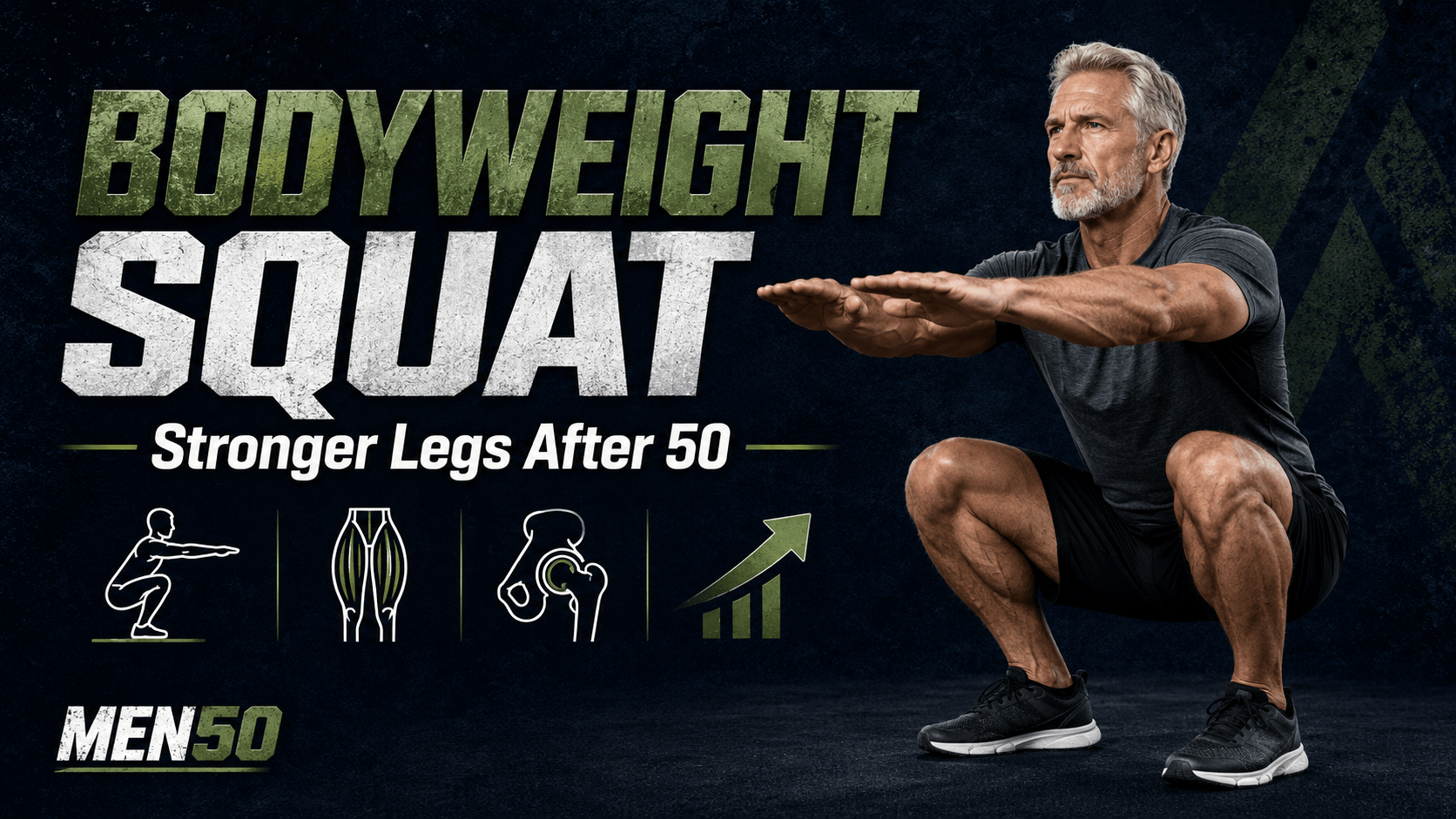
The bodyweight squat is the milestone movement in any man’s lower-body training. For men over 50, it’s the moment the chair comes out of the picture — no longer a target to tap, no longer a starting point to rise from. Just you, your bodyweight, and a movement pattern your body should be able to perform freely for life. It builds leg strength, hip control, and the everyday-movement confidence that quietly disappears in men who haven’t trained their legs in years.
Part of the Build Muscle After 50 pillar — strength training for men over 50.
Key Takeaways
- The bodyweight squat trains quads, glutes, hamstrings, core, and calves in a fundamental movement pattern your body uses every day.
- Programming: 2–4 sets of 8–12 reps, 2–3 times per week. Rest 60–90 seconds between sets.
- Control the lowering, keep your heels down, and let your hips and knees bend together. That’s the entire technique in one cue.
- This is the unsupported step in the squat progression chain: sit-to-stand → chair squat → bodyweight squat → goblet squat.
- Depth doesn’t matter as much as form. A controlled half-squat with clean mechanics beats a full squat with rounded back and lifting heels every time.
How to Perform the Bodyweight Squat
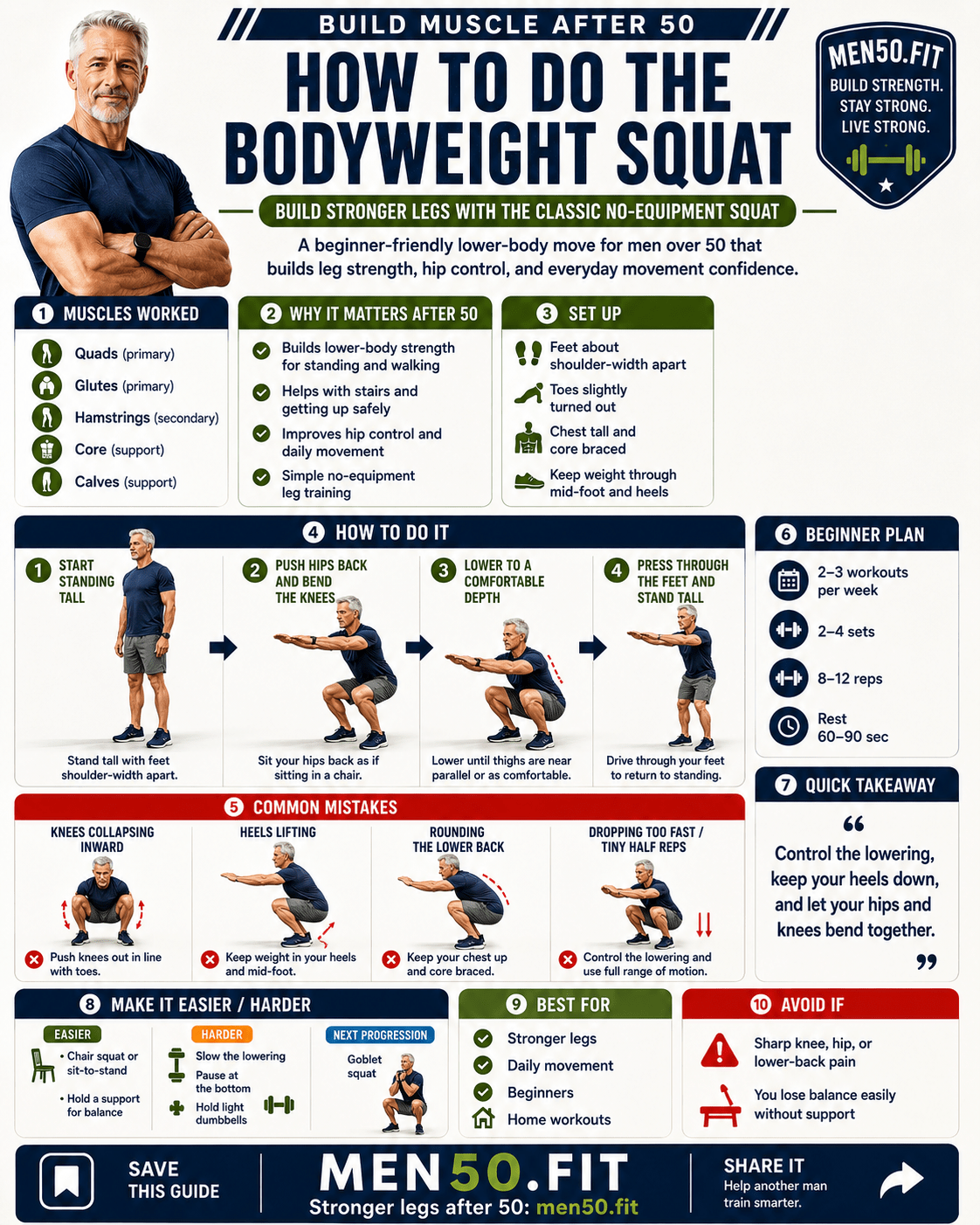
Set up first:
- Feet about shoulder-width apart.
- Toes slightly turned out (about 10–15 degrees).
- Chest tall and core braced.
- Weight distributed through mid-foot and heels — not the balls of the feet.
Then the movement:
- Start standing tall. Feet shoulder-width apart, arms extended forward for counterbalance or hands clasped at chest height. Core engaged.
- Push hips back and bend the knees. Initiate the squat by pushing your hips back like you’re sitting into an invisible chair, then bend the knees. Hips and knees should bend together — not one then the other. Take 2–3 seconds on the way down.
- Lower to a comfortable depth. Aim for thighs near parallel to the floor — or whatever depth your hips, knees, and ankles allow with clean form. Knees track over the toes, chest stays up, heels stay planted.
- Press through the feet and stand tall. Drive through the mid-foot and heels to return to standing. Squeeze the glutes at the top. Don’t rush — controlled reps build more strength than fast ones.
The cue that matters most: control the lowering, keep your heels down, and let your hips and knees bend together. Most squat problems trace back to one of those three breaking down.
Why the Bodyweight Squat Matters After 50
The squat is a fundamental human movement pattern — children do it naturally, and adults in cultures that sit on the floor maintain it for life. In the West, decades of chair-sitting effectively delete the pattern from most men by their 50s. The hip mobility, ankle mobility, and quad strength needed for a clean unsupported squat all decline if they’re not actively maintained.
Lower body strength declines at roughly 1–2% per year after 50 without training, and the squat-related muscles — quads, glutes, hip extensors — decline faster than smaller muscles. The visible result shows up gradually: harder to climb stairs, awkward getting in and out of low cars, needing to push off chair arms. The hidden result is more concerning. Hip extension strength correlates closely with fall risk in older adults, and the same muscle groups that produce a clean squat are the ones that catch you if you stumble.
Training the bodyweight squat directly reverses this decline. It builds the prime movers of standing up, walking, and stair climbing — and it does so in a position that demands hip, knee, and ankle mobility all at once. Men who do bodyweight squats consistently for 6–12 weeks typically see clear improvements in: stair climbing speed, ease of rising from low surfaces, walking power, and balance.
There’s also a milestone aspect that matters. Moving from a chair squat to an unsupported bodyweight squat is the moment many men over 50 mentally cross from “rebuilding” to “training.” The confidence that comes from squatting freely transfers to every other lower-body movement in the matrix.
Sets and Reps
Build quality reps first. Depth and load come second.
| Stage | Variation | Sets × Reps | Frequency |
|---|---|---|---|
| Beginner | Bodyweight squat, hand on chair for balance | 2–3 × 8–10 | 2× per week |
| Novice | Bodyweight squat, unsupported, partial depth | 3 × 8–12 | 2–3× per week |
| Intermediate | Bodyweight squat, parallel depth | 3 × 10–12 | 2–3× per week |
| Advanced | Slow 3-second lowering + 1-second pause at bottom | 3 × 8–12 | 2–3× per week |
| Progression | Goblet squat (dumbbell at chest) | 3 × 8–12 | 2–3× per week |
Rest 60–90 seconds between sets. Stop the set 1–2 reps before form breaks — pushing through compensation (heels lifting, knees caving, rounding the back) trains the wrong patterns under load.
When you can complete 3 sets of 12 bodyweight squats with a controlled 2-second descent, parallel depth, and no form breakdown, you’ve earned the goblet squat — the natural next step.
Common Mistakes
The four errors that turn a great exercise into a knee or back problem:
- Knees collapsing inward. Common when the glutes are weak. As you stand up, drive the knees outward to track over the second and third toes. If the knees still cave, drop reps and add glute bridges into your routine.
- Heels lifting. Means your ankle mobility is limiting depth, or you’re shifting weight forward onto your toes. Push the weight back into your heels and mid-foot. If heels still come up at depth, work on calf/ankle mobility and only squat to the depth where heels stay planted.
- Rounding the lower back. The lumbar curling forward at the bottom is the body’s way of compensating for limited hip mobility or weak glutes. Keep the chest up and the core engaged. If the round shows up only at the bottom, reduce depth — squat only as far as your back can stay flat.
- Dropping too fast or tiny half reps. Speed lets you cheat without noticing — momentum carries you up rather than your muscles. And shallow reps skip the part of the range where the strength gets built. Lower with control, use full range you can manage, drive up smoothly.
Make It Easier or Harder
If standard bodyweight squats are too challenging:
- Hold a chair, counter, or sturdy support with one hand for balance and load-sharing.
- Drop back to the chair squat or sit-to-stand until your legs are stronger. There’s no shame in going back a step — strength is built from where you are.
- Reduce depth — partial-range bodyweight squats are still useful work while you build mobility and strength.
To make bodyweight squats harder once form is solid:
- Slow the lowering phase to 3–4 seconds per rep.
- Add a 1–2 second pause at the bottom.
- Hold light dumbbells at your sides (10–20 lbs / 5–9 kg per hand) — this is a small step up rather than a true progression.
- Progress to the goblet squat — hold a single dumbbell vertically at your chest. The front-loaded position improves squat mechanics and is the natural next step for most men over 50.
Safety Note
Avoid the bodyweight squat if you have sharp knee, hip, or lower-back pain that doesn’t improve with reduced depth, or if you lose balance easily without support. If you have a diagnosed joint condition, get clearance from a physiotherapist before progressing past chair-supported variations.
Don’t grind through depth your mobility doesn’t allow. Squat only as deep as your back stays flat and your heels stay planted. Forcing more depth is how form breaks down and lower backs get injured. Mobility improves over weeks of practice — let depth come naturally as it improves.
Make sure the floor is non-slip. Stockings on a polished floor are how knees end up on the ground unexpectedly.
Build Your Personal Training Plan
The bodyweight squat is one piece of a complete lower-body programme. Get a personalised exercise plan based on your current strength, mobility, and any limitations.
Take the Free Fitness Profiler →
FAQs
How deep should my squat go?
Aim for thighs near parallel to the floor — that’s the standard target. But your maximum depth is determined by where your form breaks: heels lifting, lower back rounding, or knees caving. If those happen at half-depth, half-depth is your current limit. Mobility improves over weeks; partial range with clean form beats full range with compensations every time. Most men over 50 can reach parallel within 6–12 weeks of consistent practice if they include hip flexor stretches and ankle mobility work alongside.
What’s the difference between a bodyweight squat and a chair squat?
The chair squat uses a chair as a depth marker — you lightly tap the seat at the bottom of each rep, which provides a fixed target and a safety net. The bodyweight squat removes the chair entirely. You control your own depth based on your form and mobility. Chair squats are the right starting point for most men over 50; bodyweight squats are the unsupported next step. Move on when you can do 3 sets of 12 chair squats with clean form and feel ready to lose the safety net.
Should my knees go past my toes?
A small amount of knee travel past the toes is normal and not harmful — biomechanics research has been clear on this for years. The bigger problem is the opposite: men who try hard to keep their knees behind their toes often round the lower back instead, which loads the spine. Push the hips back first, let the knees track naturally over the toes, and don’t worry about a small amount of forward travel. The knees should track over the toes, not collapse inward.
Why do my heels keep lifting when I squat?
Two common causes. Limited ankle mobility — the ankle can’t bend forward enough to allow deep knee bend with the foot flat. Weight too far forward — you’re shifting onto the balls of your feet instead of distributing through the mid-foot and heels. Fix the weight distribution first by consciously pushing weight back into your heels. If heels still lift, work on ankle mobility (calf stretches, slow squats holding a doorframe for assistance) and reduce squat depth to where your heels stay planted.
How do I know when I’m ready for goblet squats?
When you can do 3 sets of 12 bodyweight squats with: a controlled 2-second descent, thighs reaching parallel, heels staying planted, chest up, and no form breakdown on the last reps. Hit that consistently for 2–3 sessions in a row and you’ve earned the goblet squat. Start with a light dumbbell (15–25 lbs / 7–11 kg) held vertically at chest height — the front-loaded position actually improves squat mechanics for most men.
References
- Rikli RE, Jones CJ. Development and validation of a functional fitness test for community-residing older adults. Journal of Aging and Physical Activity. 1999;7(2):129-161.
- American College of Sports Medicine. Resistance Training for Older Adults Position Stand. acsm.org
- National Institute on Aging. Exercise & Physical Activity: Your Everyday Guide. nia.nih.gov
Disclaimer: This article is for educational purposes only and is not medical advice. Consult a qualified healthcare professional before starting any new exercise programme, especially if you have existing knee, hip, or back conditions.