
The step-up is one of the most useful lower-body exercises you can do after 50. It directly trains the strength you use every time you climb stairs, step off a kerb, or rise from a chair — and it does it one leg at a time, which is how your body actually moves through the world. A sturdy step, a low box, or the bottom of a staircase is all you need.
Part of the Build Muscle After 50 pillar — strength training for men over 50.
Key Takeaways
- The step-up builds single-leg strength, balance, and stair-climbing capacity in one movement.
- Start with a low step (6–8 inches), 2–3 sets of 8–10 reps per leg, 2–3 times per week.
- Drive through the heel of the elevated foot — pushing through the toes shifts load onto the knee.
- The lowering phase is where most of the strength and balance gets built. Slow it down.
- Progress in this order: step height first, then tempo, then light dumbbells.
How to Perform the Step-Up
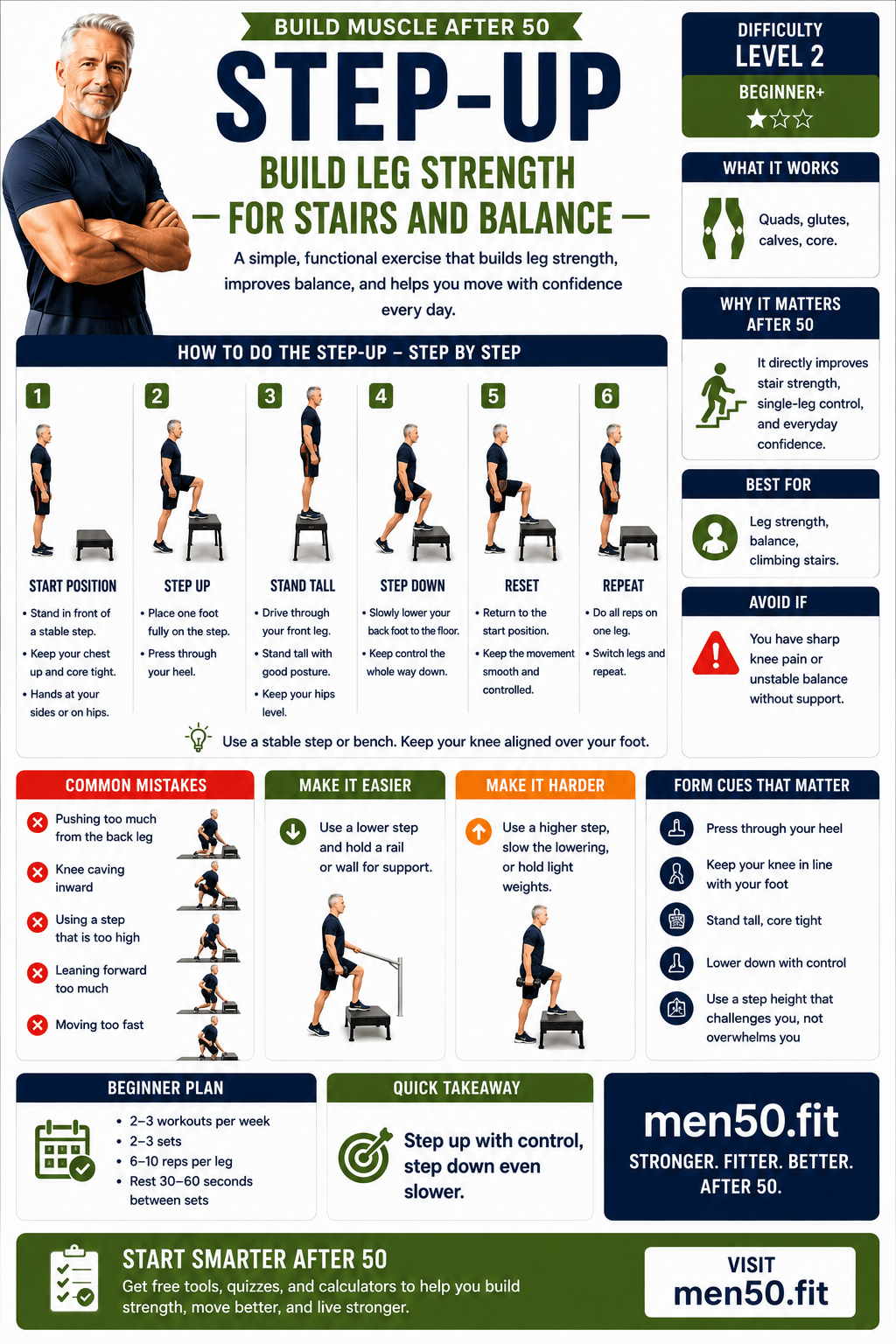
- Stand facing a sturdy step or box that puts your knee at roughly 90 degrees when your foot is on it.
- Place your right foot fully on the step. The entire foot should be in contact — no toes hanging off the edge.
- Drive through the heel of your right foot to push your body upward, bringing your left foot up to meet the right.
- Stand tall at the top for a moment. Keep your torso upright — don’t lean forward.
- Lower your left foot slowly back to the floor. Control the descent.
- Complete all reps on one leg before switching, or alternate legs each rep.
Keep your hands at your sides or lightly on your hips. If you need balance support, one hand on a wall or rail is fine while you learn.
Why the Step-Up Matters After 50
Single-leg strength is the foundation of fall prevention. Most falls don’t happen during smooth two-legged walking — they happen during transitions, when one leg has to support your full bodyweight while the other moves. Stepping up onto a kerb, getting out of a car, climbing stairs, navigating uneven ground. The step-up trains exactly this capacity.
It also targets the glutes, which are the engine for everything from walking speed to standing up out of a chair. The glutes weaken faster than most other muscles after 50, particularly if you spend long hours sitting, and that weakness shows up as a slower gait, reduced stair-climbing ability, and lower back strain. The step-up forces the glutes to fire on every rep because they’re the prime mover for hip extension at the top of the movement.
Compared with traditional barbell squats, the step-up is also easier on the lower back. There’s no loaded bar on your shoulders, and the single-leg pattern reduces the spinal compression that some men over 50 find limits how heavy they can squat.
Sets and Reps
Start conservatively. Progress one variable at a time — never increase step height, tempo, and weight in the same week.
| Stage | Step Height | Sets × Reps | Frequency | Load |
|---|---|---|---|---|
| Beginner | 6–8 inches | 2–3 × 8–10 per leg | 2–3× per week | Bodyweight |
| Intermediate | 10–12 inches | 3 × 10–12 per leg | 2–3× per week | Bodyweight, slow 3-second lowering |
| Advanced | 14–18 inches | 3–4 × 8–12 per leg | 2–3× per week | Light–moderate dumbbells |
Rest 30–60 seconds between sets. Only raise step height once you can complete every rep with a fully upright torso and a controlled lowering phase.
Common Mistakes
Five errors that turn a good step-up into a knee problem:
- Pushing off the back leg. Means your front leg isn’t doing the work. Lift the back foot slightly off the floor before each rep so the front leg has to drive the entire movement.
- Driving through the toes. Shifts the load forward and stresses the knee. Press through the heel — you should feel the glute fire at the top.
- Knee caving inward. Cue yourself to drive the knee out over the middle toes. If the knee still caves, the step is too high or the load is too heavy.
- Leaning the torso forward. Reduces glute involvement and turns the movement into a quad-only lift. Stay tall.
- Rushing the lowering phase. The negative is where strength is built. Take twice as long lowering as you did stepping up.
Make It Easier or Harder
If the basic step-up is too challenging, use a lower step (4–6 inches) and hold a wall or sturdy rail with one hand. As balance improves, reduce to fingertip support, then no support at all.
To make it harder once form is solid: use a higher step, slow the lowering phase to a 3- or 4-second count, or hold dumbbells at your sides. Start with 5–10 lbs (2–4 kg) per hand. Avoid holding weights on your shoulders — that adds spinal load most men over 50 don’t need.
Safety Note
Make sure the step or box is completely stable before loading it with your full bodyweight. A wobbling step is how injuries happen. If you’re using stairs at home, the bottom two steps are usually fine; if you’re using a box or platform at the gym, check it doesn’t slide on the floor.
Drive up through the heel of the elevated foot — pushing through the toes shifts load onto the knee rather than the hip. Use a wall or railing for balance when first learning the movement. If you have a diagnosed knee or hip condition, get clearance from a physiotherapist before adding load.
Build Your Personal Training Plan
The step-up is one piece of a complete lower-body programme. Get a personalised exercise plan based on your current strength, goals, and any limitations.
Take the Free Fitness Profiler →
FAQs
Is the step-up safe for men over 50 with knee pain?
Mild discomfort often improves with step-ups because they strengthen the quads and glutes that support the knee. But if you have sharp pain, sudden swelling, or a diagnosed condition like a meniscus tear or moderate-to-severe arthritis, get clearance from a physiotherapist first. Start with a 4–6 inch step and stop if pain increases.
What height should the step be?
For beginners, the step should put your knee at roughly 90 degrees when your foot is placed on it — usually 6–8 inches. Going higher too soon forces the knee forward over the toes and shifts the load away from the glutes. Only progress to a taller step when bodyweight reps feel easy and your form stays clean.
How often should men over 50 do step-ups?
Two to three sessions per week is the sweet spot. That’s enough stimulus to build strength while allowing recovery, which becomes more important after 50. Pair step-ups with one or two other lower-body movements like sit-to-stands or glute bridges for a balanced session.
Should I use weights?
Not at first. Master bodyweight step-ups with clean form for at least 3–4 weeks before adding load. When you progress, hold light dumbbells (5–10 lbs / 2–4 kg) at your sides — not on your shoulders, which adds spinal load most men over 50 don’t need.
What if I can’t balance on one leg?
Hold a wall, rail, or sturdy chair with one hand while learning. As balance improves, reduce to fingertip support, then no support at all. Practising the Single-Leg Stand on the side will speed up your balance progression.
References
- National Institute on Aging. Exercise & Physical Activity: Your Everyday Guide. nia.nih.gov
- Centers for Disease Control and Prevention. Older Adult Falls Data. cdc.gov
- American College of Sports Medicine. Physical Activity Guidelines for Older Adults. acsm.org
Disclaimer: This article is for educational purposes only and is not medical advice. Consult a qualified healthcare professional before starting any new exercise programme, especially if you have existing joint, heart, or balance conditions.