
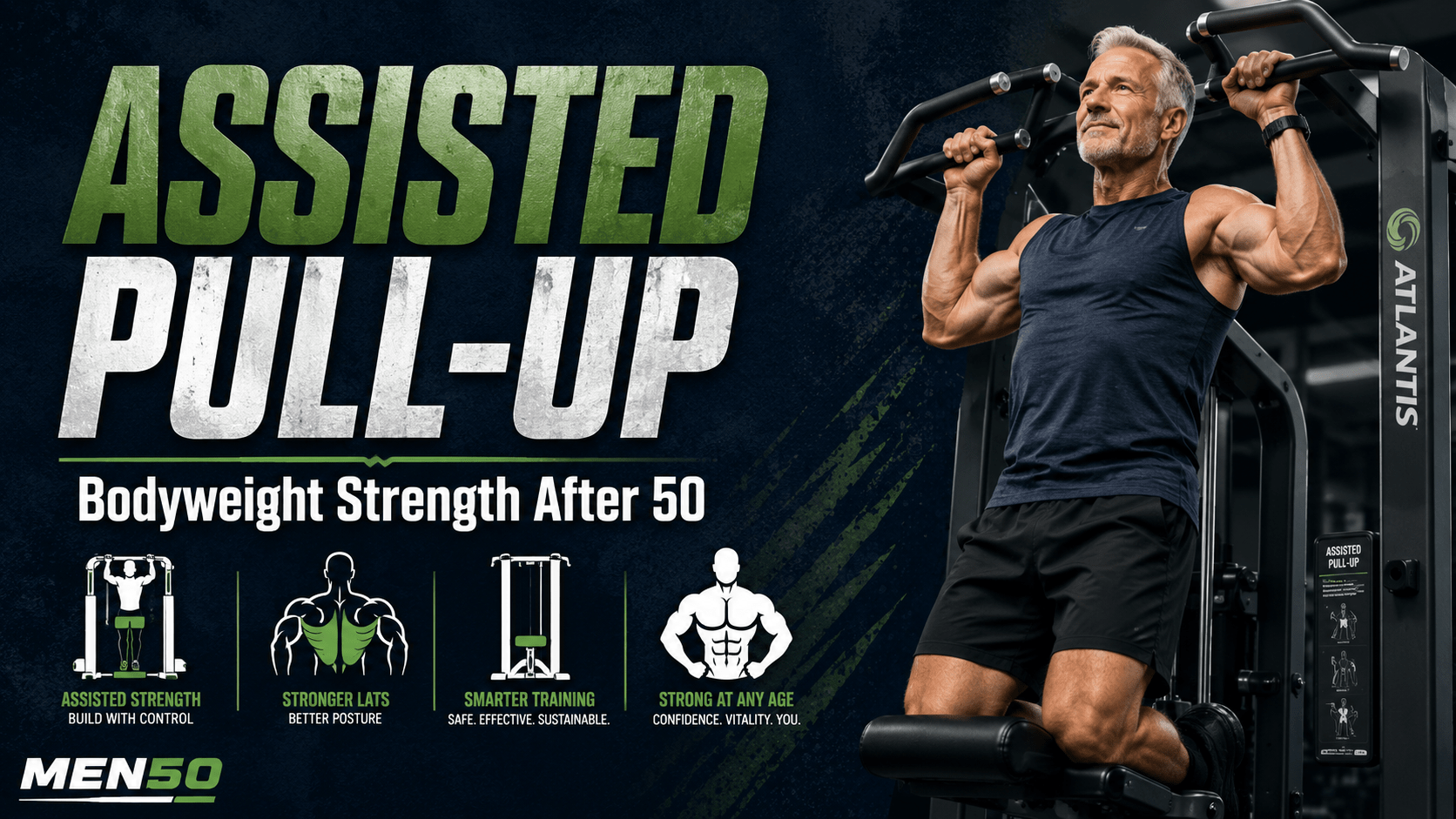
The assisted pull-up is the bridge between machine-based vertical pulling (lat pulldown, band lat pulldown) and bodyweight pull-ups. It uses an assisted pull-up machine (the kind with a kneeling or standing platform that counterweights a portion of your bodyweight) to make the full pull-up pattern achievable while you build the strength to do it unassisted. For most men over 50, this exercise is optional — the lat pulldown is enough for back development on its own. But for men who specifically want bodyweight pull-up strength as a fitness goal, the assisted pull-up is the dedicated progression path. The strength transfer from lat pulldowns alone isn’t enough to deliver pull-ups; the assisted version is what gets you there.
Part of the Build Muscle After 50 pillar — strength training for men over 50.
Key Takeaways
- The assisted pull-up uses a machine that counterweights part of your bodyweight, making the full pull-up motion achievable while you build strength.
- It’s the specific progression path for men over 50 who want to develop true bodyweight pull-up strength — something the lat pulldown alone doesn’t deliver.
- Programming: 2–4 sets of 6–10 reps, 1–2 times per week. Rest 60–90 seconds between sets.
- Pull with your back, not just your arms. Chin over the handles. Control the lowering.
- This exercise is optional in the matrix — for back development alone, the lat pulldown is sufficient. The assisted pull-up is for men who want pull-ups specifically.
How to Perform the Assisted Pull-Up
Set up first:
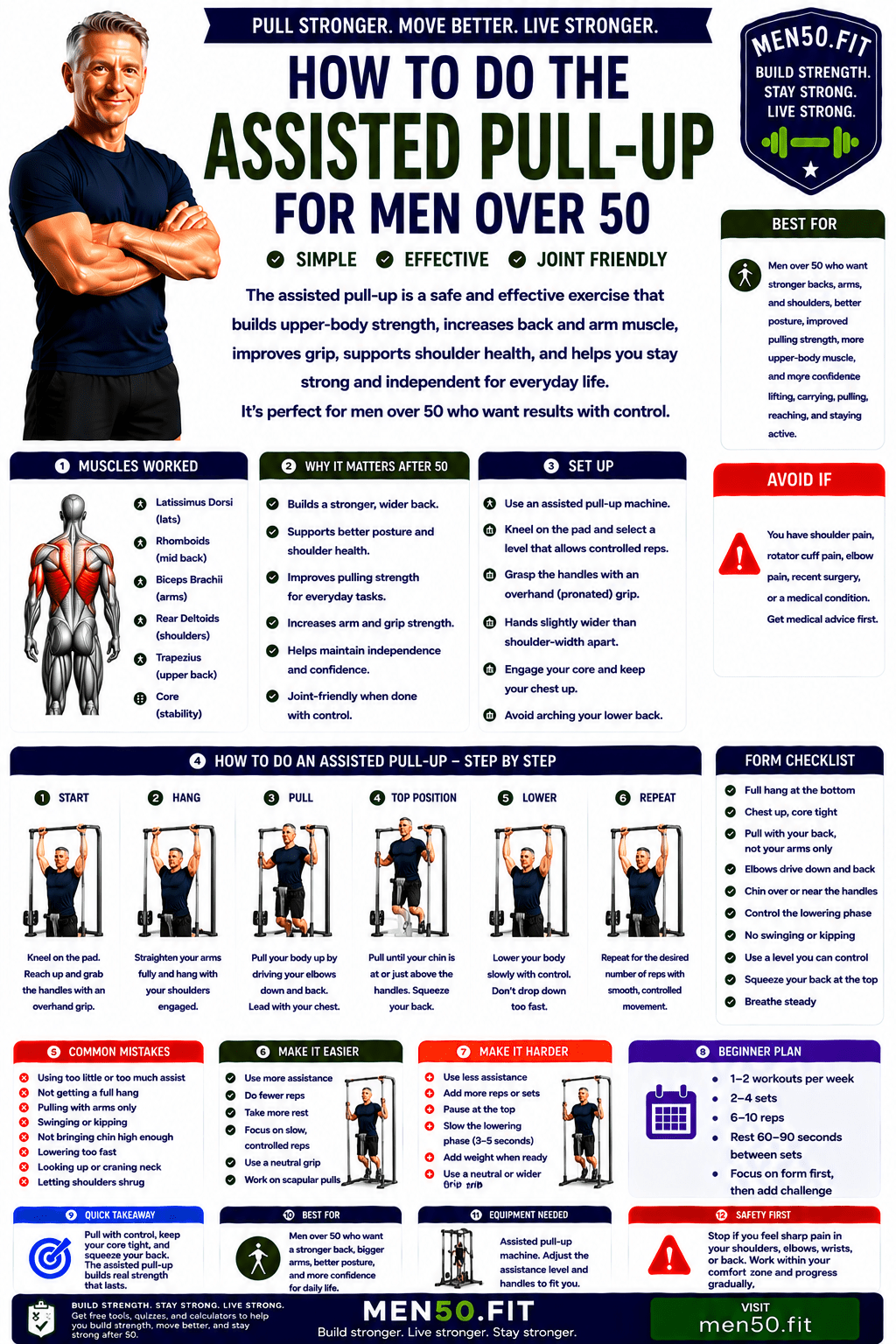
- Use an assisted pull-up machine — the standard gym version has a kneeling pad (or standing platform) that descends as you go up and rises as you go down, counterweighting a selected amount of your bodyweight.
- Select a level that allows controlled reps. Start with significant assistance — typically 50–60% of your bodyweight if you’re new to the exercise.
- Kneel on the pad (or stand if the machine uses a foot platform).
- Reach up and grasp the handles with an overhand (pronated) grip, hands slightly wider than shoulder-width.
- Engage your core, keep your chest up.
- Avoid arching your lower back — neutral spine throughout.
Then the movement:
- Start. Kneel on the pad. Reach up and grab the handles with an overhand grip, hands slightly wider than shoulder-width. Body braced.
- Hang. Straighten your arms fully and hang with your shoulders engaged — shoulders pulled down and back, not shrugged up to your ears. This is the bottom position of every rep.
- Pull. Pull your body up by driving your elbows down and back. Take 1–2 seconds to pull. Lead with your chest rising toward the bar — not just with your arms pulling on the handles.
- Top position. Pull until your chin is at or just above the handles. Squeeze your back at the top — feel the shoulder blades pulled together and down.
- Lower. Lower your body slowly with control. Take 2–3 seconds on the way down. Don’t drop down too fast — the eccentric phase is where significant strength gets built.
- Repeat. Smooth, controlled movement throughout. No swinging or kipping (using leg/hip momentum) — this isn’t CrossFit; men over 50 doing kipping pull-ups injure shoulders.
The cue that matters most: drive the elbows down and back, lead with the chest. Most men intuitively try to pull themselves up using arm strength (the biceps). This is exhausting and limits how high you can pull. Think “drive the elbows toward your hip pockets” — this engages the lats (the large back muscles) and brings the chest up toward the bar. When the back leads, you have far more strength available than when the arms lead alone.
Why the Assisted Pull-Up Matters After 50
I’m going to be honest about this exercise up front: the assisted pull-up is optional for most men over 50. The lat pulldown is generally sufficient for back development and provides equivalent muscle stimulus. You don’t need to do pull-ups to have a healthy, strong back.
But there are reasons men over 50 specifically work toward pull-ups, and those reasons are worth respecting:
1. Pull-Ups Are a Genuine Strength Milestone
Lifting your entire bodyweight is a meaningful benchmark of upper-body strength — one that declines with age unless deliberately trained. Many men over 50 could do pull-ups in their 20s and 30s and want to reclaim that capability. This is a valid goal, and the assisted pull-up is the right tool for it.
2. The Strength Transfer From Lat Pulldowns Isn’t Complete
Doing lat pulldowns alone — even at heavy weights — doesn’t fully transfer to bodyweight pull-ups. Pull-ups require additional coordination, grip endurance, and full-body bracing that the seated lat pulldown doesn’t train. Many men who can lat pulldown 150+ lbs still struggle with even one bodyweight pull-up. The body movement through space, the grip demand of supporting bodyweight, and the core bracing required are all skills that need direct practice. The assisted pull-up is lat pulldown’s missing piece for actual pull-up development.
3. Functional Carryover
Real-world tasks that benefit from pull-up strength: pulling yourself up onto a high surface, climbing over obstacles, hanging from a bar to safely arrest a fall, climbing a ladder while carrying weight. None of these are pure lat exercises — they’re full-body pulling patterns. The assisted pull-up trains the complete pattern including grip, core, and body coordination.
4. Confidence and Capability
For men over 50 specifically, doing your first pull-up after years (or decades) of not being able to is a meaningful milestone. The psychological boost from regaining a capability you thought was lost has real value — and the assisted pull-up is the structured path to that milestone.
The Honest Assessment
Most men over 50 don’t need to do this. The lat pulldown, seated cable row, and the rowing matrix already cover back development comprehensively. Skip the assisted pull-up if:
- Bodyweight pull-ups aren’t a personal goal for you
- You have any active shoulder issues
- You’re new to strength training (build the foundation first with lat pulldowns and rows)
- Your gym doesn’t have an assisted pull-up machine (don’t try to substitute with bands on a regular pull-up bar — it’s much harder to control)
Include the assisted pull-up if:
- You specifically want to achieve bodyweight pull-ups
- You have healthy shoulders and gym access
- You’ve been training back for at least 3–6 months consistently
- You enjoy the goal of progressively reducing assistance over months
Position in the Vertical Pulling Matrix
The assisted pull-up adds a third option to the vertical pulling matrix:
| Equipment/Setup | Exercise | Best For |
|---|---|---|
| Cable machine, seated | Lat Pulldown | Heavy back loading, no balance demand |
| Band, anchored | Band Lat Pulldown | Home/travel, no gym needed |
| Assisted bodyweight | Assisted Pull-Up (this article) | Path to bodyweight pull-ups |
Sets and Reps
The assisted pull-up is a progression-focused exercise — the goal is gradually reducing the assistance until you can do unassisted pull-ups.
| Stage | Sets × Reps | Frequency | Assistance Level |
|---|---|---|---|
| Beginner | 2 × 6–8 | 1× per week | 50–60% of bodyweight |
| Novice | 2–3 × 6–10 | 1–2× per week | 35–50% of bodyweight |
| Intermediate | 3 × 6–10 | 1–2× per week | 20–35% of bodyweight |
| Advanced | 3 × 6–10 + slow lowering | 1–2× per week | 10–20% of bodyweight |
| Transition to unassisted | 1–3 reps + assisted sets | 1–2× per week | 0–15% of bodyweight |
Rest 60–90 seconds between sets. Pick an assistance level where the last 2–3 reps feel clearly challenging but you can complete them with: full hang at the bottom, chin reaching the handles at the top, controlled lowering, no swinging.
A practical note on progression: most men over 50 progress by reducing assistance gradually over months — typically 5–10 lbs less assistance every 2–4 weeks if reps stay clean. Don’t try to drop assistance rapidly. The lowering phase is where most of the strength gets built — if you can complete the lowering phase slowly and under control even when the lift phase is hard, you’re ready to drop assistance.
The transition to unassisted pull-ups: when you can do 3 sets of 8 with only 10–20% bodyweight assistance, you’re ready to try unassisted reps. Most men succeed on their first unassisted pull-up at this point. Mix unassisted singles or doubles with assisted sets for the next phase of training.
Common Mistakes
The eight errors that turn a useful exercise into a shoulder problem:
- Using too little or too much assist. Too little (10 lbs) means you can’t complete reps cleanly. Too much (90 lbs) means you’re barely working. Pick a level where the last 2–3 reps feel clearly challenging but completable with clean form.
- Not getting a full hang. Skipping the full extension at the bottom shortens the range and skips the lat stretch. Fully extend arms at the bottom of every rep — shoulders still engaged (pulled down), not shrugged up to ears.
- Pulling with arms only. Trying to muscle the body up with biceps alone is exhausting and limits height. Drive elbows down and back, lead with the chest — the back does most of the work.
- Swinging or kipping. Using leg/hip momentum (the “kipping” pull-up popularised by CrossFit) is dangerous for men over 50 — the shoulders aren’t built to handle the dynamic load. Stay still in the body; pull strictly with the back and arms.
- Not bringing chin high enough. Stopping the pull before the chin reaches the handles skips the most productive contraction. Chin to or just above handle level on every rep.
- Lowering too fast. Dropping back down at the end of each rep skips the eccentric phase — where significant strength gets built. Control the lowering — 2–3 seconds back to the start.
- Looking up or craning neck. Tilting the head up to see the bar puts the cervical spine in extension under load. Look straight ahead or slightly up, but don’t crane the neck.
- Letting shoulders shrug. As you fatigue, the shoulders want to shrug up toward the ears. Pin shoulders down and back throughout — the shoulder blades stay engaged.
Make It Easier or Harder
If standard assisted pull-ups are too challenging:
- Use more assistance — 70–80% of bodyweight if needed. There’s no shame in heavy assistance; the goal is clean reps.
- Do fewer reps — 3–5 per set while you build the pattern.
- Take more rest — 90–120 seconds between sets.
- Focus on slow controlled reps — clean reps with heavy assistance train the pattern better than messy reps with less.
- Use a neutral grip (palms facing each other) if your machine offers it — shoulder-friendlier than the pronated grip.
- Work on scapular pulls as a regression — hang from the bar (with assistance) and pull only the shoulder blades down/back without bending the arms. Builds the foundation of the pull-up motor pattern.
To make it harder once form is solid:
- Use less assistance — gradually, 5–10 lbs every 2–4 weeks.
- Add more reps or sets — extend to 10–12 reps per set before reducing assistance.
- Pause at the top for 1–2 seconds with chin held over handles.
- Slow the lowering phase to 3–5 seconds per rep — significantly more demanding and builds significant strength.
- Add weight when ready — once you can do bodyweight pull-ups, add a weight belt for progressive overload.
- Use a neutral or wider grip — different grips emphasise different parts of the back.
For variety, try the negative pull-up alongside assisted reps once a week — use a step or platform to get to the top position (chin over bar), then lower yourself down slowly (3–5 seconds) without assistance. This trains the eccentric portion at full bodyweight, accelerating progress toward unassisted pull-ups.
Safety Note
Avoid the assisted pull-up if you have shoulder pain, rotator cuff pain, elbow pain, recent surgery, or a relevant medical condition. Get medical advice first.
Shoulder pain during the assisted pull-up is the most common issue. Causes: (1) Not engaging the shoulders at the bottom (hanging from the joint structures instead of from the muscles), (2) kipping or swinging (dynamic load on the shoulders), (3) too narrow a grip (shoulders cramped), or (4) training through fatigue when form has broken down. Fix the form first. If pain persists with clean form, drop back to the lat pulldown for back work and reconsider whether pull-ups are the right goal for your current shoulder status.
Elbow pain can occur from over-gripping or from the pronated grip stressing the medial elbow (golfer’s elbow position). Switch to the neutral grip if available; reduce reps and increase rest if pain persists.
Wrist pain is common with the standard overhand grip. The neutral grip is wrist-friendlier; using wrist wraps for support can help.
Lower back pain during the rep usually means the lower back is arching to swing into the rep. Brace the core before each pull; keep neutral spine throughout. If you can’t, the assistance is too low (or you’re swinging instead of pulling).
Don’t train through shoulder pain on this exercise. Pull-ups put more demand on shoulder structures than most exercises in the matrix. If pain develops, stop and reassess — don’t try to push through.
If you feel sharp pain anywhere during the rep, stop. Mild muscular fatigue in the lats and biceps is normal; sharp joint pain is not.
Build Your Personal Training Plan
The assisted pull-up is one piece of a complete upper body programme — and an optional one. Get a personalised exercise plan based on your current strength, goals, and any limitations.
Take the Free Fitness Profiler →
FAQs
Assisted pull-up vs lat pulldown — which is better?
For back development alone, the lat pulldown is generally equivalent or better — heavier loading possible, simpler setup, less shoulder demand. For working toward bodyweight pull-ups specifically, the assisted pull-up is the right tool — the lat pulldown doesn’t fully transfer to bodyweight pull-ups because it doesn’t train the body-moving-through-space pattern, the grip endurance, or the full-body bracing that pull-ups require. The honest answer: most men over 50 don’t need to do pull-ups, so the lat pulldown is sufficient. For men who specifically want pull-ups as a fitness milestone, do both — lat pulldowns for primary back development and the assisted pull-up for pull-up-specific progression.
How do I progress to a full pull-up from assisted?
A four-step framework over 4–12 months:
- Foundation — Build up to 3 sets of 8–10 assisted pull-ups with about 50% bodyweight assistance. This typically takes 4–8 weeks for men new to the exercise.
- Reduction — Reduce assistance by 5–10 lbs every 2–4 weeks while maintaining 6–10 clean reps per set. Add slow lowering (3–5 seconds) to accelerate strength gains.
- Hybrid — When you can do 3 sets of 8 with only 10–20% bodyweight assistance, mix in negative pull-ups (full bodyweight on the lowering only) and scapular pulls at full bodyweight. Test 1 unassisted pull-up every 2–4 weeks.
- Unassisted — Once you complete your first unassisted pull-up, build the unassisted reps gradually. Mix unassisted singles or doubles with assisted sets until you can do 3+ unassisted in a row.
Most men over 50 need 6–12 months of consistent training to achieve their first unassisted pull-up. Some never get there despite consistent effort — bone structure, leverages, and body composition matter, and that’s okay. The journey produces real strength regardless.
Should every man over 50 do pull-ups?
No. For back development and general health, the lat pulldown, seated cable row, and the rowing matrix are entirely sufficient. Pull-ups are a personal goal, not a requirement. Do them if you want them; skip them if you don’t. For men over 50 with any shoulder history, pull-ups may even be unwise — they put significant demand on shoulder structures and rotator cuff stability that not every shoulder can handle. No shame in skipping this exercise. Your back can be fully developed without pull-ups in the programme.
How do I know how much assistance to use?
Pick an assistance level where the last 2–3 reps of your set feel clearly challenging but completable with clean form — full hang at the bottom, chin to handles at the top, controlled lowering, no swinging. If you’re cruising through 10 reps easily, reduce assistance. If you can’t complete 6 clean reps, add assistance. Most men over 50 start at 50–60% of their bodyweight in assistance — so a 180-lb man would set 90–110 lbs on the machine. This typically allows 6–10 clean reps per set. Adjust from there based on how the first set feels.
What grip should I use?
Three options on most assisted pull-up machines:
- Pronated (overhand) — palms facing away, hands wider than shoulders. Traditional pull-up grip, emphasises the lats most directly. Drawback: can stress the wrists and elbows over time.
- Neutral — palms facing each other, hands at shoulder-width. Shoulder-friendliest grip and generally easier on wrists/elbows. Best default for most men over 50.
- Supinated (underhand) — palms facing toward you, hands shoulder-width. This is technically called a chin-up rather than a pull-up. Easier than pronated (more biceps assistance), but stresses the front of the shoulder more.
For men over 50, the neutral grip is generally the best default — most shoulder-friendly, balanced muscle recruitment, lowest joint stress. Rotate among the three for comprehensive back development if you’re working specifically toward pull-up milestones — each grip has slightly different transfer to its respective bodyweight version (neutral grip pull-up vs pronated pull-up vs supinated chin-up).
References
- American College of Sports Medicine. Resistance Training for Older Adults Position Stand. acsm.org
- Kibler WB, Sciascia A. Current concepts: scapular dyskinesis. British Journal of Sports Medicine. 2010;44(5):300-305.
- National Institute on Aging. Sarcopenia and Muscle Strength in Older Adults. nia.nih.gov
Disclaimer: This article is for educational purposes only and is not medical advice. Consult a qualified healthcare professional before starting any new exercise programme, especially if you have existing shoulder, elbow, or wrist conditions.