
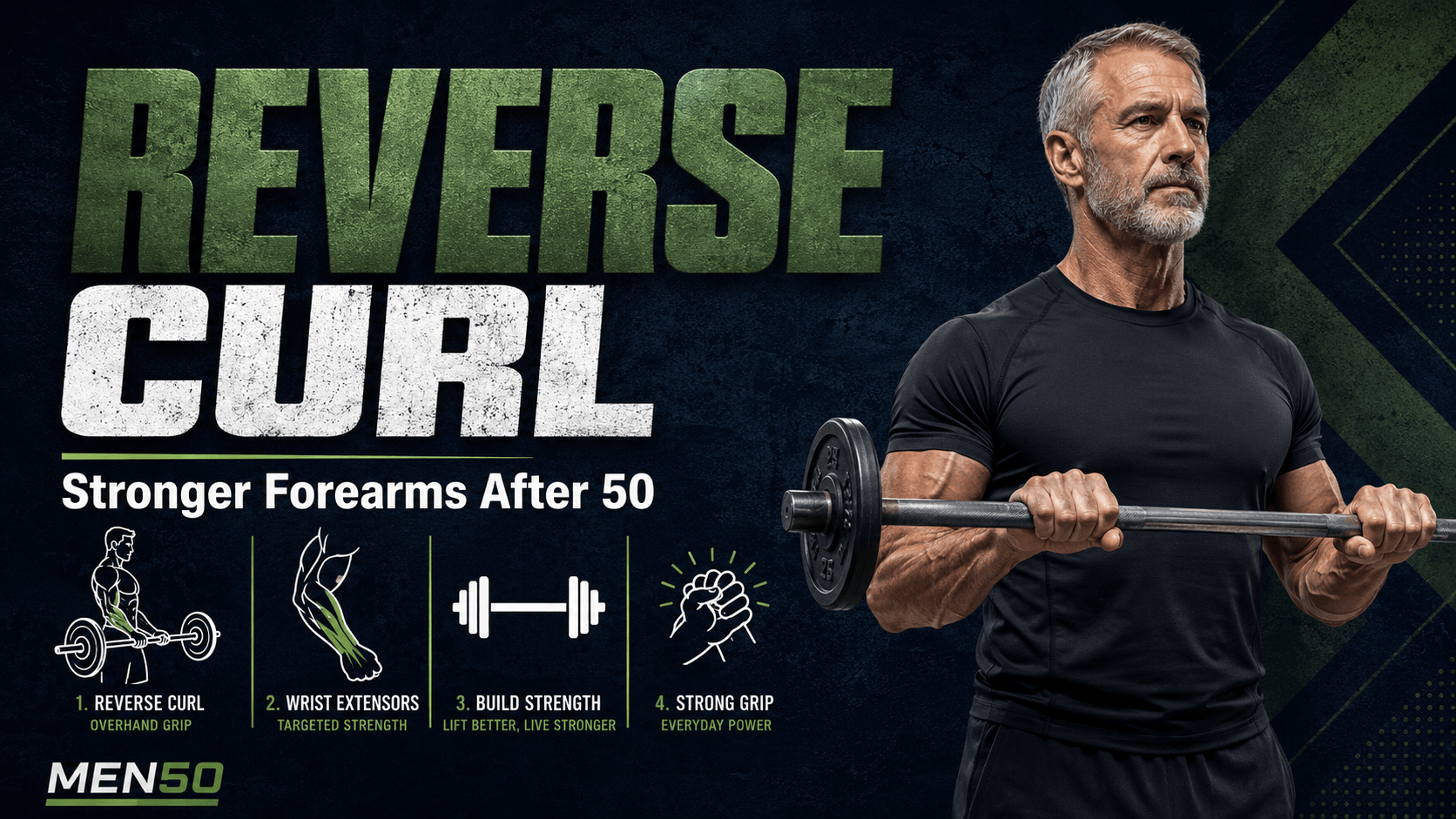
The reverse curl completes the three-grip arm training trilogy — and it’s the only exercise of the three that directly trains the wrist extensor muscles on the top of your forearm. Those muscles are commonly weak in men over 50, and that weakness is one of the biggest contributors to tennis elbow (lateral epicondylitis) — the chronic outside-of-the-elbow pain that affects roughly one in three men over 50 at some point. Most men never train their wrist extensors because daily life mostly involves gripping in pronation rather than active wrist extension. The reverse curl fixes that gap in about 10 minutes per week.
Part of the Build Muscle After 50 pillar — strength training for men over 50.
Key Takeaways
- The reverse curl uses an overhand (pronated) grip — palms facing down — which shifts the work to the forearm extensors, brachioradialis, and grip muscles.
- It’s the third grip in the arm training trilogy: biceps curl (supinated, biceps focus) → hammer curl (neutral, brachialis focus) → reverse curl (pronated, forearm extensor focus).
- Specifically helps prevent and manage tennis elbow by strengthening the wrist extensor muscles that attach at the outside of the elbow.
- Programming: 2–4 sets of 8–15 reps, 2–4 times per week. Rest 45–75 seconds between sets.
- Strong forearms improve your grip and support your elbows and wrists. Build strength with control.
How to Perform the Reverse Curl
Set up first:
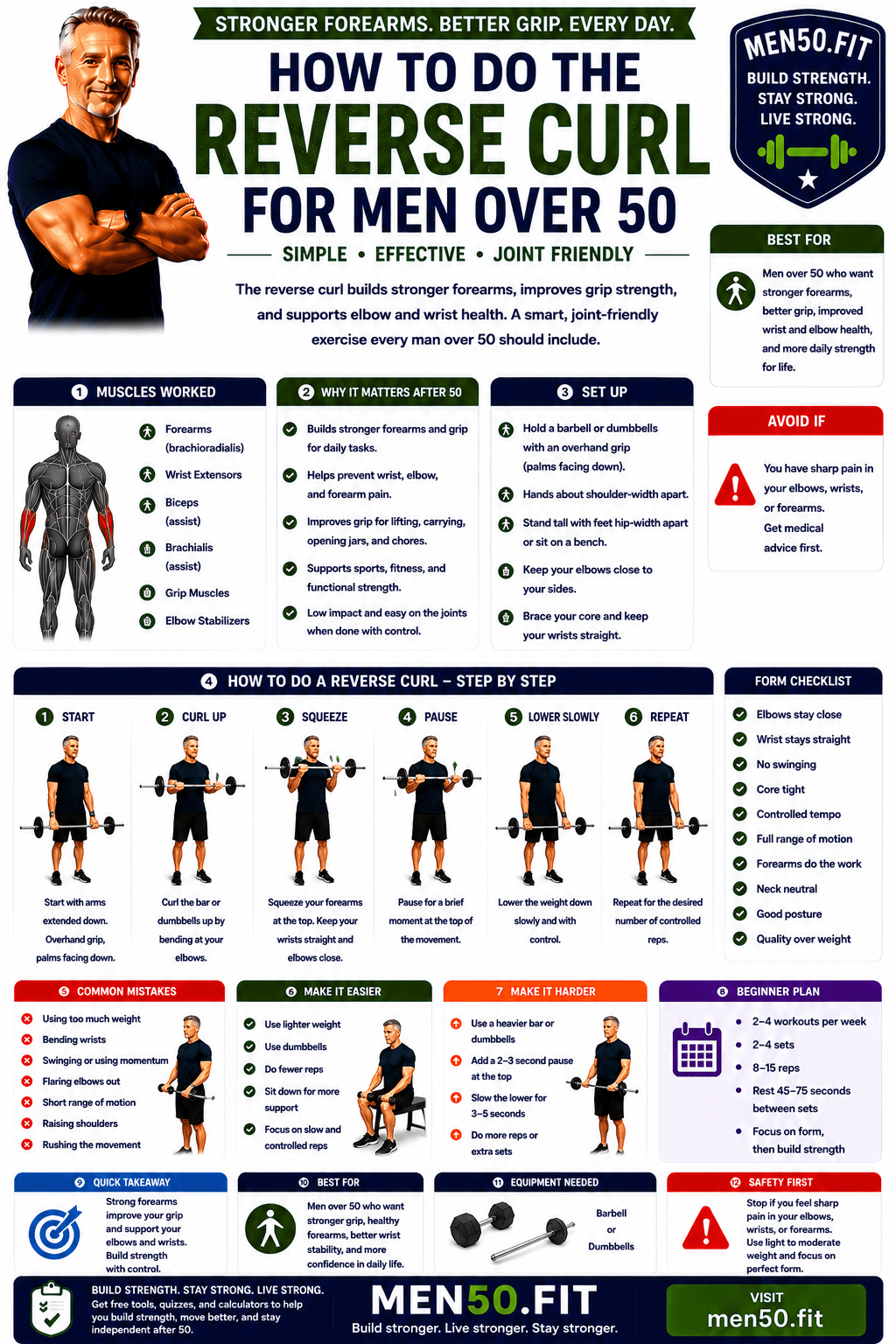
- Hold a barbell or dumbbells with an overhand grip — palms facing down (pronated).
- Hands about shoulder-width apart on the bar.
- Stand tall with feet hip-width apart, or sit on a bench for more support.
- Keep your elbows close to your sides — pinned, not flared.
- Brace your core, keep your wrists straight (don’t bend them up or down).
Then the movement:
- Start. Arms extended down with the bar or dumbbells in front of your thighs. Overhand grip, palms facing down. Elbows close to your sides.
- Curl up. Curl the bar or dumbbells up by bending at your elbows. Keep the elbows pinned to your sides throughout — they don’t drift forward or out. Take 1–2 seconds to curl up.
- Squeeze. At the top, squeeze your forearms hard. Keep your wrists straight and elbows close. Don’t let the wrists bend backward at the top.
- Pause. Pause for a brief moment at the top of the movement. Feel the muscles in the top of your forearms actively working.
- Lower slowly. Lower the weight down slowly and with control. Take 2–3 seconds on the way down. Don’t drop the weight — control the descent on every rep.
- Repeat. Maintain clean form on every rep. Quality over weight always.
The cue that matters most: keep your wrists straight throughout the rep. If the wrists bend (either backward at the top, or forward at the bottom), the load shifts to the wrist joint instead of the muscles you’re trying to train. Wrists stay in a straight line with the forearm, top to bottom.
Why the Reverse Curl Matters After 50
Most arm training in fitness focuses on the biceps and triceps. The forearm extensors — the muscles on the top of the forearm running from the outside of the elbow to the wrist — get almost no attention. That’s a problem for men over 50 for three specific reasons:
1. Tennis elbow (lateral epicondylitis) prevention. The wrist extensor muscles all attach at the outside of the elbow — specifically at the lateral epicondyle. When these muscles are weak relative to the demands placed on them (gripping, typing, lifting, carrying), the tendon at the lateral epicondyle gets overloaded and develops tendinopathy. This is tennis elbow — and despite the name, most cases occur in men who never play tennis. Direct training of the wrist extensors is one of the most evidence-supported approaches for both prevention and rehabilitation of tennis elbow.
2. Grip strength in a different pattern. The PURE study by Leong and colleagues (2015, The Lancet) followed 140,000 adults across 17 countries and found that grip strength was a stronger predictor of all-cause mortality and cardiovascular events than systolic blood pressure. Every 5 kg drop in grip strength was associated with a 17% higher risk of cardiovascular death. The reverse curl trains grip strength specifically in the overhand position — different from the farmer’s carry (neutral grip) and biceps curl (supinated grip). For complete grip development, you want strength in all three positions.
3. Brachioradialis development. The reverse curl also hits the brachioradialis — the muscle running along the top of the forearm from the elbow to the wrist. The brachioradialis is also worked by the hammer curl, but the reverse curl emphasises it from a slightly different angle. Combined, hammer curls and reverse curls give the brachioradialis comprehensive coverage.
The exercise also completes the three-grip arm training framework:
| Grip Position | Exercise | Primary Muscles |
|---|---|---|
| Supinated (palms up) | Biceps Curl | Biceps brachii |
| Neutral (palms in) | Hammer Curl | Brachialis, brachioradialis |
| Pronated (palms down) | Reverse Curl | Forearm extensors, brachioradialis |
For complete arm development, all three grips belong in a programme. Most men over 50 benefit from rotating among them — biceps curls one workout, hammer curls another, reverse curls a third. About 10 minutes per session, 2–4 times per week, covers all three.
Sets and Reps
The reverse curl uses lighter weight than other curl variations because the wrist extensor muscles are smaller and weaker than the biceps. Don’t expect to use the same weights you use for biceps curls.
| Stage | Sets × Reps | Frequency | Load Guide |
|---|---|---|---|
| Beginner | 2 × 8–10 | 2× per week | Very light, focus on form |
| Novice | 2–3 × 8–12 | 2–3× per week | Light, last 2 reps challenging |
| Intermediate | 3 × 10–15 | 2–4× per week | Working weight, RPE 7–8 |
| Advanced | 3–4 × 8–15 | 2–4× per week | Slow lowering + pause at top |
Rest 45–75 seconds between sets. Pick a weight where the last 2–3 reps feel clearly challenging but you can complete them with wrists straight, elbows pinned, no swinging, no shrugging.
A practical starting load: most men over 50 begin with 8–15 lb (3.5–7 kg) dumbbells or an empty barbell. After 3–6 months of training, many men progress to 15–25 lbs (7–11 kg) per hand. Use lighter weights than you use for biceps curls — typically about 60–70% of your biceps curl weight. The forearm extensors simply aren’t as strong as the biceps; trying to match the loads will force compensation patterns.
Common Mistakes
The seven errors that turn a great forearm exercise into a wrist or back problem:
- Using too much weight. The single most common mistake. The wrist extensors and brachioradialis are smaller and weaker than the biceps. Heavy weights force compensation — swinging, leaning back, wrist bending. Drop a size and use control.
- Bending wrists. The most exercise-specific error. As the load gets heavy, the wrists want to bend (either backward at the top or forward at the bottom) to “help” the lift. Keep the wrists straight throughout. Once the wrists bend, the wrist joint takes load it shouldn’t and the forearm extensors stop working properly.
- Swinging or using momentum. Rocking forward and back to launch the weights up turns the curl into a swing. The forearm muscles barely fire; the lower back takes load. If you can’t lift the weight without swinging, drop a size.
- Flaring elbows out. As fatigue sets in, the elbows want to drift outward to make the lift easier. Keep them pinned to your sides throughout every rep.
- Short range of motion. Going only halfway up — or stopping short of full extension at the bottom — skips part of the working range. Use the full range you can manage with clean form.
- Raising shoulders. Shrugging the shoulders toward the ears as the weight rises recruits the upper traps and shifts work away from the forearms. Keep the shoulders down and back, away from the ears.
- Rushing the movement. Quick reps use momentum and bounce. Slow reps build strength. Use 1–2 seconds up, brief pause at top, 2–3 seconds down. The slow tempo is the exercise.
Make It Easier or Harder
If standard reverse curls are too challenging:
- Use lighter weight — 5–8 lb (2–3.5 kg) dumbbells is fine for beginners. The wrist extensors respond to consistency more than load.
- Use dumbbells instead of a barbell — lets each arm work independently and exposes left-right imbalances.
- Do fewer reps — start with 2 sets of 6–8 reps and build up.
- Sit down for more support — sitting on a bench removes the temptation to use the legs and lower back for momentum.
- Focus on slow and controlled reps — clean tempo with light weight trains the pattern.
To make reverse curls harder once form is solid:
- Use a heavier bar or dumbbells — but only when the lighter weight feels easy with clean form.
- Add a 2–3 second pause at the top with wrists straight and forearms squeezed.
- Slow the lowering to 3–5 seconds per rep — significantly more demanding than it sounds.
- Do more reps or extra sets — extend sets to 15–20 reps before adding weight.
For variety, try wrist curls (sitting on a bench with forearms resting on your thighs, palms down, just bending the wrist) once a week — isolates the wrist extensors even more directly. Useful for adding extra forearm volume.
Safety Note
Avoid the reverse curl if you have sharp pain in your elbows, wrists, or forearms during the movement. Get medical advice first.
If you have current tennis elbow (lateral epicondylitis) — sharp pain at the outside of the elbow — start with very light weight and high reps. Direct loading of irritated tissue can flare it. The good news: reverse curls are also one of the rehabilitation exercises for tennis elbow once the acute phase has settled. Start light, progress slowly, and stop if pain increases.
If you have wrist arthritis or any wrist condition, the overhand grip can put more stress on the wrist joint than a supinated grip. Dumbbells are usually more wrist-friendly than a barbell because each hand can find its own comfortable angle. If wrist pain persists, the hammer curl (neutral grip) is usually better tolerated and still trains the brachioradialis effectively.
Build Your Personal Training Plan
The reverse curl is one piece of a complete upper body programme. Get a personalised exercise plan based on your current strength, goals, and any limitations.
Take the Free Fitness Profiler →
FAQs
Reverse curl vs regular biceps curl vs hammer curl — which is best?
They train different muscles, so the right answer is all three, rotated through the week. The biceps curl (supinated grip) emphasises the biceps brachii. The hammer curl (neutral grip) emphasises the brachialis and brachioradialis. The reverse curl (pronated grip) emphasises the forearm extensors and brachioradialis. Each fills a gap the others miss. For complete arm development, do biceps curls one session, hammer curls another, reverse curls a third — about 2 sets each, 2–4 sessions per week. If you can only do one, the hammer curl covers the most ground (biceps + brachialis + brachioradialis). The reverse curl is uniquely valuable for tennis elbow prevention.
How heavy should the weight be?
Heavy enough that the last 2–3 reps feel clearly challenging, but light enough that you can complete the set with wrists straight, elbows pinned, no swinging. For most men over 50 starting out, that’s 8–15 lbs (3.5–7 kg) dumbbells or an empty barbell (typically 15–25 lbs / 7–11 kg). After 3–6 months, many men progress to 15–25 lbs per hand. Expect to use about 60–70% of your biceps curl weight for reverse curls — the forearm extensors are simply not as strong as the biceps. That’s normal.
Why is this exercise harder than a regular curl?
Because you’re training smaller, weaker muscles in a mechanically disadvantageous position. The biceps is one of the strongest muscles in your arm relative to its size, and the supinated grip puts it in a position to use most of its leverage. The forearm extensors and brachioradialis are smaller muscles, and the pronated grip removes the biceps’ mechanical advantage so it can’t help as much. The result: you have to use significantly less weight to complete the same rep range. That’s not a sign you’re doing something wrong — it’s the entire reason this exercise is useful.
Can this exercise help with tennis elbow?
Yes — both for prevention and rehabilitation. Tennis elbow (lateral epicondylitis) is tendinopathy of the wrist extensor tendons at the outside of the elbow. Direct strengthening of these muscles is one of the most evidence-supported treatments. For prevention in healthy men over 50, reverse curls 2–3 times per week as part of a normal routine reduces tennis elbow risk. For active tennis elbow, the exercise can be used as part of rehab, but: start with very light weight (sometimes just bodyweight or a 2–5 lb dumbbell), high reps (15–20), and slow tempo. If pain increases, back off. Acute tennis elbow needs a physiotherapist’s guidance — don’t try to self-treat severe cases.
Should I use a barbell or dumbbells?
Both work. Barbell lets you load more weight per arm and is more efficient when you want heavier loads. Dumbbells let each arm work independently, expose left-right imbalances, and are usually more wrist-friendly because each hand can find its own comfortable angle. For most men over 50 starting out, dumbbells are the better choice. If you have wrist arthritis or limited wrist mobility, dumbbells almost certainly. Many men progress to a barbell once they’re handling 20+ lbs per hand with dumbbells and want more efficient loading.
References
- Leong DP, Teo KK, Rangarajan S, et al. Prognostic value of grip strength: findings from the Prospective Urban Rural Epidemiology (PURE) study. The Lancet. 2015;386(9990):266-273.
- American College of Sports Medicine. Resistance Training for Older Adults Position Stand. acsm.org
- National Institute on Aging. Sarcopenia and Muscle Strength in Older Adults. nia.nih.gov
Disclaimer: This article is for educational purposes only and is not medical advice. Consult a qualified healthcare professional before starting any new exercise programme, especially if you have existing elbow, wrist, or forearm conditions.