
Shadow boxing is one of the most underrated workouts for men over 50. No equipment, no gym, no partner — just you, a few square feet of floor, and a timer. In one session it trains cardiovascular fitness, coordination, core rotation, and footwork. It also burns off stress in a way few exercises can match, because focusing on punch combinations leaves no spare mental bandwidth for whatever was bothering you when you started.
Part of the Build Muscle After 50 pillar — strength training for men over 50.
Key Takeaways
- Shadow boxing is low-impact cardio that protects the knees and hips while still raising the heart rate.
- Start with 3–6 rounds of 30–60 seconds, with 30–60 seconds rest between rounds. Build round length first, then rest periods second.
- It’s about control and rhythm, not power. Punching hard at empty air is how shoulders and elbows get injured.
- The dual-task demand of coordinating punches, footwork, and breathing makes it one of the more brain-engaging exercises you can do.
- Best for: cardio at home, joint-friendly conditioning, stress relief, coordination work.
How to Perform Shadow Boxing
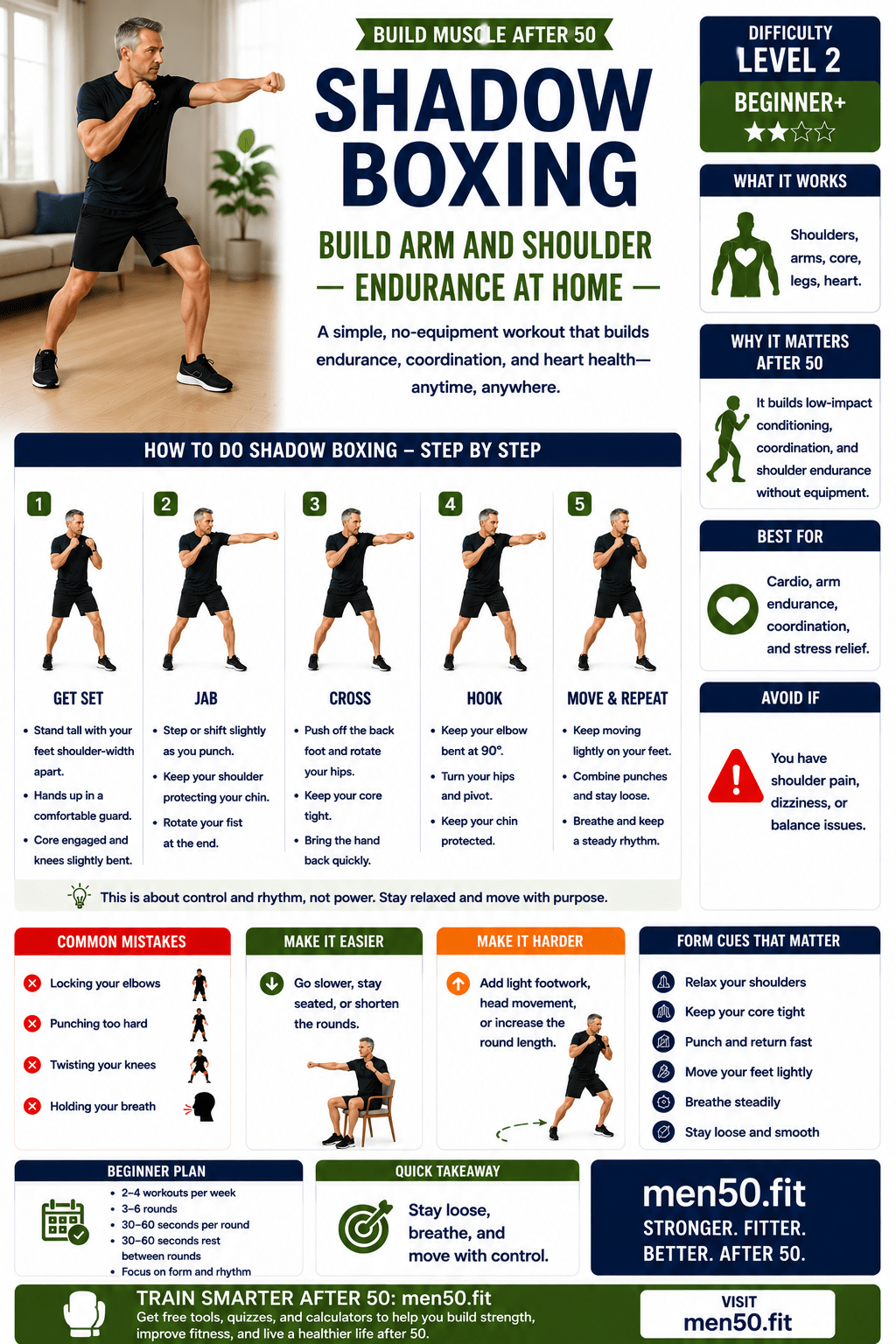
- Get set. Stand tall with feet shoulder-width apart, non-dominant foot slightly forward. Hands up in a comfortable guard around chin height. Core engaged, knees slightly bent. Stay loose — tense shoulders fatigue fast.
- Jab. Push the lead hand straight out from the guard. Rotate your fist at the end so the palm faces down. Shoulder protects the chin. Bring the hand back fast.
- Cross. Push off the back foot, rotate your hips, and drive the rear hand straight out. The power comes from hip rotation, not arm muscle.
- Hook. Keep the elbow bent at 90 degrees and rotate the hips and pivot the lead foot as you swing the hand across in front of you. Chin stays tucked.
- Move and repeat. Keep moving lightly on your feet — step, shift, circle. Combine punches: jab-cross, jab-cross-hook, double jab. Stay loose and breathe.
The whole thing is about rhythm and control. Snap the punches out and back without putting full force into them — you’re not trying to knock anything down. Power into empty air is how elbows hyperextend.
Why Shadow Boxing Matters After 50
Shadow boxing builds cardiovascular fitness through continuous varied movement without the joint impact of running. Heart rate climbs naturally when you combine punching, footwork, and breathing, and you can scale the intensity up or down second by second based on how you feel — there’s no machine telling you to keep pushing past sensible limits.
The rotational punching motion trains the obliques and deep core, the same muscles that protect the spine when you twist to grab something, reach across the body, or swing a golf club. Footwork during rounds also trains balance and coordination in a way static gym exercises don’t.
There’s an underrated cognitive benefit too. Research on dual-task exercise — movement that requires you to think while moving — suggests it may support cognitive function in older adults better than steady-state cardio alone. Coordinating punches, footwork, and breathing all at once is exactly this kind of dual-task work.
And then there’s the stress relief, which is harder to measure but easy to feel. Three rounds of focused shadow boxing leaves you in a different headspace than three rounds of treadmill walking — a lot of men find it the most effective mental reset of anything they do.
Sets and Reps
Start short and build. Most men over 50 will be surprised how tiring 30 seconds of constant movement is.
| Stage | Rounds | Round Length | Rest | Frequency |
|---|---|---|---|---|
| Beginner | 3–4 | 30 seconds | 60 seconds | 2–3× per week |
| Intermediate | 4–6 | 60 seconds | 60 seconds | 2–4× per week |
| Advanced | 6–8 | 90–120 seconds | 30–60 seconds | 3–4× per week |
Use a free interval timer app on your phone (search “boxing round timer”) so you’re not watching a clock. Shadow boxing works as a standalone cardio session, as a 5–10 minute warm-up before strength training, or as low-impact conditioning on rest days from heavier lifts.
Common Mistakes
The four errors that turn a great workout into a sore shoulder:
- Locking your elbows. Snapping punches out to full extension with force is how elbows hyperextend. Stop the punch just short of full extension and bring the hand back fast.
- Punching too hard. There’s nothing to hit. Punching hard at empty air loads the joints far more than landing the same punch on a bag would. Stay at 60–70% effort.
- Twisting your knees. When you throw a cross or hook, the lead foot should pivot — the heel turns out, the toe stays planted. Forcing rotation through a locked knee is how knee injuries happen.
- Holding your breath. Most men hold their breath when concentrating on a new movement pattern. Exhale on every punch — even a small sharp “ts” sound through the teeth — and you’ll keep oxygen flowing.
Make It Easier or Harder
If standing rounds are too much, shadow box seated in a sturdy chair. Focus on the upper body — jabs, crosses, hooks — without the footwork. This is also a good option on a tired day or after a heavy leg session. Shorten rounds to 20–30 seconds with full minute of rest between.
To make it harder once basic combinations feel comfortable: add head movement (slips, ducks), increase round length, shorten rest periods, or add light hand weights of 1–2 lbs (0.5–1 kg). Heavier than that and you risk shoulder injury — the joint isn’t designed for repeated punching with significant load.
Safety Note
Keep movements controlled. Don’t hyperextend the elbows by trying to put real power behind punches in the air. If you have a shoulder injury or impingement, start with light, shorter punching movements and avoid overhead-style punches like upward hooks or uppercuts until cleared.
Stay hydrated, especially during longer sessions. Stop if you feel dizzy, get shortness of breath beyond normal exertion, or feel any chest pain. If you have a known heart condition or have been sedentary for years, check with your doctor before starting any new cardio programme.
Build Your Personal Training Plan
Shadow boxing is one piece of a complete fitness programme. Get a personalised exercise plan based on your current fitness level, goals, and any limitations.
Take the Free Fitness Profiler →
FAQs
Do I need any equipment for shadow boxing?
No. The whole appeal is that it requires nothing — no gloves, no bag, no partner, no gym. A few square feet of floor and a timer is all you need. If you want to add equipment later, a free phone-app round timer is the only worthwhile addition. Hand weights and gloves come much later, if at all.
How long should a shadow boxing workout be?
Beginners can get a real workout from 3 rounds of 30 seconds — about 5 minutes total including rest. As fitness improves, build to 6 rounds of 60 seconds, which is around 15 minutes. Most men will plateau in benefit somewhere between 15–25 minutes per session, so there’s no need to go longer than that to get the cardio effect.
Is shadow boxing good cardio for men over 50?
Yes — it raises the heart rate, sustains it, and trains aerobic capacity without the joint impact of running. It also has the advantage that you control the intensity by the second, so you can back off the moment something feels wrong, which makes it safer than fixed-pace cardio like treadmills.
Will shadow boxing help me lose belly fat?
Shadow boxing burns calories like any other moderate cardio — roughly 300–500 per hour depending on intensity. But belly fat loss is driven by overall calorie balance and consistent training, not by any single exercise. Shadow boxing pairs well with walking and basic strength work as part of a sustainable plan.
Can I shadow box if I’ve never boxed before?
Absolutely. Most men learning shadow boxing have never trained boxing in any form. Start with just the jab — the simplest punch — and add the cross, hook, and footwork over the first few weeks. A 5-minute YouTube tutorial on basic boxing stance and the four core punches will get you started; the rest is practice and consistency.
References
- American Heart Association. Recommendations for Physical Activity in Adults and Older Adults. heart.org
- Centers for Disease Control and Prevention. Physical Activity Guidelines for Americans, 2nd Edition. cdc.gov
- National Institute on Aging. Exercise and Cognitive Health in Older Adults. nia.nih.gov
Disclaimer: This article is for educational purposes only and is not medical advice. Consult a qualified healthcare professional before starting any new exercise programme, especially if you have existing heart, joint, or balance conditions.