
Brisk walking is the single most evidence-based exercise for men over 50, and the most dismissed. Too many men hear “walking” and assume it’s a beginner’s consolation prize — the thing you do when you can’t do “real” exercise. The research says the opposite. Walked at the right pace, consistently, brisk walking lowers all-cause mortality, reduces cardiovascular disease risk, improves blood sugar control, and supports muscle and bone health — with almost zero injury risk. The best cardio is the one you can repeat consistently. Brisk walking wins that test more often than anything else in the gym.
Part of the Build Muscle After 50 pillar — strength training for men over 50.
Key Takeaways
- “Brisk” means a pace where you can talk but not sing — roughly 5–6 km/h (3–4 mph), or about a 5–6 out of 10 effort.
- The 2022 JAMA Internal Medicine meta-analysis found that 6,000–8,000 steps per day is the sweet spot for adults over 60 — benefits plateau beyond that, not at 10,000.
- Programming: 4–6 days per week, 10–30 minutes per session to start. Target 150 minutes per week of brisk walking total.
- The best cardio is the one you can repeat consistently. A 20-minute walk you’ll do daily beats a 60-minute run you’ll skip.
- Pair walking with strength training. Walking alone doesn’t prevent muscle loss — strength work does. Together they’re the most powerful combination available.
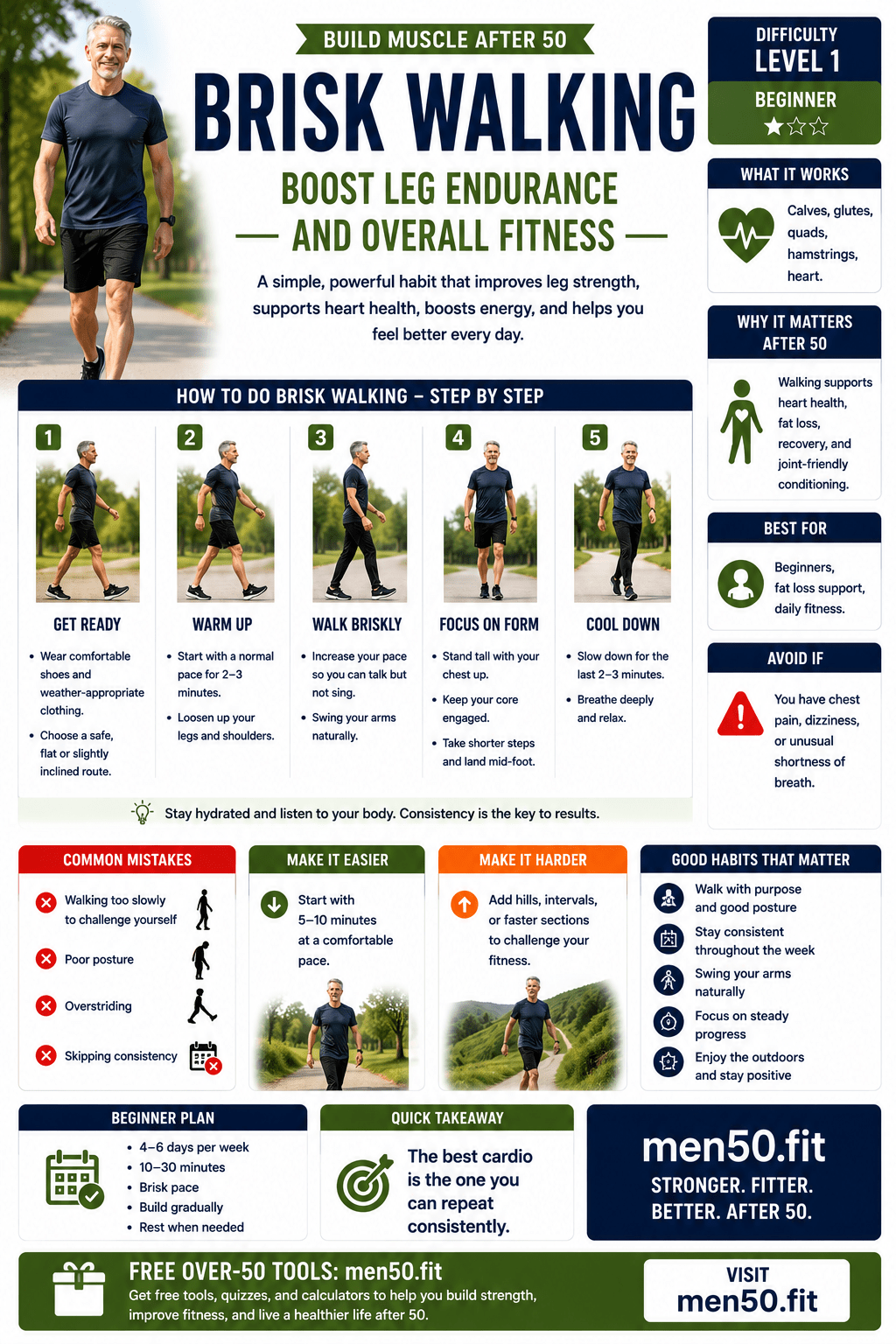
How to Perform Brisk Walking
- Get ready. Wear comfortable, supportive shoes appropriate for your walking surface and weather-appropriate clothing. Choose a safe, flat or slightly inclined route — pavements, paths, parks, or a treadmill all work.
- Warm up. Start with 2–3 minutes at a normal pace. Loosen your legs and shoulders. Don’t launch into a brisk pace cold, especially in cooler weather or first thing in the morning.
- Walk briskly. Increase your pace until you can still hold a conversation but not sing comfortably. This is the “talk test” — and it’s a more reliable guide than any heart rate target. Swing your arms naturally. Don’t lock the elbows; let them swing in rhythm with your stride.
- Focus on form. Stand tall, chest up, gaze forward (not at your feet). Keep the core gently engaged. Take shorter steps and land mid-foot or with a slight heel strike — not on your toes, not with a long over-reaching stride.
- Cool down. Slow down for the last 2–3 minutes of your walk. Breathe deeply. Let your heart rate come down gradually rather than stopping abruptly.
The most important thing isn’t form — it’s frequency. Walking five days a week with imperfect form beats walking once a week with perfect form every time.
Why Brisk Walking Matters After 50
The evidence on walking and longevity is overwhelming, and most of it has accumulated in the last decade. A 2022 meta-analysis by Paluch and colleagues, published in JAMA Internal Medicine and pooling data from 47,471 adults across 15 studies, found that all-cause mortality dropped progressively as daily step count rose — but the benefit plateaued earlier than the famous “10,000 steps” target. For adults over 60, the curve flattened at around 6,000–8,000 steps per day. Hitting that range is associated with a 40–53% lower mortality risk compared to the least-active adults in the studies. Going from 6,000 to 10,000 steps adds little additional benefit.
What matters more than the step count is the intensity. A 2022 study in JAMA Internal Medicine by Del Pozo Cruz and colleagues found that the speed you walk at matters independently of total steps — adults who walked more briskly had lower mortality even at lower total step counts. This is why “brisk” walking, not just “walking,” is the focus of every credible exercise guideline.
Beyond mortality, walking improves blood sugar regulation (particularly when timed after meals), supports healthy testosterone production in men with metabolic syndrome, reduces cortisol, and maintains the joint-friendly conditioning that running and high-impact cardio can’t. It also keeps the lymphatic system active, which becomes more important after 50 as recovery and immune function slow down.
The honest caveat: walking alone does not prevent muscle loss. Sarcopenia (age-related muscle loss) starts accelerating in the 50s and requires resistance training to stop. Walking is the cardiovascular and metabolic foundation. Strength training is the muscle and bone foundation. You need both — and brisk walking is the easier of the two to actually do consistently.
Sets and Reps
Build the habit before you build the volume. Consistency is the only metric that matters at the start.
| Stage | Duration | Frequency | Intensity | Step Target |
|---|---|---|---|---|
| Beginner (returning to exercise) | 10–15 min | 4–5× per week | Comfortable pace | 4,000–6,000/day |
| Novice | 20–30 min | 5–6× per week | Brisk (talk test passed) | 6,000–8,000/day |
| Intermediate | 30–45 min | 5–6× per week | Brisk + occasional hills | 7,000–10,000/day |
| Advanced | 45–60 min | 6× per week | Brisk + intervals | 8,000–12,000/day |
The 150-minutes-per-week target from the WHO and Physical Activity Guidelines for Americans is the minimum for cardiovascular benefit. Most men over 50 see better outcomes splitting this into 5 × 30-minute walks rather than 2 × 75-minute walks. You can also split a single day’s target into two 15-minute sessions — the research shows accumulated walking time delivers the same benefits as a continuous session.
Common Mistakes
The four errors that turn a high-value habit into low-value time on the feet:
- Walking too slowly to challenge yourself. A casual stroll is better than nothing but won’t deliver the cardiovascular or metabolic benefits the research describes. Use the talk test: if you can sing comfortably, you’re walking too slowly to count as brisk.
- Poor posture. Looking at your phone or the ground rounds the upper back and tightens the front of the body. Look up, chest open, shoulders back. Walking with good posture is also a free postural exercise.
- Overstriding. Taking too-long steps with a hard heel strike sends impact up through the knees and hips. Shorten the stride slightly, land mid-foot or with a gentle heel strike, and let cadence (steps per minute) build naturally as your fitness improves.
- Skipping consistency. The biggest mistake of all. Walking 7 days in a row once a month is worth less than walking 4 days a week every week. The benefits compound over months of consistency, not over heroic single sessions.
Make It Easier or Harder
If brisk walking for 20–30 minutes is currently too challenging, start with 5–10 minutes at a comfortable pace and build duration before intensity. Add 2–3 minutes per week until you’re comfortable at 30 minutes total, then begin extending the “brisk” portion of the walk.
To make walking harder once consistency is established: add hills (even a single uphill section in your route increases intensity meaningfully), add intervals (60–90 seconds at a faster pace, alternating with normal brisk pace), or wear a weighted vest (5–10% of bodyweight maximum, only after several months of consistent walking). The farmer’s carry is essentially loaded walking and pairs naturally with a walking habit — try a 1-minute farmer’s carry at the start or end of a walk for added grip and total-body strength work.
Safety Note
Brisk walking is safe for almost all men over 50, but anyone with chest pain, unusual shortness of breath, dizziness, uncontrolled high blood pressure, or recent lower-limb surgery should get medical clearance before significantly increasing activity. If chest pain or shortness of breath happens during walking — particularly if it’s new, sharp, or radiating to the arm or jaw — stop and seek medical evaluation.
Stay hydrated, particularly in hot or humid climates. Wear supportive walking shoes, replace them every 500–700 km, and don’t walk in worn-out trainers — they’re a knee and hip injury waiting to happen. If you have a history of knee or hip arthritis, stick to flat or gently inclined routes and prioritise softer surfaces (pavement is fine; trails and tracks are even better) over hard concrete.
Build Your Personal Training Plan
Brisk walking is one piece of a complete fitness programme. Get a personalised exercise plan based on your current fitness, goals, and any limitations.
Take the Free Fitness Profiler →
FAQs
How fast is “brisk” walking?
The talk test is the most practical measure: a pace where you can speak in full sentences but not sing comfortably. In numbers, that works out to roughly 5–6 km/h (3–4 mph) for most men, or about a 5–6 out of 10 effort level. If a heart rate monitor is helpful, aim for 50–70% of your maximum heart rate (roughly 220 minus your age × 0.5–0.7).
Is 10,000 steps a day really the right target?
For most men over 50, no — and the research is increasingly clear on this. The 10,000-step number originated from a 1965 Japanese pedometer marketing campaign, not from research. The 2022 Paluch meta-analysis in JAMA Internal Medicine found benefits plateau around 6,000–8,000 steps per day for adults over 60. Hitting that range with mostly brisk walking is more effective than slogging out 10,000 steps at a stroll. Quality and consistency beat raw step count.
Can walking replace strength training?
No — and this is the most important thing to understand. Walking is excellent cardiovascular and metabolic training, but it doesn’t prevent the muscle and bone loss that accelerate after 50. Sarcopenia requires resistance training. The right model isn’t walking or strength work — it’s walking plus strength work, 2–3 strength sessions per week and 4–6 walks per week. Most men over 50 see their best results from this exact combination.
Should I walk every day or take rest days?
Daily brisk walking is fine for most men over 50 because walking is low-impact and doesn’t require recovery the way heavy lifting does. That said, if you’re walking long distances or adding hills/intervals, one or two lower-intensity days per week is a good idea. Listen to your knees, hips, and feet — soreness that lasts more than a day suggests you need either better shoes or a recovery day.
Is treadmill walking as good as outdoor walking?
Almost. Treadmill walking is slightly easier than outdoor walking at the same pace because there’s no wind resistance and the belt assists slightly. To match outdoor intensity, set the treadmill to a 1–2% incline. The mental and stress-relief benefits of outdoor walking are real and measurable — daylight, nature exposure, and changing scenery contribute to the antidepressant effects of walking — so when the weather allows, outdoor wins. When it doesn’t, treadmill walking still ticks every cardiovascular box.
References
- Paluch AE, Bajpai S, Bassett DR, et al. Daily steps and all-cause mortality: a meta-analysis of 15 international cohorts. The Lancet Public Health. 2022;7(3):e219-e228.
- Del Pozo Cruz B, Ahmadi MN, Lee IM, Stamatakis E. Prospective Associations of Daily Step Counts and Intensity With Cancer and Cardiovascular Disease Incidence and Mortality and All-Cause Mortality. JAMA Internal Medicine. 2022;182(11):1139-1148.
- Centers for Disease Control and Prevention. Physical Activity Guidelines for Americans, 2nd Edition. cdc.gov
Disclaimer: This article is for educational purposes only and is not medical advice. Consult a qualified healthcare professional before starting any new exercise programme, especially if you have existing heart, lung, joint, or balance conditions.