
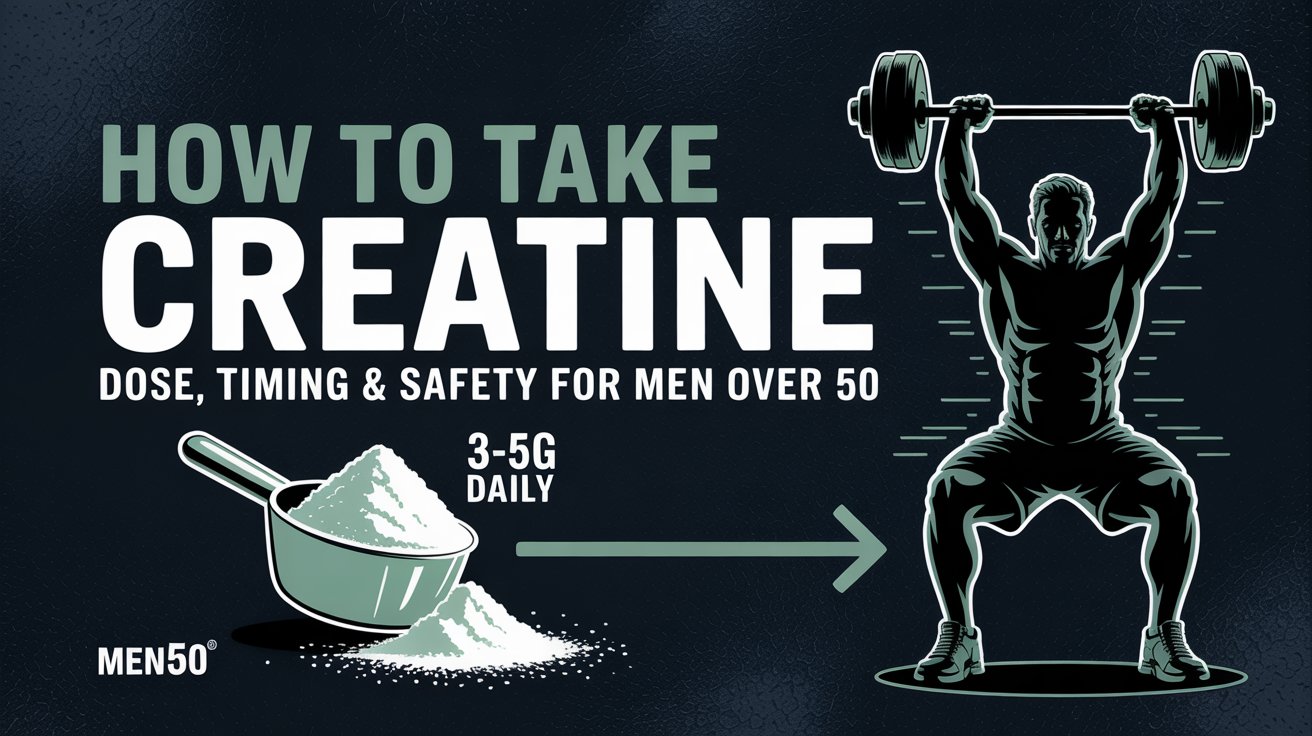
Creatine is one of the most researched supplements on earth — and it may be even more useful after 50 than in your 20s. Muscle creatine stores drop with age, sarcopenia accelerates, and the gap between “could have” and “did have” muscle mass through your 60s widens. Creatine helps close that gap, supports brain energy, and is one of the safest, cheapest supplements you can take. Here’s exactly how much, when, and how to do it safely.
Part of the Supplement Guide for Men Over 50.
Key takeaways
- Standard dose: 3–5 g of creatine monohydrate per day, every day. No loading needed for most men.
- Timing doesn’t matter — take it whenever you’ll consistently remember.
- Monohydrate is the only form worth buying. Everything else is marketing.
- Creatine doesn’t damage kidneys in healthy adults — the persistent myth is based on misapplied research.
- Effects show up in 3–4 weeks of consistent use. Don’t quit at week 2.
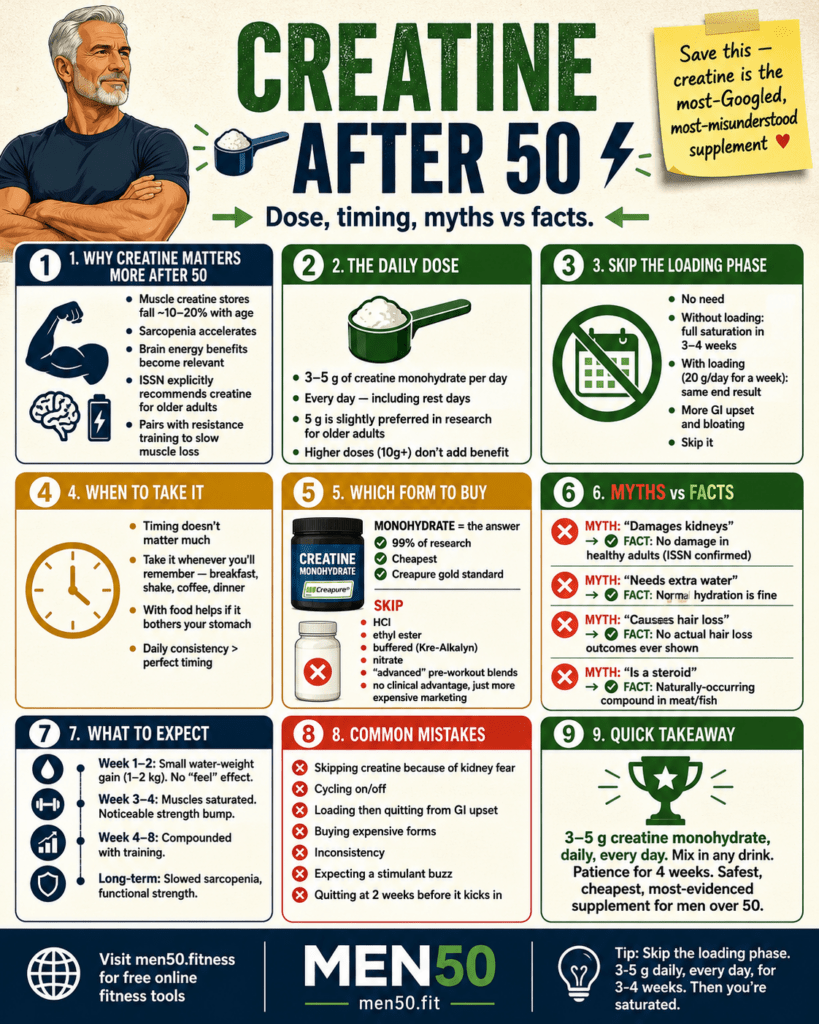
Why creatine matters MORE after 50
Three things shift after 50 that make creatine more useful, not less:
1. Your muscle creatine stores fall
Older adults have roughly 10–20% less stored creatine in muscle than younger men. Supplementing brings you back to “young man” levels, which means the relative impact is bigger than at 25.
2. Sarcopenia accelerates
Age-related muscle loss starts in your 40s and speeds up after 50. Creatine plus resistance training is one of the most effective combinations to slow it down. The ISSN position stand explicitly recommends creatine for older adults for this reason.
3. Brain energy benefits become relevant
Creatine isn’t just for muscles — your brain uses creatine to regenerate ATP for cognitive work. Studies in older adults suggest modest benefits to memory, mental fatigue, and processing speed, particularly under stress or sleep deprivation.
There’s also the practical strength piece. Maintaining force production matters more functionally at 55 than at 25 — picking up grandchildren, climbing stairs without holding the rail, getting up off the floor without help. Creatine plus training pays off in those concrete, daily ways.
How much creatine to take (daily dose)
The standard dose is 3–5 g of creatine monohydrate per day, every day.
- 3 g/day works for most men.
- 5 g/day is the upper end of the standard recommendation and slightly preferred in research for adults over 50.
- Higher doses (10 g+) don’t provide additional benefit and may cause GI discomfort.
- For very large men (over 100 kg), 5 g is appropriate; no need to scale higher.
The dose is the same every day, whether you train that day or not. Creatine works by saturating your muscles — once they’re saturated, they stay that way as long as you keep taking it.
Do you need a loading phase?
A loading phase means taking 20 g/day for 5–7 days (split into four 5 g doses) to rapidly saturate muscle creatine.
Short answer: skip it.
Reasons:
- Without loading, you reach the same saturation in 3–4 weeks at 3–5 g/day.
- Loading often causes GI upset, bloating, and water retention that can put men off creatine entirely.
- The end result is identical at 4 weeks regardless of whether you loaded or not.
Only consider loading if you have a specific reason to want fast effects (a competition or time-limited training block). Otherwise, start at 3–5 g/day and be patient.
Maintenance dose
Maintenance is the same dose you started with: 3–5 g per day, every day, indefinitely.
- Daily consistency matters more than perfect timing or dosing.
- No need to cycle on and off.
- Take it every day, including rest days, off-season, and vacations.
- If you stop for 4+ weeks, your muscle creatine drops back to baseline. Starting again means another 3–4 weeks to re-saturate.
The cycling myth (“take a break every 8 weeks”) has no scientific basis. The ISSN position stand confirms long-term daily use is safe.
Best time to take creatine
Creatine timing matters very little. The internet has elaborate timing theories — pre-workout, post-workout with carbs and protein, empty stomach, with caffeine, without caffeine. The research on actual outcomes is unimpressive.
The real answer: take it whenever you’ll consistently remember.
Practical options:
- With breakfast (mixed in coffee or shake).
- With a protein shake (any time).
- In a water bottle you sip during the day.
- With dinner (if you’d otherwise forget).
A few practical notes:
- Mix in water, coffee, juice, or a shake — all work.
- If creatine bothers your stomach, take it with food.
- Cold water dissolves creatine slowly; warm water dissolves it better.
- Don’t worry if some grit settles in your glass — it’s still effective. Drink it down with the last sip of water.
Which form to buy (monohydrate vs the rest)
The answer is monohydrate. Here’s why:
Creatine monohydrate
- The form used in roughly 99% of clinical research.
- Cheapest by a wide margin.
- Most evidence for safety, effectiveness, and long-term use.
- Look for: pure unflavoured powder.
- Gold standard: Creapure (a German-manufactured monohydrate, third-party tested for purity). Any pure monohydrate from a reputable brand works.
Other forms — skip them
| Form | Marketing claim | Reality |
|---|---|---|
| Creatine HCl | “Better absorbing” | No clinical advantage; more expensive |
| Creatine ethyl ester | “More bioavailable” | Marketing; some research shows it’s worse than monohydrate |
| Buffered creatine (Kre-Alkalyn) | “Easier on stomach” | No clinical advantage |
| Creatine nitrate | “Better pump” | No clinical advantage |
| Creatine magnesium chelate | “Enhanced uptake” | No clinical advantage |
| Pre-workout blends with creatine | Various | Usually under-dosed and you can’t see actual creatine content |
If a creatine product costs more than around $1 per 5 g serving, you’re paying for marketing. Generic monohydrate from a reputable brand is the right choice for almost everyone.
Is creatine safe after 50? Kidneys, hydration, myths
The kidney myth
“Creatine damages kidneys” is among the most persistent supplement myths. Reality:
- Long-term studies (3+ years) of 5 g/day in healthy adults show no kidney damage.
- The ISSN position stand explicitly states creatine does not impair kidney function in healthy people.
- The myth originated from misapplying research on kidney disease patients to healthy adults.
- If you have pre-existing kidney disease, talk to a nephrologist before starting. For everyone else, the kidney concern is not supported by evidence.
Important caveat about blood tests: supplementing creatine can slightly elevate serum creatinine (a kidney function marker) because creatinine is a creatine metabolite. This doesn’t mean your kidneys are stressed — but it can confuse a routine blood panel. Two options:
- Mention to your doctor that you take creatine before any kidney blood work.
- Stop creatine for 5–7 days before a planned kidney test if you want a clean baseline.
The hydration myth
“You need extra water because of creatine.” Reality: creatine pulls water into muscle cells, where it belongs. You don’t need extra fluid beyond normal hydration. The 1–2 kg early weight gain is intramuscular water, which is part of how the effect works.
Other myths cleared up
- “Creatine causes hair loss.” Based on one 2009 study that showed a brief increase in DHT. No actual hair loss outcomes have been demonstrated in clinical trials.
- “Creatine is a steroid.” No. Creatine is a naturally-occurring compound found in red meat and fish — and made daily in your liver.
- “Creatine causes cramps.” Research shows the opposite — creatine may slightly reduce cramping risk by supporting muscle hydration.
- “Creatine is bad for the heart.” No evidence of harm; some evidence it supports cardiac function in older adults.
When to talk to your doctor first
- Pre-existing kidney disease.
- Taking certain diuretics (rare interaction).
- Already in poor hydration status due to other medical conditions.
For most healthy men over 50, creatine is among the safest supplements available.
What to expect, week by week
| Time | What to expect |
|---|---|
| Week 1–2 | Possible small water-weight gain (1–2 kg). Slightly better gym output. No “feel” effect — creatine is not a stimulant. |
| Week 3–4 | Muscles fully saturated. Noticeably better training performance — more reps at the same weight, or slightly heavier weight at the same reps. Bodyweight stabilises. |
| Week 4–8 | Compounded effect with training. Visible strength gains. Possible improvements in mental sharpness under stress. Slightly improved recovery between sessions. |
| Months 2–6+ | Slowed sarcopenia (muscle preservation). Better functional strength in daily life. Reduced muscle damage markers after hard sessions. Possible bone density support when combined with resistance training. |
What you won’t feel: a “buzz” or stimulant effect. Creatine isn’t caffeine. The effect is gradual, measurable, and shows up in your training log — not in how you feel 30 minutes after taking it.
Build your personalised stack →
Common creatine mistakes for men over 50
- Skipping creatine because of kidney fear. The myth is not supported by evidence. Talk to your doctor if you have a kidney condition; otherwise, you’re missing out.
- Cycling on and off. Wastes the 3–4 weeks of saturation work. Take it continuously.
- Loading and getting GI upset. Most men over 50 should skip loading entirely.
- Buying expensive “advanced” forms. Monohydrate is the only form worth buying.
- Inconsistency. 3 days a week doesn’t work. Daily intake is the only protocol that delivers.
- Expecting a stimulant buzz. Creatine doesn’t work like caffeine. Effects show up in your training log over weeks.
- Stopping at 2 weeks. Most men quit just before the effect arrives. Give it the full 4–6 weeks.
- Not pairing it with training. Creatine amplifies the effect of training. Without training, the benefit is much smaller.
For the full list of supplement traps, see 9 Common Supplement Mistakes Men Over 50 Make.
Frequently asked questions
Should I take creatine on rest days?
Yes. The point of creatine is to keep your muscles saturated. Skipping rest days means your stores fluctuate. Take 3–5 g every day, including rest days, off-season, and vacations.
Will creatine make me gain weight?
A small water-weight increase (1–2 kg) in the first 2–3 weeks is normal. That’s intramuscular water — part of how the effect works. It’s not fat gain, and it stabilises.
Can I take creatine and protein together?
Yes. They have no interaction; many men mix creatine into their protein shake for convenience. There’s modest evidence that taking them post-workout together may slightly improve creatine uptake, though the effect is small. See the Creatine vs Protein comparison for how the two pair up.
Is creatine safe with high blood pressure or heart conditions?
For most men with stable, treated conditions, yes — but check with your cardiologist first. Creatine doesn’t raise blood pressure and may modestly support cardiac function in older adults. Specific medications (some diuretics) warrant individual review.
Is creatine safe with statins?
Generally yes. There’s no documented direct interaction. One caution: if you experience statin-related muscle pain after starting creatine, mention it to your doctor — the symptoms can overlap and confuse the picture.
How long until I notice results?
3–4 weeks for muscles to fully saturate; 4–6 weeks for noticeable training improvements. If nothing has changed at 8 weeks of consistent daily use, the issue is usually training inconsistency or under-eating protein.
Will creatine make me look “puffy”?
The intramuscular water creatine creates makes muscles look fuller, not puffier. Subcutaneous water (the bloated/puffy look) isn’t from creatine. If you do feel bloated, drop to 3 g/day instead of 5 g and take it with food.
Should I stop creatine on vacation or during non-training periods?
No. Take it continuously. Muscle creatine washes out over ~4 weeks if you stop, then takes another 3–4 weeks to re-saturate when you restart. Just keep taking it.
Does creatine raise creatinine in blood tests?
Slightly, yes. Creatinine is a creatine metabolite, and supplementation can elevate serum creatinine without affecting actual kidney function. Mention to your doctor that you take creatine before kidney blood work, or stop for 5–7 days before a test if you want a clean baseline.
I’m vegetarian — do I need more creatine?
Vegetarians have lower baseline creatine stores (no dietary creatine from meat or fish), so the relative impact of supplementation is larger. The standard 3–5 g daily is still the right dose; you just notice it more.
Can creatine help cognitive function in older adults?
Emerging evidence is encouraging. Studies in older adults show modest benefits to memory, mental fatigue, and processing speed — particularly under sleep deprivation or stress. It’s not a “smart drug,” but the benefit is real and free if you’re already taking creatine for muscle.
Can I drink coffee with creatine?
Yes. The “caffeine cancels creatine” claim came from one study that hasn’t been replicated. Daily intake of both is fine for most men. Mix creatine in your coffee if it’s easier to remember.
Written by the Men50 Fitness team. Medically reviewed by [add reviewer name + credentials].
Related reads
- Creatine vs Protein After 50: Which Matters More? — head-to-head comparison and how the two pair up.
- How to Take Protein After 50 When You Train Regularly — the other foundational supplement.
- Best Supplement Stack for Men Over 50 Who Train Regularly — where creatine fits in the broader stack.
- Best Beginner Supplement Stack for Men Over 50 — creatine is one of the three “start here” picks.
- How to Build a Safe Supplement Routine After 50 — the protocol for adding any supplement safely.
References
- Kreider RB, et al. ISSN position stand: safety and efficacy of creatine supplementation. JISSN, 2017.
- Candow DG, et al. Creatine supplementation and aging musculoskeletal health. Endocrine, 2014.
- Forbes SC, et al. Creatine supplementation and brain function. Nutrients, 2022.
- NIH Office of Dietary Supplements — creatine fact sheet.
- Examine.com — independent creatine evidence summary.
Disclaimer: This article is for educational purposes only and is not medical advice. Talk to your doctor before starting any supplement, especially if you take medication or have a kidney condition.