
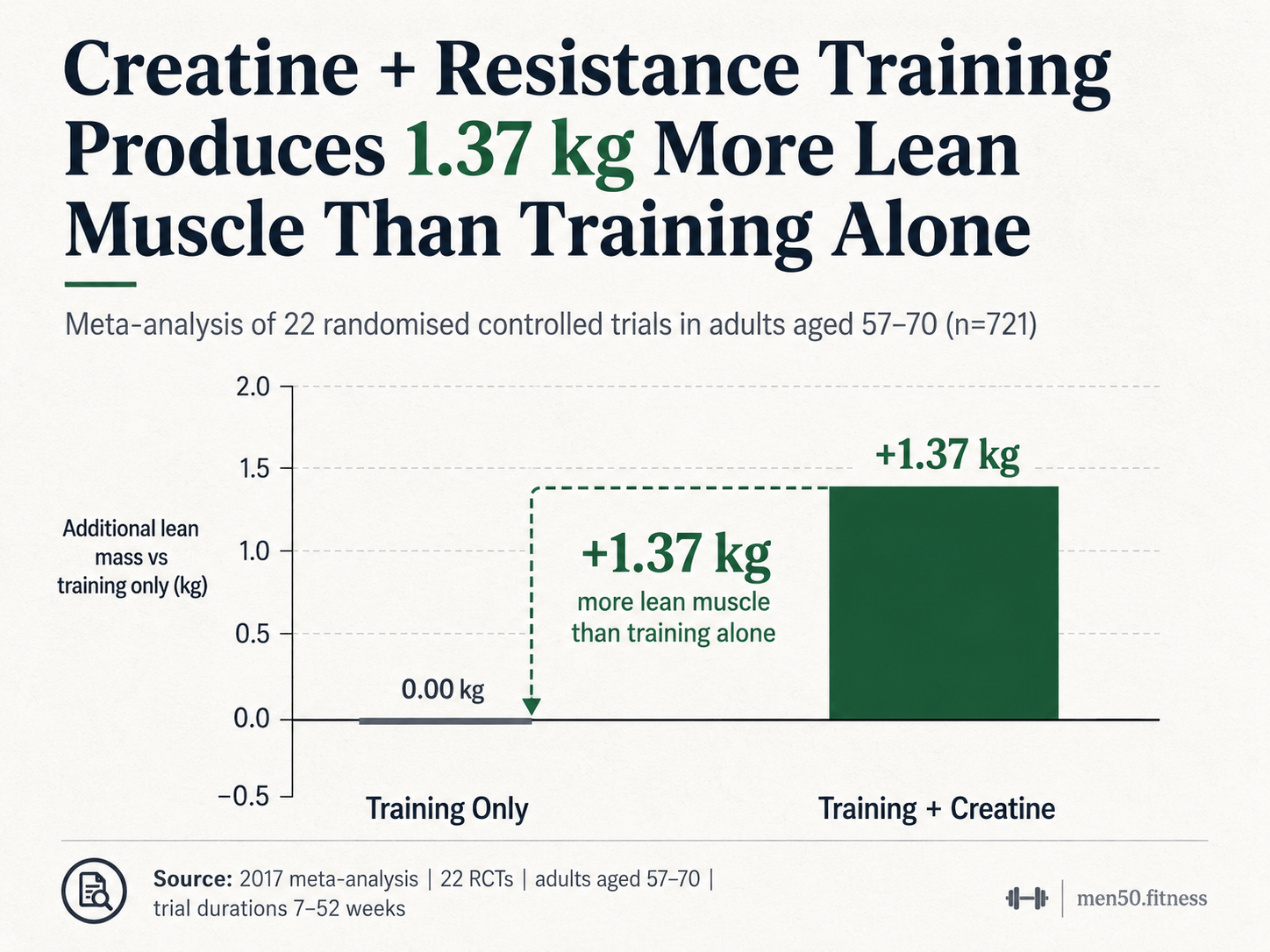
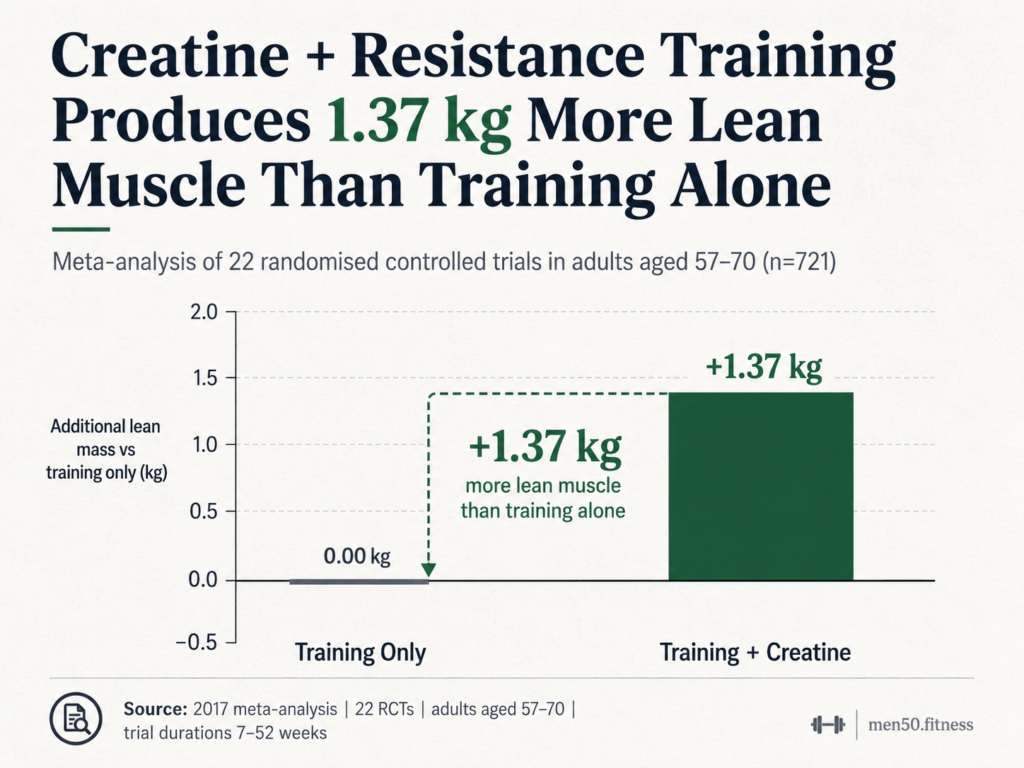
Adding creatine to a resistance training programme produces 1.37 kg more lean muscle than training alone — a finding consistent across 22 randomised controlled trials in men and women aged 57 to 70.
Here are the benchmarks.
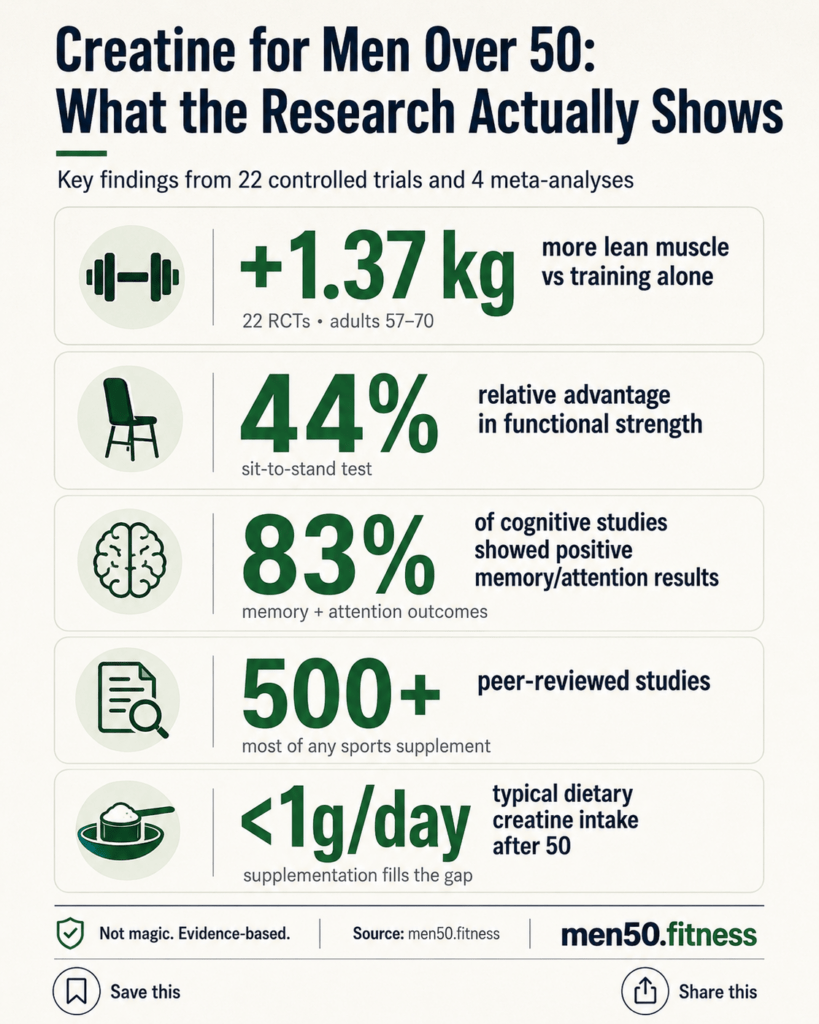
We analysed the findings from 22 randomised controlled trials, four independent meta-analyses, and the International Society of Sports Nutrition’s position stand on creatine supplementation in older adults. Participants ranged in age from 50 to 80+, with trials lasting 7 to 52 weeks. Here’s what the evidence shows.
Key Findings
- Adding creatine to resistance training produces 1.37 kg more lean muscle mass than training alone — the result of a meta-analysis of 22 randomised controlled trials in adults aged 57–70 (721 participants total)
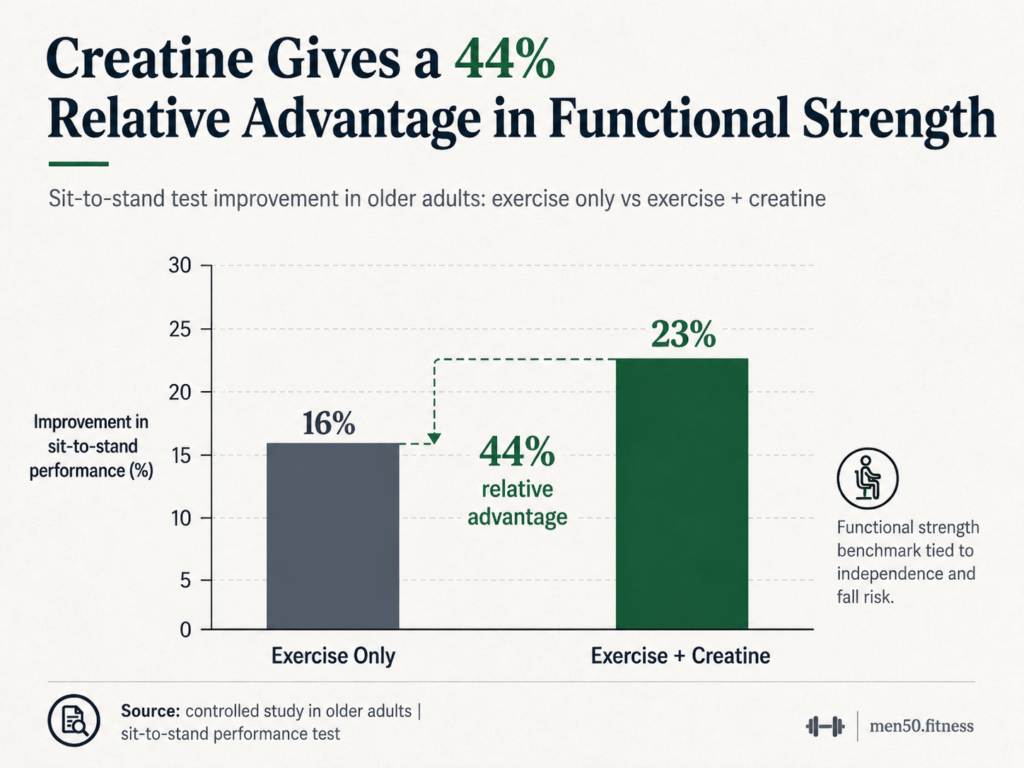
- Creatine users improve sit-to-stand performance by 23%, compared to 16% for those doing resistance training without creatine — a 44% relative advantage in functional strength
- Creatine supplementation increases chair stands completed in 30 seconds by a mean of 1.93 repetitions versus placebo — a direct measure of fall risk and daily functional ability
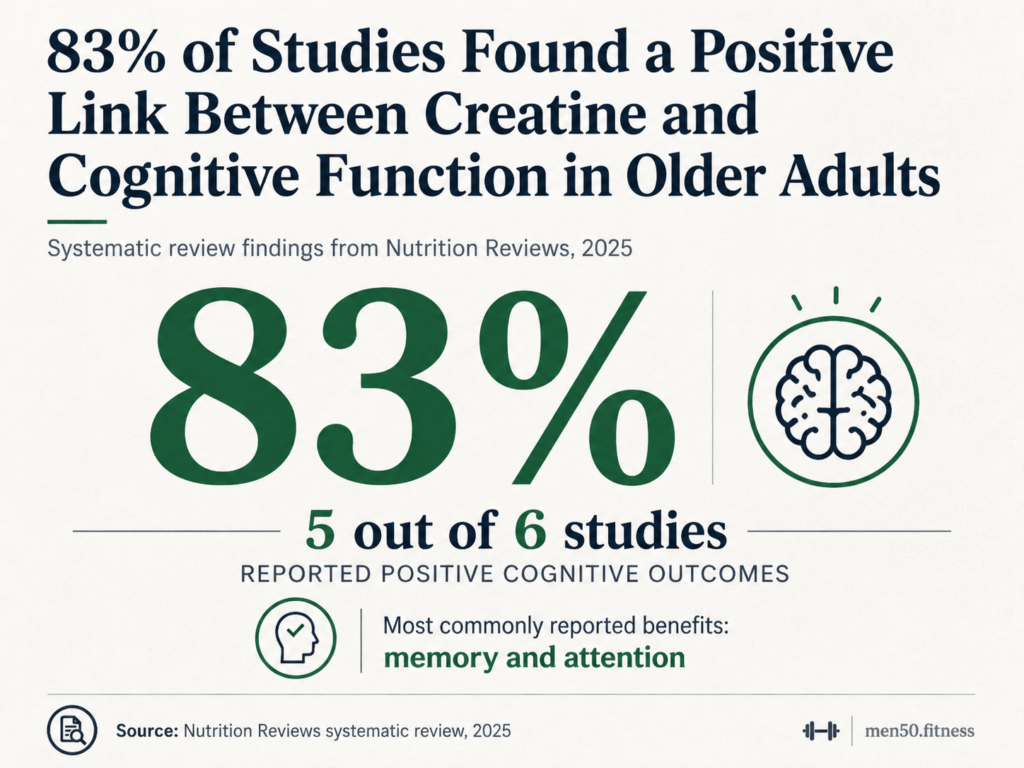
- 83% of cognitive studies (5 of 6) reported a positive relationship between creatine and cognition in older adults, particularly in memory and attention domains
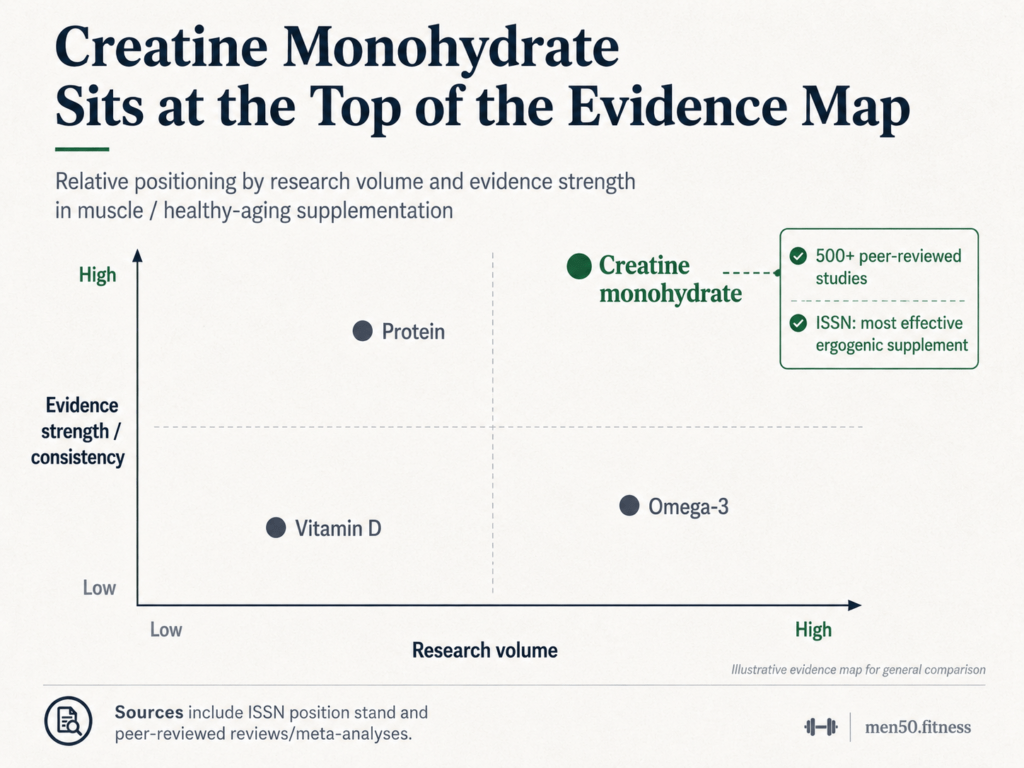
- The International Society of Sports Nutrition classifies creatine monohydrate as the most effective ergogenic nutritional supplement currently available — and declares it safe at doses up to 30g/day for up to 5 years
- No adverse effects on kidney function have been found in healthy older adults in any peer-reviewed trial or meta-analysis — including in older adults with type 2 diabetes and those classified as pre-frail
- Most older adults consume less than 1g/day of dietary creatine from food — supplementation at 3–5g/day fills a gap that diet alone cannot reliably cover after 50
- Creatine works at any time of day — timing is not a significant variable in long-term outcomes; daily consistency is the only meaningful predictor of response
- Loading phases are not necessary for most men over 50 — 3–5g/day without loading reaches effective muscle saturation over 3–4 weeks
- Type II muscle fibres — the fibres with the highest creatine content — decline fastest with age, making creatine’s role in preserving fast-twitch fibre function disproportionately relevant after 50
- Creatine’s benefits extend beyond muscle: emerging evidence shows potential in supporting bone metabolism, reducing inflammation markers, and mitigating age-related declines in energy production at the cellular level
- More than 500 peer-reviewed studies have evaluated creatine supplementation — more than any other sports nutrition supplement in the research literature
Adding Creatine Produces More Lean Muscle Than Training Alone in Adults Over 57
In men and women aged 57–70, combining creatine supplementation with a structured resistance programme consistently produces greater lean tissue gains than resistance training by itself. A meta-analysis pooling 22 randomised controlled trials — 721 participants, trials ranging from 7 to 52 weeks — found that creatine group participants gained a mean of 1.37 kg more lean mass than placebo participants who followed identical training programmes. The effect held across multiple settings, dosing strategies, and participant profiles.
The mechanism is straightforward: creatine increases the availability of phosphocreatine in muscle tissue, which fuels the short-burst, high-effort contractions that resistance training depends on. More available fuel means more work per session. More work per session, done consistently, produces greater adaptation. For men over 50 working against the background of natural muscle loss, the compounding effect of this incremental advantage is meaningful over months of training.
Creatine Produces a 44% Relative Advantage in Functional Strength Tests
The lean mass finding matters. But the functional performance finding may matter more to men over 50 whose goal is not aesthetics but capacity — the ability to move well, stay independent, and avoid injury.
In a controlled study, elderly participants who combined resistance exercise with creatine supplementation improved performance on the sit-to-stand test by 23%. Participants in the exercise-only group improved by 16%. That is not a small difference: a 44% relative advantage in a test that directly measures the kind of lower-body power needed to get up from a chair, climb stairs, or recover from a stumble.
A meta-analysis measuring chair stands in 30 seconds found that creatine supplementation produced a mean of 1.93 additional stands per 30-second window compared to placebo — a finding that reached statistical significance (95% CI: 0.19–3.67) across studies. Falls and fall-related hospitalisation are among the leading causes of loss of independence for men over 60. Functional strength tests like these are validated proxies for fall risk. The creatine-related improvement in these benchmarks is one of the more clinically meaningful findings in the supplement research literature for this age group.
83% of Cognitive Studies Show a Positive Relationship Between Creatine and Brain Function in Older Adults
Most men over 50 who start taking creatine are thinking about muscle. The emerging cognitive research is the finding most of them don’t know about.
A 2025 systematic review published in Nutrition Reviews (Oxford Academic) evaluated six studies on creatine supplementation and cognitive outcomes in older adults. Five of the six studies — 83% — reported a positive relationship between creatine and cognition, with the clearest effects appearing in the domains of memory and attention. The proposed mechanism is the same as in muscle: creatine increases phosphocreatine availability, which the brain draws on heavily during cognitively demanding tasks. As brain creatine stores decline with age, supplementation may help restore reserves that support working memory and processing speed.
The researchers noted that study quality was mixed and that high-quality clinical trials are needed to confirm the findings. The cognitive benefits are promising but not yet at the same evidence level as the muscle and strength findings. The muscle data is robust; the cognitive data is suggestive and improving.
The ISSN Classifies Creatine as the Most Effective Ergogenic Supplement Available — and Safe for Long-Term Use
The International Society of Sports Nutrition (ISSN) has reviewed creatine more extensively than any other sports supplement body. Their position stand states clearly that creatine monohydrate is “the most effective ergogenic nutritional supplement currently available to athletes in terms of increasing high-intensity exercise capacity and lean body mass during training.”
On safety: the same position stand found that creatine supplementation at doses up to 30g/day for up to 5 years is safe and well-tolerated in healthy individuals across a range of populations — from infants to the elderly. A systematic review and meta-analysis specifically examining kidney function found no adverse effects on renal markers in healthy older adults, including populations with type 2 diabetes and those classified as pre-frail. A modest rise in serum creatinine after starting supplementation is commonly observed — this reflects increased creatine turnover, not kidney damage, and should not be interpreted as a sign of harm in the absence of other symptoms or pre-existing kidney conditions.
The kidney safety finding matters because it is the most common reason men over 50 hesitate to start creatine. The evidence does not support that hesitation in healthy individuals.
Most Men Over 50 Are Not Getting Enough Creatine From Diet Alone
The body produces some creatine naturally, primarily in the liver and kidneys from amino acids. Most dietary creatine comes from red meat and fish. The challenge for men over 50 is that older adults typically consume less than 1 gram of dietary creatine per day — far below the 3–5g/day threshold used in clinical trials. Changes in dietary patterns (less red meat, smaller portions), reduced appetite, and a general decline in dietary protein intake all contribute to the gap.
This is why supplementation is not simply “extra” — for many men over 50, it is the primary way to reach levels that have any clinical relevance. The form matters: creatine monohydrate is the form used in the research literature, the most bioavailable, and the most cost-effective. Creatine gummies, blends, and proprietary formulations often contain far less than 3g per serving, meaning users who rely on them are chronically underdosing without knowing it.
Dosing: Daily Consistency Matters More Than Timing or Loading
The clinical finding on dosing is worth stating plainly because the supplement industry has complicated it significantly. The research supports the following:
- Effective dose: 3–5 grams per day of creatine monohydrate
- Timing: Any time of day. Pre-workout, post-workout, with meals — no significant difference in long-term outcomes across studies
- Loading: Not required for most people. A loading phase (20g/day for 5–7 days) accelerates muscle saturation but is not necessary for the benefits seen at 12+ weeks of supplementation
- The one factor that does matter: Daily consistency. Missing days slows saturation. Treat creatine like a daily habit, not a performance-day supplement
Data Quality and Methodology
The statistics in this report are drawn from peer-reviewed randomised controlled trials, systematic reviews, and meta-analyses published in PubMed-indexed journals. The primary lean muscle mass finding (1.37 kg mean difference) is sourced from a 2017 meta-analysis published in the Open Access Journal of Sports Medicine, covering 22 RCTs with 721 participants aged 57–70, resistance training 2–3 days per week for 7–52 weeks. The cognitive findings are from a 2025 systematic review in Nutrition Reviews (Oxford Academic). The functional performance and safety data are drawn from multiple meta-analyses published between 2019 and 2026.
All statistics represent findings in healthy older adults without pre-existing kidney disease. Men with kidney disease, cancer history, endocrine conditions, or who are on medications that affect creatinine levels should consult their doctor before supplementing.
A companion guide covering how to use creatine as part of a simple supplement stack for men over 50 is available separately: The Simple Supplement Stack for Men Over 50 Who Train.
Sources
- Effect of creatine supplementation during resistance training on lean tissue mass and muscular strength in older adults: a meta-analysis — PMC
- Meta-Analysis Examining the Importance of Creatine Ingestion Strategies on Lean Tissue Mass and Strength in Older Adults — PMC
- Impact of creatine supplementation and exercise training in older adults: a systematic review and meta-analysis — PMC
- Creatine and Cognition in Aging: A Systematic Review of Evidence in Older Adults — Nutrition Reviews / Oxford Academic
- Effectiveness of Creatine Supplementation on Aging Muscle and Bone: Focus on Falls Prevention and Inflammation — PMC
- Effect of creatine supplementation on kidney function: a systematic review and meta-analysis — PMC
- A short review of the most common safety concerns regarding creatine ingestion — PMC
- International Society of Sports Nutrition position stand: safety and efficacy of creatine supplementation — PMC
- Creatine monohydrate supplementation for older adults and clinical populations — Taylor & Francis Online
- Creatine Reconsidered: What the Latest Research Reveals — ACE Fitness, May 2025