
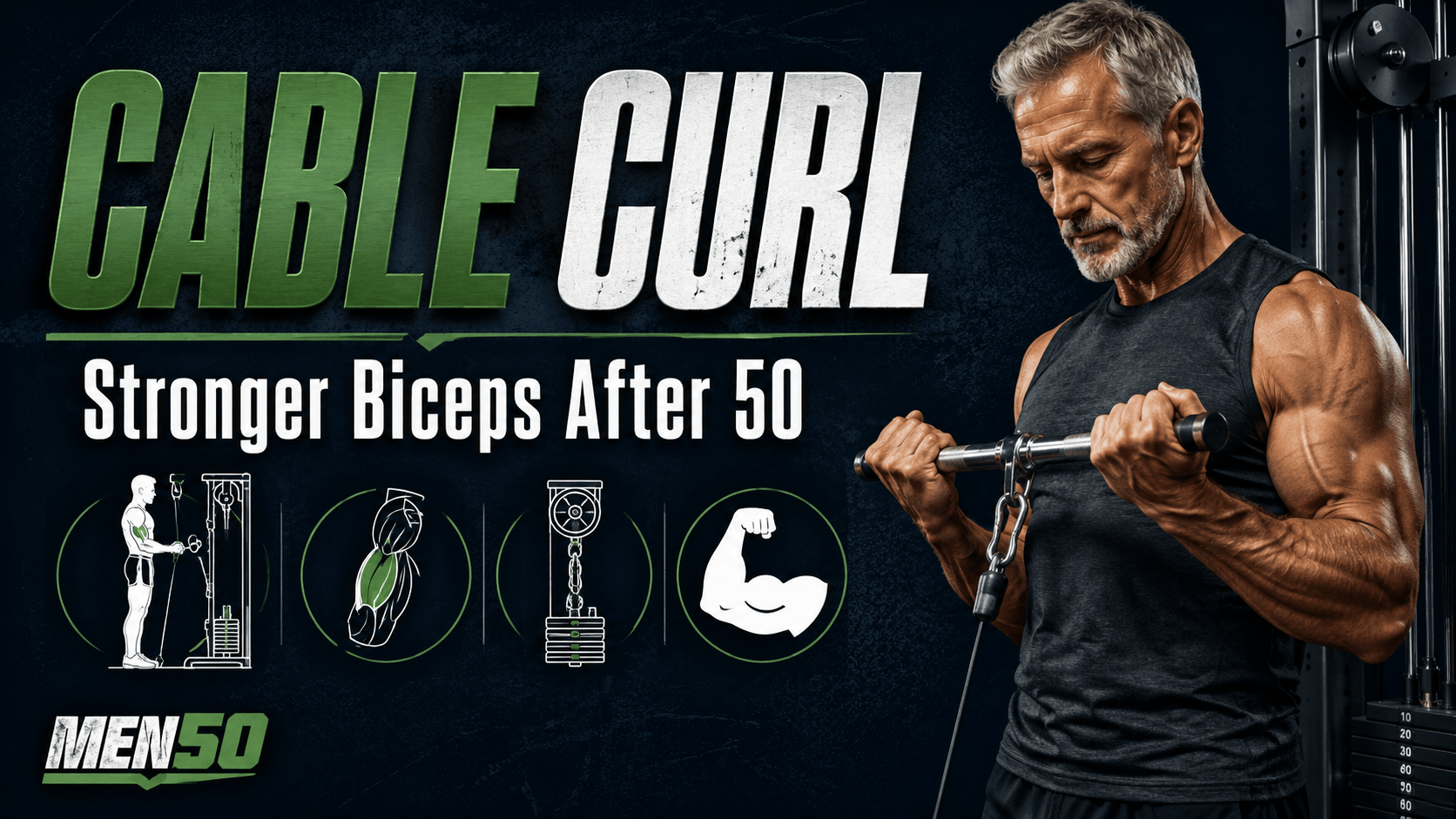
The cable curl is the gym-machine version of biceps isolation — and like the cable lateral raise and cable triceps pressdown, it has one specific advantage over the dumbbell version that matters: constant tension throughout the rep. Dumbbells produce maximum tension when the forearm is parallel to the floor (mid-rep) and almost zero tension at the very top of the curl (when the elbow is fully bent and the dumbbell is near the shoulder). Cables stay loaded through the entire range, including at the top where the biceps is most contracted. For men over 50 with gym access, the cable curl is often the more effective biceps exercise for sustained muscle tension.
Part of the Build Muscle After 50 pillar — strength training for men over 50.
Key Takeaways
- The cable curl targets the biceps brachii (primary), brachialis (assist), and brachioradialis (forearm) — same muscle group as the dumbbell biceps curl and resistance band curl.
- The constant cable tension keeps the biceps loaded at the top of the rep, where dumbbells lose tension entirely.
- It’s the gym counterpart to the three-grip dumbbell curl trilogy (biceps curl, hammer curl, reverse curl) and the resistance band curl.
- Programming: 2–4 sets of 10–15 reps, 1–2 times per week. Rest 45–60 seconds between sets.
- Keep elbows pinned to sides, squeeze at the top, control the lowering. Quality reps build stronger arms after 50.
How to Perform the Cable Curl
Set up first:
- Attach a straight bar, EZ bar, or rope to the low pulley of a cable machine. (See the grip discussion below for which attachment to choose.)
- Select a light to moderate weight to start — this is genuinely a light exercise.
- Stand facing the machine, feet shoulder-width apart, slight bend in your knees.
- Grip the bar with an underhand grip (palms up) for a straight bar, or neutral grip (palms facing each other) for a rope.
- Keep your elbows close to your sides — this is the critical setup detail.
- Stand tall with chest up, core tight, shoulders down and back.
Then the movement:
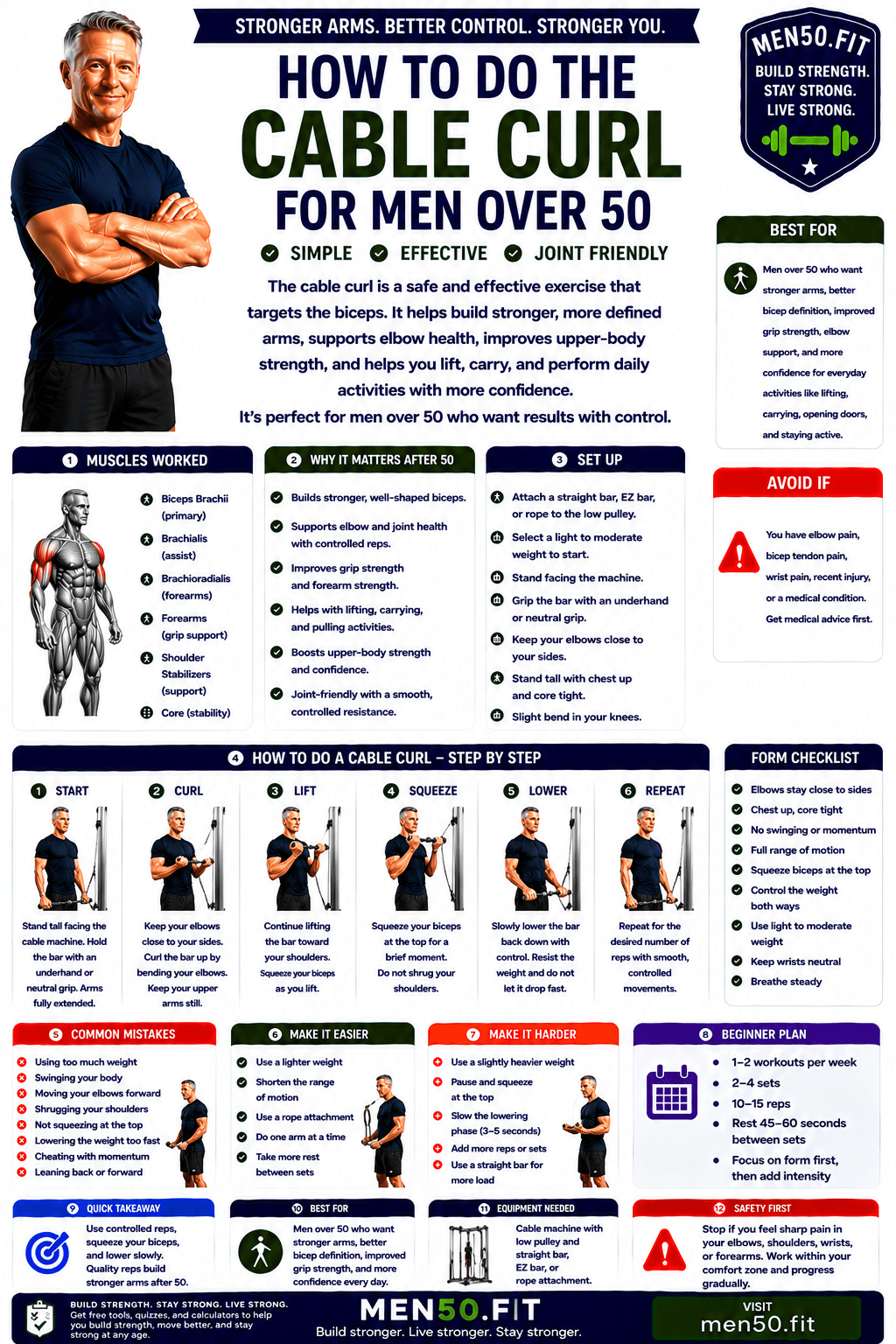
- Start. Stand tall facing the cable machine. Hold the bar with an underhand or neutral grip. Arms fully extended down. Body braced.
- Curl. Keep your elbows close to your sides. Curl the bar up by bending your elbows. Take 1–2 seconds to curl. Keep your upper arms still — only the forearms move.
- Lift. Continue lifting the bar toward your shoulders. Squeeze your biceps as you lift.
- Squeeze. Squeeze your biceps at the top for a brief moment. Do not shrug your shoulders — they stay pinned down throughout.
- Lower. Slowly lower the bar back down with control. Take 2–3 seconds on the way down. Resist the weight and do not let it drop fast — the lowering phase is where significant muscle development happens.
- Repeat. Smooth, controlled movements throughout. Focus on the biceps, not on momentum.
The cue that matters most: elbows pinned to your sides — the upper arms should not move during the rep. Most men over 50 doing curls (cable or dumbbell) let the elbows drift forward as they fatigue, which recruits the front delts and shifts work away from the biceps. Imagine the upper arms are glued to your ribs — they should not move at all. When only the forearms move, the biceps does all the work. The same principle established for the cable triceps pressdown applies in reverse here.
Why the Cable Curl Matters After 50
The biceps does meaningful work in daily life — far more than just looking good in a t-shirt. Every pulling movement involves the biceps:
- Carrying grocery bags up stairs
- Lifting children or grandchildren
- Opening heavy doors (the pull motion)
- Carrying briefcases or laptop bags
- Pulling weeds, holding heavy garden tools
- Lifting suitcases out of overhead bins
- Stabilising the elbow during any rowing or pulling exercise
But the deeper reason the biceps matters after 50 is the grip strength connection. Leong and colleagues’ 2015 study in The Lancet (the PURE study, 140,000+ participants) found that grip strength was a stronger predictor of all-cause mortality and cardiovascular events than systolic blood pressure. Grip strength depends on the forearm muscles — and the biceps complex (brachialis, brachioradialis especially) are deeply involved in producing and sustaining grip. Direct biceps training builds the supporting structures that grip strength rides on top of.
The Biceps Complex — Three Muscles, Not Just One
Like the triceps (covered in the cable triceps pressdown article), the “biceps” is really a complex of muscles working together:
| Muscle | Location | Best Trained By |
|---|---|---|
| Biceps brachii | Front of upper arm | Supinated grip (dumbbell curl, straight-bar cable curl) |
| Brachialis | Deep, under the biceps | Neutral grip (hammer curl, rope cable curl) |
| Brachioradialis | Forearm, near the elbow | Pronated grip (reverse curl) |
For complete development of the upper-arm flexor complex, men over 50 benefit from varying the grip across different sessions or weeks. The cable curl supports this — with a straight bar (supinated), EZ bar (semi-supinated), or rope (neutral), you can hit each muscle differently using the same cable setup.
Why the Cable Version Specifically
The dumbbell biceps curl and cable curl train the same muscles — but the resistance curves are completely different:
| Position | Dumbbell Tension | Cable Tension |
|---|---|---|
| Arms extended down (bottom) | Low | High |
| Forearms parallel to floor (mid-rep) | Maximum | High |
| Hands near shoulders (top) | Near zero | High |
With dumbbells, gravity acts straight down through the dumbbell. When the elbow is fully bent (top of the curl), the dumbbell is nearly directly above the elbow joint, producing very little torque on the biceps. The muscle is fully contracted but unloaded — a strange mismatch.
With cables, the resistance comes from the cable’s direction of pull, which runs from the low pulley up to your hand. Even at the top of the rep, the cable still pulls down and forward, keeping the biceps loaded. This is why cable curls feel like they keep working all the way through the rep — they do.
For training the biceps fully, this matters. Many men over 50 doing dumbbell curls feel they’re “working hard but not seeing development at the top” — and the resistance curve is exactly why. The peak contraction position is unloaded with dumbbells. Cables fix this.
The Cable Push-Pull Arm Pair
The cable curl completes the cable arm pair in the matrix:
| Exercise | Movement | Muscle |
|---|---|---|
| Cable Triceps Pressdown | Push (elbow extension) | Triceps |
| Cable Curl (this article) | Pull (elbow flexion) | Biceps |
These two together provide balanced arm training in the same equipment, same session, same body position. Three sets of each, alternating between them with 45–60 seconds rest, is one of the most efficient arm workouts in any gym. Roughly 12 minutes of total time, complete arm work.
Position in the Biceps Cluster
The cable curl is the fifth piece of the comprehensive biceps cluster in the matrix:
| Exercise | Grip | Equipment | Best For |
|---|---|---|---|
| Dumbbell Biceps Curl | Supinated | Dumbbells | Biceps brachii primary |
| Hammer Curl | Neutral | Dumbbells | Brachialis primary |
| Reverse Curl | Pronated | Dumbbells | Brachioradialis primary |
| Resistance Band Curl | Supinated | Band | Home option |
| Cable Curl (this article) | Underhand or neutral | Cable | Gym, constant tension |
Five biceps exercises covering every grip variation and every equipment level. The matrix now has the most comprehensive biceps coverage in any fitness content for men over 50.
Sets and Reps
The cable curl is an isolation exercise — moderate to higher rep ranges work better than heavy loading.
| Stage | Sets × Reps | Frequency | Load Guide |
|---|---|---|---|
| Beginner | 2 × 10–12 | 1× per week | Very light (15–25 lbs / 7–11 kg) |
| Novice | 2–3 × 10–15 | 1–2× per week | Light (25–40 lbs / 11–18 kg) |
| Intermediate | 3 × 10–15 | 1–2× per week | Moderate (40–60 lbs / 18–27 kg) |
| Advanced | 3–4 × 10–15 | 1–2× per week | Moderate-heavy + pause + slow lowering |
Rest 45–60 seconds between sets. Pick a weight where the last 2–3 reps feel clearly challenging but you can complete them with: elbows pinned to sides, no shrugging, no body swinging, no excessive lean, wrists neutral, controlled tempo both directions.
A practical note on load: biceps isolation rewards form, not heroic loads. If the elbows start drifting forward or the body starts swinging, the weight is too heavy — the body is recruiting the front delts and torso to lift the bar rather than using the biceps alone. Most men over 50 plateau in the 40–60 lb range for the cable curl — and that’s perfectly fine. Use approximately the same weight as your cable triceps pressdown — the biceps and triceps are roughly similar in strength when trained in isolation, so the weights should be in the same ballpark.
Common Mistakes
The eight errors that turn a useful biceps exercise into a back or shoulder problem:
- Using too much weight. The single most common mistake. Heavy weight forces compensation — body swinging, elbows drifting, shoulder shrugging, partial reps. Drop a size if form breaks down. Biceps isolation rewards form, not heroic loads.
- Swinging your body. Rocking back and forth to launch the bar up uses momentum instead of biceps strength. Stay still in the torso; only the forearms move. If you can’t, the weight is too heavy.
- Moving your elbows forward. As the biceps fatigue, the elbows want to drift forward (toward the front of the body) to recruit the front delts. Pin elbows to sides — they should not move at all during the rep.
- Shrugging your shoulders. Hiking the shoulders toward the ears recruits the upper traps instead of the biceps. Shoulders stay pinned down throughout.
- Not squeezing at the top. Rushing through the top of the rep skips the most productive contraction — and on cable curls specifically, the top is where the muscle is still under tension (unlike dumbbells). Pause briefly at the top with biceps squeezed.
- Lowering the weight too fast. Letting the bar drop at the end of each rep skips the eccentric phase — where significant biceps development happens. Control the lowering — 2–3 seconds back to the start.
- Cheating with momentum. Bouncing the weight off the bottom of each rep, using the body’s elastic recoil, removes the biceps from the equation. Start each rep from a controlled dead stop, not a bounce.
- Leaning back or forward. Body lean during the rep usually means the weight is too heavy. Stand upright with a neutral spine throughout. A slight forward lean from the hips (not the lower back) is fine at the very bottom of the rep, but not extreme.
Make It Easier or Harder
If standard cable curls are too challenging:
- Use a lighter weight — 10–15 lbs (5–7 kg) is fine for beginners.
- Shorten the range of motion — start the curl from a slightly higher hand position while you build strength.
- Use a rope attachment — the rope’s neutral grip is gentler on the wrists and elbows.
- Do one arm at a time — easier to focus on form, exposes left-right asymmetry, uses lighter weight per side.
- Take more rest between sets — 60–90 seconds.
To make it harder once form is solid:
- Use a slightly heavier weight — but only when the lighter weight feels easy with clean form.
- Pause and squeeze at the top for 1–2 seconds with biceps fully contracted.
- Slow the lowering phase to 3–5 seconds per rep — significantly more demanding.
- Add more reps or sets — extend to 15–20 reps before adding load.
- Use a straight bar for more load — easier to grip heavier weight than a rope.
For variety, try the single-arm cable curl with a D-handle once a week — exposes left-right asymmetry, easier to focus on biceps activation, and lets each arm work independently (most men have meaningful asymmetry between dominant and non-dominant biceps). Use significantly lighter weight (~50% of bilateral) for the unilateral version.
Safety Note
Avoid the cable curl if you have elbow pain, biceps tendon pain, wrist pain, recent injury, or a relevant medical condition. Get medical advice first.
Elbow pain during the cable curl is most often caused by (1) too much weight, (2) locking the elbows out at the bottom (slamming them straight under load), or (3) wrist not staying neutral (causing rotational stress through the elbow). Drop the weight, keep a slight bend at the bottom, keep wrists straight. If pain persists, the cable curl may be aggravating an existing condition — switch to the resistance band curl (less load) and see a physiotherapist.
Biceps tendon pain (at the front of the shoulder or in the upper arm) during the rep is uncommon but warrants attention. It usually means (1) the weight is too heavy, (2) the elbows are drifting forward, or (3) you’re swinging the bar up using elastic recoil. If pain persists with light weight and clean form, see a physiotherapist — biceps tendinopathy needs proper assessment in men over 50.
Wrist pain is more common with a straight-bar grip than with a rope or EZ bar. The straight bar forces the wrist into full supination (palms up), which can stress the wrist over time. Switch to an EZ bar (the wavy bar — slightly angled grip) or rope if you have any wrist arthritis or tendinopathy. The EZ bar is particularly wrist-friendly while still allowing significant load.
Shoulder pain during the rep usually means the shoulders are shrugging or the elbows are drifting forward. Pin shoulders down and elbows back before each rep.
Lower back pain during the rep usually means you’re leaning back at the top or arching the lower back to swing the bar up. Stand tall, slight forward lean from the hips only, core engaged.
If you feel sharp pain anywhere during the rep, stop. Mild muscular fatigue in the biceps is normal; sharp joint pain is not.
Build Your Personal Training Plan
The cable curl is one piece of a complete upper body programme. Get a personalised exercise plan based on your current strength, goals, and any limitations.
Take the Free Fitness Profiler →
FAQs
Cable curl vs dumbbell biceps curl — which is better?
For training the biceps specifically, the cable version is generally more effective because of the resistance curve. Dumbbells lose tension almost entirely at the top of the rep (when the elbow is fully bent and the dumbbell is near the shoulder) — exactly where the biceps is most contracted. Cables maintain tension through the entire range, including the peak contraction position. However, dumbbells have practical advantages: they don’t require gym access, allow independent left-right work, and are familiar to most men. For men over 50 with gym access, the cable curl is the better tool for biceps development; for men training at home, the dumbbell biceps curl is fine and still trains the muscle effectively. Many men over 50 use both — cables in the gym, dumbbells at home or while travelling.
Cable curl vs band curl — which is better?
For men over 50 with gym access, the cable version has three advantages: constant tension throughout (bands are easier at the top because they’re less stretched), precise progressive overload (weight stack increments vs band thickness jumps), and consistent feel (bands wear out and lose tension over months). For men training at home, the resistance band curl is the practical choice — no gym needed, easy to set up, easy to take while travelling. Neither is “better” overall — they serve different equipment situations. If you have both options, use cables most of the time and bands for variety or convenience.
Should I use a straight bar, EZ bar, or rope?
Depends on your priorities:
- Straight bar — full supinated grip (palms fully up), targets the biceps brachii most directly, allows the heaviest loading. Drawback: can stress the wrists.
- EZ bar — semi-supinated grip (palms angled slightly inward), wrist-friendlier than a straight bar, still allows heavy loading. Best default for most men over 50.
- Rope — neutral grip (palms facing each other), targets the brachialis more, easiest on the wrists and elbows. Best for men with any wrist or elbow issues.
For most men over 50, the EZ bar is the best default — it allows progressive overload while being wrist-friendly. For men with wrist arthritis or elbow tendinopathy, the rope is the safer choice. Rotate among the three for comprehensive arm development — different grips emphasise different parts of the biceps complex.
How heavy should the weight be?
Heavy enough that the last 2–3 reps feel clearly challenging, but light enough that you can complete the set with: elbows pinned to sides, no shrugging, no body swinging, no leaning, wrists neutral, controlled tempo both directions. For most men over 50 starting out, 15–25 lbs (7–11 kg) on the weight stack. After 3–6 months of training, many progress to 25–40 lbs (11–18 kg). Advanced lifters often work in the 40–60 lb (18–27 kg) range. If the elbows start drifting forward or the body starts swinging, the weight is too heavy regardless of the number. Most men over 50 plateau in the 40–60 lb range — and that’s perfectly fine for excellent biceps development. Roughly match your cable triceps pressdown weight — biceps and triceps are similar in isolation strength.
Why do my elbows hurt during this exercise?
Three most common causes. (1) Too much weight — heavy curls force the body to recruit the elbow joint structures instead of the biceps muscle. Drop the weight. (2) Hard lockout at the bottom — slamming the elbows into full extension under load stresses the joint. Keep a slight bend at the bottom of each rep. (3) Wrong attachment for your wrists — the straight bar’s full-supinated grip can stress the wrists, which transfers stress to the elbow. Try the EZ bar or rope. If pain persists after fixing all three, the cable curl may be aggravating an existing condition (often biceps tendinopathy or elbow tendinopathy in men over 50) — switch to the resistance band curl (much lighter load) and consult a physiotherapist.
References
- Leong DP, Teo KK, Rangarajan S, et al. Prognostic value of grip strength: findings from the Prospective Urban Rural Epidemiology (PURE) study. The Lancet. 2015;386(9990):266-273.
- American College of Sports Medicine. Resistance Training for Older Adults Position Stand. acsm.org
- National Institute on Aging. Sarcopenia and Muscle Strength in Older Adults. nia.nih.gov
Disclaimer: This article is for educational purposes only and is not medical advice. Consult a qualified healthcare professional before starting any new exercise programme, especially if you have existing elbow, wrist, or shoulder conditions.